This course has been archived. See the updated course here.
Where to find free sounds & noises to my animated infographic
Questions

Student Gallery
Be the first to share something.
Course info
Overview
- You will need a copy of Adobe After Effects, Illustrator & Photoshop CC 2017 or above. 90% of the course will be done in After Effects but a few things are better done in Illustrator & Photoshop. A free trial can be downloaded from Adobe.
- No previous motion graphic skills are needed.
- No previous After Effects, Illustrator or Photoshop skills are needed.
- 48 lectures 5+ hours of well structured content.
- You'll learn to take Excel spread sheets and animate this in After Effects.
- You’ll learn how to make animated pie charts, line charts & bar graphs.
- You’ll learn how to create percentage counters.
- You’ll learn how to animate icons making beautiful infographics.
- You’ll learn how to create 'voice over' infographics.
- You’ll learn all the animation techniques needed to bring your data to life.
- You will have the finished files so you never fall behind.
- Downloadable exercise files & cheat sheet.
- Forum support from me and the rest of the BYOL crew.
- Techniques used by professional motion graphic designers.
- A wealth of other resources and websites to help your new career path.
- No previous After Effects experience is necessary.
- This course is for people completely new to After Effects. No previous animation or motion graphic design experienced is necessary.
- This is a relaxed, well paced introduction that will enable you to produce impressive video for your business or organization. Only basic computing skills are necessary - If you can send emails and surf the internet then you will cope well with our course.
- There is a 100% refund if you don’t find this course useful. Just message me, no questions asked, I’ll refund your payment in full.
Course duration 5.5 hours + your study.

Daniel Walter Scott
Founder of Bring Your Own Laptop & Chief Instructor
I discovered the world of design as an art student when I stumbled upon a lab full of green & blue iMac G3’s. My initial curiosity around using the computer to create ‘art’ developed into a full-blown passion, eventually leading me to become a digital designer and founder of Bring Your Own Laptop.
Sharing and teaching are a huge part of who I am. As a certified Adobe instructor, I've had the honor of winning multiple Adobe teaching awards at their annual MAX conference. I see Bring Your Own Laptop as the supportive community I wished for when I was first starting out and intimidated by design. Through teaching, I hope to bring others along for the ride and empower my students to bring their stories, labors of love, and art into the world.
True to my Kiwi roots, I've lived in many places, and currently, I reside in Ireland with my wife and kids.
Certificates
We’re awarding certificates for this course!
Check out the How to earn your certificate video for instructions on how to earn yours and click the available certificate levels below for more information.
Downloads & Exercise files
Transcript
Hi there, in this video we're going to add little noises behind our animations to make them feel more real, like this guy. Creatives. Now there is an ongoing debate in our household-- There he is. See that little blop noise? Let's go figure out where we can find them, and how to implement them. So let's first of all find our sound.
So if you need sounds for interface kind of things, like we're going to do for this pop, you need some clicks, some bumps, some groans just like little noises. Often the term to look for is Interface Noises. And there's no real one place. I use freesound.org quite a bit because their licensing allows me to use them for free. But double check the licenses before you go and use them. And the weird thing is looking for them.
Like, say you want a noise, and you can hear it in your head, I'm not sure if I'm explaining that right but you know what that noise is but how do you describe it in words? So you might go 'zap'. Like in, this bit of noise. Boom, wow, or bloop, is the one I want. That's the one I wanted. Not advisable. You can download them easy, by clicking on them, and downloading. I've got one ready for us in this animation. So let's jump into After Effects.
What I did was, in your audio files that we brought in earlier I've made this 'Blop'. And actually just recorded it myself, I made a noise. I made a noise on my microphone like this, or… any sorts of those noises, I use quite a bit for my animations because I get the exact noise that I want. And I can use them commercially because I made them. You're allowed to use my Blop whenever you like. You have my full rights.
So what I'd like to do is just time it right. So my house appears, and I'm going to bring in this Blop. Nice. Now what I might have to do as well is turn my audio back on just to get the timing right. 'The Value of Sleep', turn that sound on. Now, trying to time it all together. Probably needs to come along a little bit. It's not bad. Everyone's is going to be slightly different because you're working on your own file. Maybe a littlee bit further on. Then it comes down to-- it's a little bit of art, trying to get everything timed nicely. That feels okay. It's maybe going a bit slow, my little Pop as well.
Anyway, we've looked at where to get sounds from. We've made our own, and we've applied it. These are one of the things that get often overlooked when you're watching somebody else's Infographic and you're like, "Ah, that's cool," and you don't notice all the little noises in the background that kind of add the life to the little animations. So just keep an ear out for those sorts of noises and see if you can find similar ones. End of it, you get to add it to your own work. All right, let's get on to the next video.
How do I add sound effects to an animation in After Effects?
Find a short sound effect that suits the movement, check its licence, then add it to your After Effects composition. Position the audio so it plays when the animated element appears, and preview it alongside any existing audio. Adjust the timing until the sound and movement feel like one action.
Free Sounds: Add Life to Your After Effects Animations
Key Takeaways
Search for interface noises, pops, clicks and bloops to complement small animated movements.
Check each downloaded sound’s licence before using it in your work.
Record your own little noises when you want a particular sound.
Preview and adjust the audio timing alongside the animation and existing soundtrack.
Little Noises Make a Big Difference
A small pop behind an animated icon can make the whole thing feel more alive. It is a tiny addition, but it helps the movement feel more real rather than simply being an object appearing on a screen.
For this example, I’m pairing a little “blob” sound with a house icon as it pops into an animated infographic. Nothing elaborate. Just a short noise at the right moment.
These details are easy to overlook in other people’s work. You might notice that an infographic feels polished without immediately recognising all the little sounds helping it along. Sound effects are part of that finishing work, not just an extra soundtrack.
Where to Find Free Animation Sound Effects
For small interface-style animations, you often need clicks, bumps, groans or pops rather than a big dramatic effect. A useful starting search term is interface noises.
There is no single place that has every sound you will want. I use Freesound quite a bit because I can find sounds with licences that allow free use. However, always check the licence attached to the particular sound before using it. Finding a free download does not, by itself, tell you whether it suits your intended use.
Search for the Noise You Hear in Your Head
The awkward part is often describing the sound. You know exactly what you want it to sound like, but what do you type into a search box?
Sometimes the best approach is to spell out the noise itself. Try words such as:
Zap for a zappy little effect.
Bloop for the sort of rounded noise that might suit a pop.
Click, bump or pop when those words get closer to what you have in mind.
Listen to a few results rather than assuming the first search will get it right. In this example, “zap” was not quite the sound I wanted, but “bloop” got closer. Once you find a suitable result, open it, check its licence and download it.
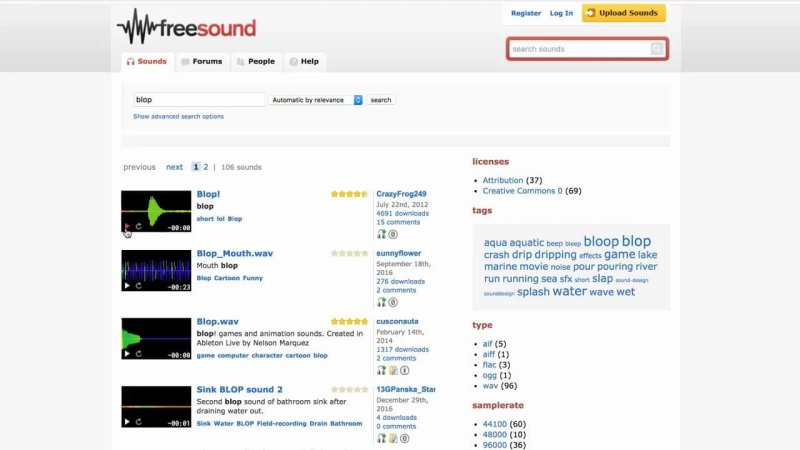
Try a sound-like word such as bloop, then listen through the results for the right fit.
Make Your Own Pop or Blob Sound
You do not have to search a library at all. For the house animation, I recorded the blob sound myself by making a little noise into a microphone.
I do this quite often. If I can make the noise I have in mind, I get the exact character I want without hunting through lots of results. Because it is my own original recording, I can also use it commercially.
The blob recording supplied with the exercise is available to use as well; I give permission to use that sound. That permission applies to my supplied recording, not to other sounds you might download elsewhere.
Time the Sound in After Effects
With the sound ready, the next job is to make it fit the movement. Here, the event I’m aiming for is the house icon appearing.
Add the audio to the composition. Use your downloaded sound or your own recording as an audio layer.
Position it near the animated event. Place the blob sound where the house icon pops into the scene.
Enable the existing audio. Turn the main audio back on so you can hear how everything works together. In this project, that includes the audio for The Value of Sleep.
Preview the animation. Listen to the effect while checking the icon’s appearance.
Move the sound and preview again. Shift it a little along the timeline if it feels early or late.
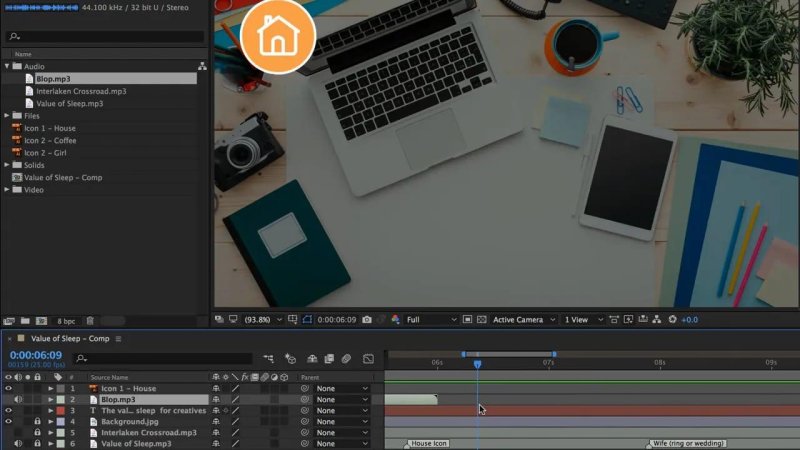
Use the house icon’s appearance as the point to test and refine the sound timing.
This is where a little bit of art comes into it. The first placement may be close, but moving the sound slightly can make the pairing feel much better.
Your timing will be different if your animation is different. There is no universal timestamp to copy. Judge the relationship between the sound and your own movement.
Also pay attention to the pace of the visual pop itself. In my example, the pop felt a little slow even once the sound was reasonably placed. Check the movement and the audio together, rather than treating the sound’s position as the only thing that matters.
Keep an Ear Out for the Finishing Details
The process is simple: find or make a sound, add it to the animation, then refine the timing. The value is in remembering to do it.
When you come across an infographic that feels particularly lively, listen for the small noises behind the movements. Notice which sounds suit which actions, then look for similar effects or record your own. A little blob in the right place can give a simple animation a lot more personality.
Key Terms
Interface noises
Short sounds such as clicks, bumps and pops that can accompany small animated actions. The phrase is a useful search term when looking for this type of effect.
Sound licence
The terms governing how you may use a downloaded sound. Check the licence for each individual recording before adding it to a project.
Audio timing
The placement of a sound in relation to an animated event. Small adjustments can help the noise and movement feel connected.
FAQs
Are all sounds on Freesound free to use commercially?
Do not assume that every recording has the same permissions. Check the individual sound’s licence to confirm that it allows your intended use.
Can I make animation sound effects with my voice?
Yes. A little noise recorded into a microphone can work well for a pop or blob effect. It is also a handy way to get the particular sound you have in mind.
What if my sound effect feels out of sync?
Move the audio slightly along the timeline and preview it again with the existing audio enabled. Check the pace of the animation too, since the movement itself may need attention.
Written by Daniel Walter Scott — Founder of Bring Your Own Laptop & Chief Instructor
