This course has been archived. See the updated course here.
Lower thirds type animation
Questions


Student Gallery
Be the first to share something.
Course info
Overview

- This course is for absolute beginners
- You'll need a copy of Adobe After Effects CC 2015 or above. A free 30 day trial can be download from Adobe here.
- Create beautiful motion graphics
- Animate compelling infographics
- Choose the correct video settings.
- You’ll learn how to exporting your video easily.
- You’ll be able to create slick type animations.
- Rendering your video for Youtube & Vimeo.
- Create titles for interviews.
- Add music to your motion graphics.
- Trim & editing video.
- Add watermarking your video.
- Fixing shaky footage.
- Color correct & fix any bad footage.
- Add a vignette to your video.
- Learn how to use your skills from Illustrator & Photoshop
- How to use green screen footage
- How to mask like a pro.
- How to animate infographics like bar graphs, line graphs & pie charts.
- How to use camera to make 3D type.
- Animating static images using parallax
- Plus basic character animation.
- + More…
- This course is for people who want to start earning money as a motion graphics designer.
- This course is for beginners wanting to learn to use After Effects for motion graphics and infographics.
- No previous After Effects or animation skills are necessary.
- This course is NOT for people who have a good understanding of After Effects already. This is for new people only.
Course duration 5 hours+ your study.

Daniel Walter Scott
Founder of Bring Your Own Laptop & Chief Instructor
I discovered the world of design as an art student when I stumbled upon a lab full of green & blue iMac G3’s. My initial curiosity around using the computer to create ‘art’ developed into a full-blown passion, eventually leading me to become a digital designer and founder of Bring Your Own Laptop.
Sharing and teaching are a huge part of who I am. As a certified Adobe instructor, I've had the honor of winning multiple Adobe teaching awards at their annual MAX conference. I see Bring Your Own Laptop as the supportive community I wished for when I was first starting out and intimidated by design. Through teaching, I hope to bring others along for the ride and empower my students to bring their stories, labors of love, and art into the world.
True to my Kiwi roots, I've lived in many places, and currently, I reside in Ireland with my wife and kids.
Downloads & Exercise files
Transcript
Hi there, in this video were going to create a lower thirds title overlay. So people call it lower thirds, titles, any sort of bit of text that appears at the bottom of the screen explaining, generally you have a talking head and you want to explain who they are, set the scene, what they are, what their credentials are, who were talking to or listening to at least.
To do it, we've got this old project open, I need a new one so I just want to let you know, you save it, you go to file and you go to close project, remember we get given an untitled project to get started for our next project.
So first thing we need to do is create a composition, so instead of going to a new composition, were going to let the video create it, so were going to import video and I'm going to give you your first bit of sneaky short cut awesomeness. Can you see in the project window this big empty area here, if you double click it, it goes to import, awesome aye. So instead of going to file, import, file, you just double click in there. There's one in here called talking head.mp4, bring that in. so we've got this mp4, you can double click it to preview it, this is not a composition its just giving you your little preview, its me talking to myself. So what we can do to make a comp from it is right click it, new comp from selection and we've got this thing called talking head, you could rename it now by right clicking it, talking head work for me. I'm going to save this project and I'm going to stick it on our desktop, where do you stick it, I'm sticking it in this one here, you can out yours on your desktop, I'm putting mine in these production files here mainly, I talked about them earlier, just so that if you get lost you can use my files.
So, next thing you need to do is there's my playing, running through. I'm going to turn the audio down, A because I hate listening to myself talk and you need to be able to hear me talk, weird. But can you see over here this little mute button, with it on I can hear stuff, with it off its just me talking. You have to make sure you turn it back on when you export because otherwise it wont export audio so, I'm going to bring my play head back to the beginning and what id like to do is a white box to slide out over here, or maybe just appear and then type to slide into it and then it all to disappear a little bit later so were going to do a couple of bits of animation and its really just the same sorts of things that we did for our first text animation, slightly different but key framing, adding some motion blur and some easing.
So first thing we need to do is we need to grab this thing here called the rectangle tool, now the rectangle tool is a crazy one, if you're self taught and you start doing this, watch, weirdly it becomes a mask, you just want a rectangle, I just want a white box, so I'm going to undo, undo is under edit and there's one called undo. so I've gone back to it, its fine. What you need to do is grab your black arrow and just click off in here, so you’ve got no layers selected. So if I've got no layers selected here and I use the exact same tool, it will go through and draw a rectangle. So the red one is not what I want. So just make sure you’ve got nothing selected down here, lets give it a fill colour, I'm going to have white and in terms of the stroke around the outside, because it’s a white stroke you're not going to see it but I'm going to get rid of it just by turning it to zero, click in here type zero. Alright and I'm going to draw a box, its going to be like that sort of size. I want it to appear over this side here and I'm going to put some type, I'm going to put Daniel Scott after effects trainer or something like that.
So first thing you need to do is I'm going to grab my black arrow and I'm going to set some key frames, so what id like you to do is actually play for a little while before this thing even starts to play up here. To get it to start later on, at the moment it starts right at the beginning here, so I'm going to get it to start here, maybe after a second or two and watch this, I can drag this guy along just so that it doesn’t exist and you can see there's a gap here now and it exists from then on it just appears at the moment. I've hit a little shortcut; I'm going to leave it in there because I accidentally hit it. I hit the n key on my keyboard. The n key is a shortcut which is really good when you know what you're doing but if you don’t and it starts doing this, you get that error, if you get that it means that you’ve hit the n key accidentally. All it means is that that might be your problem, this is called the work area, well talk about him later on but if you accidentally get this really small, it comes up with errors and you just need to extend that out to be the whole animation and you should be away again.
Not my smoothest tutorial by far but we've worked out a few little problems here. So we've got them along, what id like to do is Id like to play around with the opacity, so I want this to fade it. To do it I want my play head to be right at the beginning here. It’s not very clever, it doesn’t snap to beginning so its not hard to get it to eh beginning here but a nice little thing that you can do is while you're dragging your play head or your CTI, is you can drag it along and if you hold shift on your keyboard, if you hold shift drag, drag, watch when it gets close it just launched out there and snapped to the edge, so its really a cool little shortcut. Two shortcuts in one video, awesome.
So I'm at the beginning, what id like to do is play with the opacity so along here there's a bunch of things hanging out at the bottom of the shape ladder. Lets call this one, lets double click the word, lets right click it and go to rename and lets call this one instead of shape layer lets call this one lower third background. Great, and under transform I want to go down to opacity and were going to set the little stopwatch going again so its like waiting, waiting, click and now its recording what I do. And I'm going to turn the opacity down to zero so it’s completely gone. And after a little while, how long, I'm not too sure yet maybe half a second, something like that, you can drag these icons around afterwards, is turn the opacity up to one hundred percent. Now if you're following along, you can always keep an eye on this, if I say half a second, you can see I've actually put it on, its at one second, and 16 frames. So you can type that in here by going like this, and a cool little trick is you can just go 116 and it will put in the colons and everything for you.
Alright, so starts at zero, goes up to one hundred percent, pull my play head back, space bar and I'm happy with that timing, it’s fine. If you're not happy with it, you can drag it further apart, make it go slower, watch this, space bar, slowly comes on and if you want it to be a bit faster you can bring them together and they an go a bit faster, that works for me. I wanted that.
Now I want type to slide in so id like to, you can see if I twirl this up and I twirl that up, I've got two layers, there's my video behind, there's my lower third background, now I'm going to grab my type tool, and I'm going to click once here and I'm going to type in Daniel Walter Scott, select it all, pick a font, if you cant see your fonts, you’re looking at this character one here, I shrunk mine down when I was dealing with this preview. If you cant find yours anywhere go to window, character. And font size I'm going to drag this down so it fits, I'm going to make it a colour I can see, I'm going to click black from there, grab my black arrow to move it around so its going to end up here. I'm not going to worry about it too much because I'm going to end up changing this. And what I might do is double click it, jump to the type tool, put a return in and I am the founder of, I have to use BYOL because its just too damn long, bring your own laptop so I'm just going to shrink that down, might use that as the bold, might use that as the light version. You can spend ages on fonts, I’d like to but I need to get on with this tutorial. I'm going to go to fit as well, the reason its all pixelated as well, why is it all pixelated, did you guess? Its because of this, it will export fine, but previewing in here, its set to quarter, so I'm going to set it to full because I really wan to see my lovely preview, another good error, see this red thing down the bottom here, it says disabled and it all goes black. It means its because I've got my caps lock on. Because a second ago I was typing in upper case, I had caps lock on my keyboard on I'm going to turn caps lock off and magically it comes back. So if you ever have the problem of that, where it goes blank and a little red bar at the bottom, its because you’ve left caps lock on your key board. I've had people re install after effects trying to get rid of that thing and it turns out caps lock was on for their whole afternoon.
So we've got this, we've got that what I want to do is start animating it now. So where, I'm going to hit space bar, that appears and my type here just like this other one. I want it to start a little bit later, so instead of starting right at the beginning here I'm going to get it to start about there. Hold shift to get it to play head. So if you're following me mines at 1.19 and what I'm going to do is I'm going to start it off screen so I'm going to hold shift to get it to play head, so if you're following me, mines at 1.19 and what I'm going to do is I'm going to start it off screen so I'm going to grab my black arrow, and hold shift to get it to go straight, get off. You might have to zoom out a little bit, go back to 50%. So you can see this side here. We’re going to set our first key frame and its full position so twirl it down, transform, set the stop watch going so its going to settle the key frame right there, off screen, little bit long how far is a little, I've got mine at 2 seconds 2 frames and I'm going to hold shift, I think you need to start dragging, then hold shift rather than shift to start with. So start dragging and pulling then hold shift and it will get it in a straight line.
So I'm going to drag it back preview me talking if this happens, can you see its only buffering and only getting to here because it gets to the green thing and loops around, its because I accidentally hit space bar twice, so I might have to bring it back here, hit space bar, if you hit space bar twice, it tries to loop back on itself so if you ever get stuck in that eternal loop. Just drag the play head out again, hit space bar again and it should be fine. There he goes, it’s a bit fast so I'm going to open it up a little bit, back to here, so its sliding on but its missing the magic, we learnt the magic in an earlier video. There's two of them, there's easing and there's motion blur. Because I'm not doing motion blur and easing to the fade of the lower third, the white box is because I find when you do fades is that you can mess around with easing all day and the motion blur all day, It makes no difference. There'll be purists out there that will not agree but I think its just not worth it, I just cant see any difference with easing with things fading in and out.
So what I'm going to do is id like to play around with these two guys. So do the easing, it’s easiest just to grab both of them. It depends what you want to do, I'm going to get mine to ease both sides, you could just do one so it just starts fast and ends slow. I'm going to do both of them because I like the look of that, right click key frame velocity, 70, 70, drag it back, hit space bar and still a little fast, so its smoother but I'm going to open it out a little bit. It looks nice. Now the other magic, so that’s the easing, first step in awesomeness. The second step is motion blur.
Remember you turn it on globally and then you forget and you click play and nothing happens, what’d you have to do, remember you have to go through and turn it on globally and also for the layer, this particular I'm going to twirl this down and make it look nice, you could turn it on for this one as well and this one, its not going to do anything, I think you cant see it at least. So here we go, slide blurry when it moves. Alright, hit save and I will see you in the next video.
How do you animate a lower third in After Effects?
Create a rectangle shape layer and a separate text layer over your footage. Animate the rectangle’s opacity from 0% to 100%, then use Position keyframes to slide the text in from off-screen. Finish by adjusting the timing, adding easing to the text movement, and enabling motion blur for both the composition and text layer.
How to Create Lower Thirds Type Animation in After Effects
Key takeaways
Create a composition directly from your footage rather than setting it up manually.
Avoid accidentally drawing a mask when you want a rectangle shape.
Build a staggered entrance with a fading background and sliding text.
Use keyframe spacing, easing and motion blur to make the movement feel smoother.
Fix common preview problems without rebuilding your project.
A lower third is a little bit of text near the bottom of the screen that explains who someone is. It might show their name, job title, organisation or credentials. Nothing terribly complicated, but it gives useful context while the person is speaking.
For this example, I’m using a white background box with two lines of black text: Daniel Walter Scott and Founder of BYOL. The box fades in first, then the text slides in from the right. The design is simple, so we can concentrate on the useful stuff: layers, keyframes, timing and those finishing touches that make the animation feel nice.
1. Import your footage and create a composition
If you already have a project open, save it first, then choose File > Close Project. After Effects gives you an untitled project ready for the next job.
Now for a sneaky little shortcut: double-click an empty area of the Project panel. That opens the import dialogue without having to go through File > Import > File. Nice.
Import your footage. My example file is called TalkingHead.mp4.
If you want to check the clip, double-click it in the Project panel and press the Spacebar to preview it.
Right-click the imported footage and choose New Comp from Selection.
Rename the composition if needed, then save your project somewhere you can find it again.
Double-clicking the footage only opens a footage preview. It does not create a composition. New Comp from Selection is the step that gives us a composition based on the clip, with the footage already on its timeline.
If hearing the clip’s dialogue repeatedly is getting a bit much, you can switch off the footage layer’s audio using its speaker switch. Just remember to switch it back on before exporting if you want that audio included.
2. Draw the lower third background without creating a mask
The Rectangle Tool has a little trap in it. If your footage layer is selected and you draw a rectangle, After Effects creates a mask on that footage. Suddenly, most of your picture disappears. Not quite the white box we were after.
If that happens, undo it using Edit > Undo, then follow this sequence:
Choose the Selection Tool, the black arrow.
Click an empty area of the timeline so that no layers are selected.
Choose the Rectangle Tool.
Set the Fill colour to white.
Set the Stroke width to 0.
Draw a box near the bottom-right of the composition, leaving room for your name and role.
With nothing selected, the Rectangle Tool creates a separate shape layer. That is exactly what we need: a background we can animate independently of the footage.
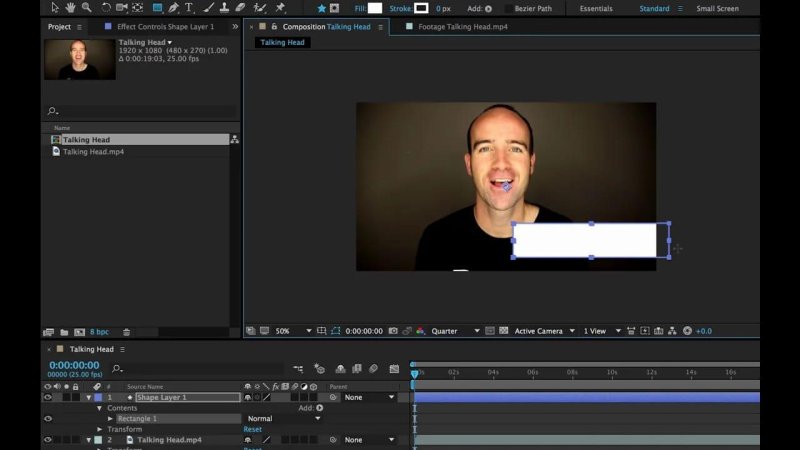
The white box sits on its own shape layer, ready to become our lower third background.
Right-click the new layer, choose Rename, and call it Lower Third Background. A descriptive name is much more useful than leaving everything as Shape Layer.
3. Delay the background and animate its fade
I don’t want the title to appear immediately. Give the footage a moment to get going, then bring in the background.
Drag the background layer’s bar to the right in the timeline so that it begins roughly a second into the composition. The gap before the layer starts means the box does not exist on-screen during that opening section.
Snap the playhead to the layer’s start
To place the playhead precisely at the beginning of the background layer, drag it while holding Shift. As you get close to the layer edge, it snaps into place. Much nicer than trying to land on the exact frame by eye.
The playhead is also called the Current Time Indicator, or CTI. Different name, same little timeline marker.
Add the opacity keyframes
Expand the background layer’s Transform properties.
At the layer’s starting point, click the stopwatch beside Opacity.
Set Opacity to 0%. This creates the first keyframe and makes the box invisible.
Move the playhead a short distance forwards.
Set Opacity to 100%. After Effects adds the second keyframe.
Move the playhead back and press the Spacebar to preview the fade.
Around half a second is a useful starting point for the fade, but don’t get too attached to the number. In my example, the second opacity keyframe initially lands at 1 second and 16 frames on the composition timeline. That is its absolute position, not the duration of the fade.
You can also enter a time directly in the current-time display. In this example, typing 116 lets After Effects supply the timecode separators for 1 second and 16 frames.
Keyframe spacing controls the speed. Move the opacity keyframes further apart for a slower fade, or closer together for a faster one. Preview it, adjust it, and stop when it feels right.
4. Add and format the name and role
Collapse the background layer’s properties to tidy up the timeline. You now have the footage underneath and the white background above it.
Select the Type Tool and click once over the white box.
Type the name. I’m using Daniel Walter Scott.
Select the text and choose a font in the Character panel.
Set the text colour to black and reduce the font size until it fits.
Use the Selection Tool to position the text inside the box.
Double-click the text to edit it, insert a line break, and add the role underneath.
If the Character panel has gone missing, choose Window > Character.
For the second line, I use Founder of BYOL. BYOL stands for Bring Your Own Laptop, but the full organisation name is a bit too long for this little box.
You can select each line separately to adjust its size and font weight. Try a smaller role line and contrasting weights to distinguish the two pieces of information. You could happily spend ages choosing fonts. I certainly could. For now, make it fit and keep it readable.
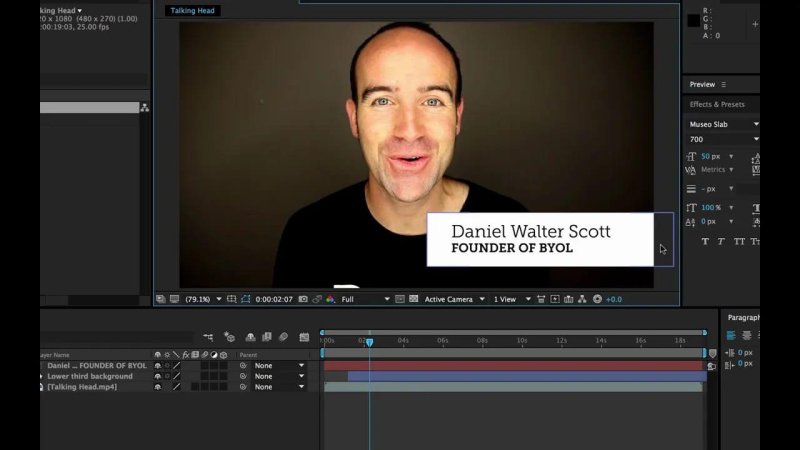
Two lines give us the name and role without making the lower third overly complicated.
5. Animate the text sliding in from off-screen
The background fades in first. The text should arrive just afterwards, rather than being visible from the very beginning.
Move the text layer’s bar to the right so its start follows the background’s entrance. Hold Shift while dragging to snap the layer edge to the playhead. My initial text start is at 1 second and 19 frames.
Next, create the slide:
Place the playhead at the text layer’s start.
Using the Selection Tool, drag the text completely off the right-hand side of the composition.
Begin dragging, then hold Shift to keep the movement horizontal.
If you cannot see enough space outside the composition, reduce the composition magnification to 50%.
Expand the text layer’s Transform properties and click the stopwatch beside Position.
Move the playhead forwards. My initial endpoint is at 2 seconds and 2 frames.
Drag the text back into its final position inside the white box, again holding Shift after you begin dragging.
You now have two Position keyframes: one with the text off-screen and one with it settled in the box.
Preview the entrance. If it feels too fast, move the second keyframe further along the timeline. I lengthen the movement after the first attempt because the initial slide is a little too quick.
Those time values are starting points, not a formula. The important relationship is background first, text second, with enough time for the text to travel comfortably into place.
6. Add easing and motion blur
A straight slide works, but it is missing a bit of magic. There are two finishing touches I like here: easing and motion blur.
Ease the Position keyframes
Easing changes how the movement accelerates and slows down. Instead of travelling at one constant speed and stopping abruptly, the text can start gently, move through the slide, and settle into place.
Select both text Position keyframes.
Right-click and choose Keyframe Velocity.
Set the incoming and outgoing Influence values to 70%.
Confirm the settings and preview again.
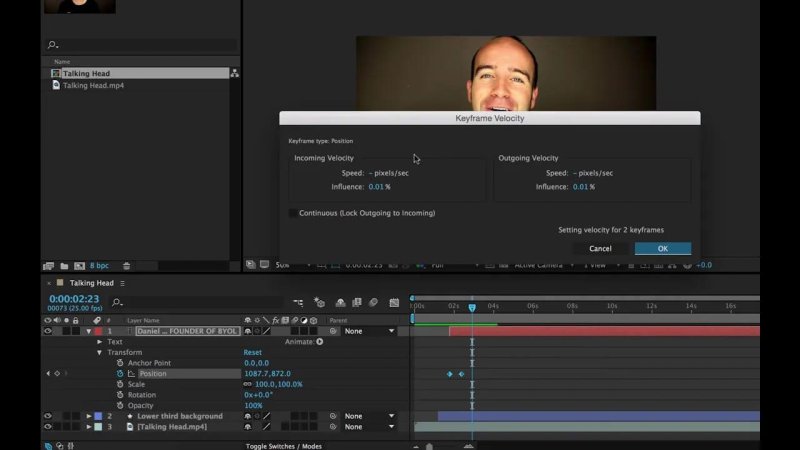
Keyframe Velocity lets us adjust the easing on the text’s entrance.
I ease both ends because I like the result. You could ease only the arrival if you wanted the text to begin quickly and slow down as it reaches the box.
Remember that easing does not replace timing. If the eased slide still feels rushed, spread the keyframes further apart. I make another small timing adjustment here before moving on.
Enable motion blur in both places
Motion blur gives the text a slight blur while it moves, then leaves it sharp once it stops. There are two switches involved:
Enable motion blur for the composition using the global timeline switch.
Enable motion blur on the text layer itself.
Turning on only the global switch is the classic little mistake. You press play, nothing changes, and wonder what you missed. Both switches need to be enabled for this text layer.
I leave the white box’s opacity fade simple. For this sort of fade, I don’t find extra easing worth fussing over, and motion blur does not add anything useful to a stationary box changing opacity. The moving text is where those finishing touches make the difference.
Common After Effects problems and quick fixes
A few small interface mistakes can make this exercise look much more broken than it really is. Before doing anything drastic, check these.
The preview area is unexpectedly tiny
The N key sets the end of the work area at the playhead. If you press it accidentally near the beginning, you can end up with a very short preview range and preview errors.
Extend the work area’s end back out across the animation, then try previewing again.
The text looks pixelated
Check the composition panel’s preview resolution. If it is set to Quarter, the image and text can look rough even though the finished export will be fine.
Switch the preview resolution to Full when you want to inspect the text clearly. Preview resolution and composition magnification are different controls: one changes preview detail, while the other changes how large the composition appears in the panel.
The composition goes black with a red warning bar
Check Caps Lock. After Effects disables preview refresh while Caps Lock is on, which can leave you with a black or unresponsive composition panel and a red warning bar.
Turn Caps Lock off. That may be all it takes. Definitely worth checking before reinstalling After Effects.
The preview keeps looping over a short section
If pressing the Spacebar twice leaves playback stuck repeating a short buffered section, reposition the playhead and start the preview again with a single press.
Check the entrance and save
Run the animation from before the background starts. The sequence should be clear: the footage plays on its own, the white box fades in, and the text slides in smoothly with a little motion blur before settling sharply in place.
This exercise builds the entrance animation. An exit was part of the initial idea, but it is not set up here, so don’t mistake the completed entrance for a fully animated in-and-out title.
Once the timing feels good, save the project. If you muted the footage layer while working, restore its audio before exporting. Simple design, a few keyframes, and a much nicer result once the movement has those finishing touches.
Key terms
Lower third
A text or graphic overlay near the bottom of the picture. It commonly identifies a person by name, role or credentials.
Composition
The After Effects workspace where layers are arranged and animated over time. Creating one from footage gives you a composition based on that clip.
Shape layer and mask
A shape layer is a separate graphic, such as our white rectangle. A mask limits which parts of an existing layer are visible, which is why selecting the footage before drawing produces a different result.
Keyframe
A recorded property value at a specific time. After Effects calculates the changes between keyframes to produce a fade or movement.
Easing
An adjustment to the rate of change between keyframes. For the sliding text, it softens the start and finish of the movement.
Motion blur
Blur applied while a layer moves. In this workflow, it must be enabled for both the composition and the text layer.
Work area
The timeline range used for previewing a section of the composition. Accidentally shortening it can restrict playback to a tiny part of the animation.
FAQs
Why does the Rectangle Tool create a mask instead of a shape?
Your footage layer is selected. Undo the mask, deselect all layers, then draw the rectangle again to create a separate shape layer.
How do I make the lower third animation slower?
Move the relevant keyframes further apart. Adjust the background’s Opacity keyframes to slow the fade, or the text’s Position keyframes to slow the slide.
Why is motion blur not appearing on my text?
Check both motion blur switches. You need the composition-level switch enabled as well as the motion blur switch on the text layer.
Why is my After Effects preview black?
If there is a red warning bar indicating that refresh is disabled, Caps Lock may be on. Turn it off to restore preview refresh.
Does this lower third include an exit animation?
No. This setup creates a fading background entrance and a sliding text entrance, followed by easing and motion blur. It does not add exit keyframes.
Written by Daniel Walter Scott — Founder of Bring Your Own Laptop & Chief Instructor
