This course has been archived. See the updated course here.
Whats the right composition settings
Questions


Student Gallery
Be the first to share something.
Course info
Overview

- This course is for absolute beginners
- You'll need a copy of Adobe After Effects CC 2015 or above. A free 30 day trial can be download from Adobe here.
- Create beautiful motion graphics
- Animate compelling infographics
- Choose the correct video settings.
- You’ll learn how to exporting your video easily.
- You’ll be able to create slick type animations.
- Rendering your video for Youtube & Vimeo.
- Create titles for interviews.
- Add music to your motion graphics.
- Trim & editing video.
- Add watermarking your video.
- Fixing shaky footage.
- Color correct & fix any bad footage.
- Add a vignette to your video.
- Learn how to use your skills from Illustrator & Photoshop
- How to use green screen footage
- How to mask like a pro.
- How to animate infographics like bar graphs, line graphs & pie charts.
- How to use camera to make 3D type.
- Animating static images using parallax
- Plus basic character animation.
- + More…
- This course is for people who want to start earning money as a motion graphics designer.
- This course is for beginners wanting to learn to use After Effects for motion graphics and infographics.
- No previous After Effects or animation skills are necessary.
- This course is NOT for people who have a good understanding of After Effects already. This is for new people only.
Course duration 5 hours+ your study.

Daniel Walter Scott
Founder of Bring Your Own Laptop & Chief Instructor
I discovered the world of design as an art student when I stumbled upon a lab full of green & blue iMac G3’s. My initial curiosity around using the computer to create ‘art’ developed into a full-blown passion, eventually leading me to become a digital designer and founder of Bring Your Own Laptop.
Sharing and teaching are a huge part of who I am. As a certified Adobe instructor, I've had the honor of winning multiple Adobe teaching awards at their annual MAX conference. I see Bring Your Own Laptop as the supportive community I wished for when I was first starting out and intimidated by design. Through teaching, I hope to bring others along for the ride and empower my students to bring their stories, labors of love, and art into the world.
True to my Kiwi roots, I've lived in many places, and currently, I reside in Ireland with my wife and kids.
Downloads & Exercise files
Transcript
Alright, you're back. So this video we’re going to look at what the right settings are for a new composition. When you're new you're like, I'm going to make a new document, what size shall it be.
So what were going to do is were going to go to composition, were going to go new, and the cool thing about it, its pretty easy, you drop down here and you're looking for this one here, HDTV 1080 25, its just the most common. Its HD size, 1080 refers to the height of the video and this is the most common at the moment, this 25 frames per second, we’ll look at a bit more nerdy stuff later on, this is old school TV, and that’s old school UK TV, old school American TV, but in terms of, if you're making something say that’s going to go out to broadcast, or its most probably going to be doing stuff for web at the moment, YouTube and videos for websites, you're going to be using this one. So if you're unsure, click him, change nothing else and click okay. The one thing we’ll have to change in here is just looking at the duration, yours is probably set to 10 or 30, it will remember the last thing you do. What were going to do is just set ours to 10 seconds, the little timing thing here is, that is your seconds, you get up to hours, hopefully you don’t need, sorry minutes and then hours. Just so you know, if you're using after effects and you start getting into hours, after effects is going to die. If you want to do full on editing a big long video, try premier but after effects is to make smaller motion graphics or titles for videos for premier. So 10 seconds is quite common.
And this last little bit is how many frames. Every second is broken into 25 frames. You don’t need to worry too much about that, just mainly the seconds. Lets click okay. Were given something called comp 1 or composition 1, we can renaming it because were going to be very good at renaming things, right clicking it and going to rename. And were going to call this one my first comp. Alright, so when you're making a first ever document and you're unsure what size, your first comp should be, just make sure you pick HDTV 1080 and 25. I said ten eighty in there instead of one thousand and eighty, if you're new to after effects, you're not allowed to call it one thousand and eighty, people in the industry call is ten eighty. There's no reason or use for it but if you walk into a video conference and you start calling it one thousand and eighty they know you're going to be new. So make sure you keep up with the lingo and just call it ten eighty.
Alright, now were going to go off and start building our animation. Well do that in another video. Alright, see you in the next one.
What composition settings should I use for my first After Effects animation?
For a simple first animation, choose the HDTV 1080 25 preset and set the duration to 10 seconds. That gives you an HD composition running at 25 frames per second, without needing to adjust every setting. Leave the remaining preset settings alone, create your composition, and give it a useful name.
What Are the Right Composition Settings in After Effects?
Key Takeaways
Use the HDTV 1080 25 preset as a straightforward starting point.
Understand what 1080 and 25 mean before changing settings.
Set your duration deliberately rather than relying on the remembered value.
Keep After Effects focused on short animations and titles, with Premiere handling longer edits.
Rename your composition from the start.
Create a New Composition
Opening a new project can bring you straight to the first little hurdle: what size should the document be? In After Effects, you start by creating a composition, often shortened to “comp”.
The good news is that you do not need to understand every option in the settings window to get started.
Open the Composition menu.
Choose New Composition.
Open the Preset dropdown.
Select HDTV 1080 25.
For this first exercise, leave the other preset settings as they are. There is just one more thing to check before clicking OK: the duration.
What Does HDTV 1080 25 Mean?
That preset name looks a bit technical, but the two numbers tell you the important bits:
1080 refers to the height of the video in pixels.
25 means 25 frames per second.
This gives you an HD starting point for a simple animation, such as something intended for YouTube or a website. You will also find older television presets in the list, including formats associated with UK and American television. You do not need to work through all of those for your first comp.
The aim here is to choose a sensible starting preset, not to get tangled up in every possible delivery format. For this exercise, HDTV 1080 25 is the one to pick.
Set the Duration to 10 Seconds
Check the Duration field before creating the composition. It might already show 10 seconds, 30 seconds, or a value remembered from the last time you used After Effects.
Set it to 10 seconds. That is a manageable length for a first motion graphics exercise.
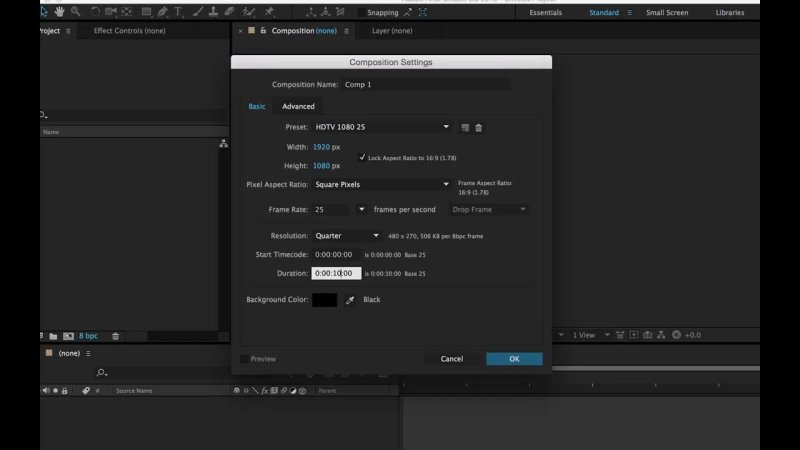
Check the duration before creating the comp rather than relying on the previous value.
Read the Timing Fields
The duration display separates time into hours, minutes, seconds and frames. The final part is not another seconds field: it counts individual frames.
With this preset, each second contains 25 frames. For a whole 10-second composition, set the seconds portion to 10 and leave the hours, minutes and frames at zero. Then click OK.
Keep Long Video Edits in Premiere
Although the duration field allows hours, that does not make an hours-long composition a good starting point. After Effects is better suited to shorter motion graphics pieces and titles than to assembling a big, long video.
If your job is a full-length edit, use Premiere for that work. After Effects can handle the smaller animated elements and titles that become part of the larger edit. Ten seconds is plenty to start learning without making the project unnecessarily heavy.
Rename Your Composition
Your new composition will usually have a default name such as Comp 1. We are going to be good at naming things right from the beginning.
Right-click the composition in the Project panel.
Choose Rename.
Enter My First Comp.
And a small bit of industry lingo: 1080 is commonly pronounced “ten eighty”. Nothing mysterious there, just a useful way to recognise the term when people say it aloud.
With your preset selected, duration checked and composition named, you are ready to start building the animation.
Key Terms
Composition
The working setup for your animation in After Effects, commonly called a comp. Its settings include the video size, frame rate and duration.
Preset
A saved combination of settings that lets you start without entering every value manually.
Frame rate
The number of individual frames in each second. The preset used here runs at 25 frames per second, or 25 fps.
Duration
The length of the composition, expressed here in hours, minutes, seconds and frames.
FAQs
Does 1080 mean the width or height of the video?
It refers to the height of the video in pixels. In the HDTV 1080 25 preset, the separate number 25 identifies the frame rate.
Why does my new composition have a different duration?
After Effects may remember a previously used duration. Always check the field and set it to the length you need, which is 10 seconds for this exercise.
Should I use After Effects to edit a long video?
Use Premiere for the longer edit and After Effects for shorter motion graphics or animated titles. Being able to enter hours in the duration field does not make it the best tool for that editing job.
Written by Daniel Walter Scott — Founder of Bring Your Own Laptop & Chief Instructor
