Automatically add a watermark text or logo in Photoshop
Questions










Student Gallery
Course info
Overview
- 13+ Hours of content!
- 10+ Interactive exercises
- 68 downloadable resources
- You'll learn the best selection and masking techniques
- You'll know how to fix images that look 'hard to fix'
- You'll master advanced levels and curves tricks, specifically with skin, adjusting and enhancing colors
- You'll learn how to enlarge images without distortion and what to do when things go wrong
- You'll know how to convincingly remove all kinds of objects from images
- My favourite: You'll master the ability to distort, bend and reshape images
- Lets look at how current trending styles are super easy to duplicate
- You will become a type nerd. We'll use font pairing in Typekit. We'll also use Photoshop's ability to guess fonts
- Your Artboards skill will be mastered
- A master of retouching, you will become!
- You'll learn to edit videos in Photoshop, who'd have thought?
- We'll also create awesome cinemagraphs, AKA: Moving pictures!
- You'll learn to master 3D in Photoshop!
- You'll learn lots about professional, reusable mockups, techniques and shortcuts!
Course duration 13 hours 45 mins + your study.

Daniel Walter Scott
Founder of Bring Your Own Laptop & Chief Instructor
I discovered the world of design as an art student when I stumbled upon a lab full of green & blue iMac G3’s. My initial curiosity around using the computer to create ‘art’ developed into a full-blown passion, eventually leading me to become a digital designer and founder of Bring Your Own Laptop.
Sharing and teaching are a huge part of who I am. As a certified Adobe instructor, I've had the honor of winning multiple Adobe teaching awards at their annual MAX conference. I see Bring Your Own Laptop as the supportive community I wished for when I was first starting out and intimidated by design. Through teaching, I hope to bring others along for the ride and empower my students to bring their stories, labors of love, and art into the world.
True to my Kiwi roots, I've lived in many places, and currently, I reside in Ireland with my wife and kids.
Certificates
We’re awarding certificates for this course!
Check out the How to earn your certificate video for instructions on how to earn yours and click the available certificate levels below for more information.
Downloads & Exercise files
Transcript
Hello it is time for actions. In particular we're going to create watermarks. So we're going to record our custom owned action. Click on it, and just hit 'Play'. Then it's going to add our watermark of our author right in the middle there. We can do it over and over again on every image. We can also do it with logos. So I've got one here that we make in this particular video on logos. Goes in the bottom right. Bottom right, super quick, super easy, saving you loads of time. We love actions. Let's go.
Let's get started by opening up our 'Exercise Files'. You'll find them in the 'Exercise Files', under '03 Preferences and Workflow'. Let's open up 'Image 1', '2', '3', and '4'. We'll start with 'Image 1'. Let's quickly look at what actions are, if you haven't used them before. Let's got to 'Window', and go to 'Actions'. Basically all they are is steps in Photoshop that somebody else has recorded. You'll see here, like there's one here for a vignette. If I twirl it down it just means, just going through steps in Photoshop, is take a snapshot, add a feather, make a copy of the layer, fill it, all these steps are just recorded in here. So you can use some of the default ones. These haven't been updated since like-- it feels like the 90s, if we click on 'Wood Frame' and hit '+', it says it has to be that big, it's okay, and you get a very 1990s wood frame around the outside. You might love it, and there you go, just click on that button. You can see over here, we've got kind of images, the frame could be turned off.
Basically somebody before us has created this wood frame. Recorded it, saved it as the default ones in Photoshop. I'm going to go to 'File', 'Revert', that's going to go-- there's just too many undos, that's probably happened. So if I revert, it goes back right back to the beginning. So you can play around with these ones, there's a few more in here. There are some, say 'Text Effects'. Scroll up here, this panel is a little bit hard to use, I won't lie to you. And the easiest way is to say, twirl up the default ones. Grab some text. Dan. Move Tool, you can see it's got type there, means that this one needs to have a Type Layer selected. And if I hit 'Water Reflection', and hit 'Play', it's going to give me a kind of a Ripley watery effect, and you can see, they're all separate layers. Some of them are kind of cool, and lots of them aren't.
So let's look at making our own one, and we'll do specifically the watermark. Let's go to 'File', and let's go to 'Revert'. I'm going to click on 'Text Effects', and just hit the trash can to get rid of them. They're not deleted forever, I can go back and get them. So basically all we're going to do is type some text in the middle, and record it at the same time. I want to record it in this Default Actions. I'm going to click on this one that says, I'm going to make a New Action, this little turned-up peach here. Let's give it a name, and we'll call this one 'Watermark'. This one's going to be a watermark for just text. You can give it shortcut keys, but if you're like me, on a Mac, none of these work, that will open iTunes or something else.
Let's just click 'Record', and now you got to be careful. It's remembering every single thing you do. The little record button's going, and we freak out, I do anyway. So just remember it's going to record every step. So our steps are going to be, I'm going to grab my 'Type Tool', I'm going to pick a color for my Type. I'm going to click once in here, no Type. Now this isn't my photograph, this is one from Unsplash, so this is Paul Hermann's photograph, so I'm going to be doing it then. I have the copyright symbol, and if you're like me, I can never remember what key it is. On a PC or Mac, just hold down your 'Alt' or 'Option' key, and just smash away the keys - it's my method anyway - until I find the copyright, got lucky.
With it being a watermark you now decide on how big it is. I'm just transforming it, say I want it to be that big. I'm going to lower the opacity, I'm on my Move Tool. I'm just going to type any of the numbers on my keyboard. You can see, I've set the opacity to 50%. Now one thing you might have to do is, it's a little bit ugly, but it will look good against black or a dark background, but it's going to be a little bit lost here in the white. So often an easy way to kind of have both ways instead of just creating two separate actions, is just to add a Drop Shadow to it. 'Drop Shadow', that's working for me. Means it can be seen up here, and down here, fine.
I'll lower the opacity again. You can start to see, it's recording everything. I'm not going in a very linear method here. I'm kind of working it out. You can go through and delete these afterwards, if you want to make it all nice and pretty. You don't have to do though, I never do. So I wanted that, I want it to be in the middle. And that's going to be it, I'm going to hit the 'Stop' button. So it's recorded now, let's look at Image 2. And what we need to do now is play back that thing we've recorded that action. Now weirdly it will-- if I hit 'Play' now it'll play from wherever this gray highlight is. So it's only going to do the Move Layer. So you need to click back on there for some reason. Then hit 'Play', and it's going to run through them. Watch it, it'll scream through all these, watch. It used to be able to like topple through them all. You can see there, added a watermark. Cool, huh?
Let's get a little bit more advanced, and let's say we want to update it, because we're going to run into trouble, like, there's fine, there's fine, that's good. Let's say-- let's do two things, I want to put in image in it rather than text. So I'm going to go to 'File', 'Revert'. Back to the beginning, and instead of doing this one here, I'm just going to twirl it up. So it's nice and tidy, I'm going to create a new one. And this one's going to be called 'Watermark', but this one's going to be my 'Logo'. Instead of just typing in, I've got like a logo that we've already made, and I click 'Record'. Basically it's the same thing, we're going to go to, 'File', 'Place Embedded' though instead of typing out text.
In your '03 Preferences', there's 'Logo - White'. I'm going to click 'Place'. I'm going to get it to the right size, that works for me. Hit 'Enter' on my keyboard, can you see, it's recording 'Place'. I'm going to lower the opacity down to maybe 40%. I add my Drop Shadow again. There we go. Let's do something even more advanced, because basically we could stop that now and go and play it. Actually let's do that, let's stop it, go over here, go back to the top, hit 'Play'. And it goes and brings through my logo. Cool, huh? We'll batch them in the next video. At the moment we're just doing the action, and we'll show you how to do them to hundreds of images in one go. That'll be the very next video.
So 'File' let's go back to 'Revert', let's go back to this one. So another bit more advanced action-ness. We've done this, but let's say we want to adjust it again. Like do something else, we want to put it down the bottom right, like this. So we've already created this. How do we go and edit it? What we can do is, we can say, here, at this stage I want to start recording again. And whatever you do from now on will just add to that list. I want to show you a little trick of how to do it in the bottom right, because it's not as simple as it sounds, there's a little work around.
So what we need to do is select both of these layers, then use, your Line Functions up here, but it doesn't work as the background. This background here, this is locked, gives us all sorts of grief, right? So all we need to do is double click the background, click 'OK'. You should give it a name. Then we can use the feature. Instead of just shift-clicking like we do up here, we can use like an automated feature, the actions is going to like a little bit better, because it likes going to here, and just going 'Select', 'All Layers'. Finds that easier, then at the top here, we can go, I would like to 'Align to Right'. Then I want to go down to the bottom. You can see in here, it's just aligning the current layers I have selected. That one does the bottom, that one does the left.
Next thing I want to do is have just the Logo Layer selected, and I'm going to move it up and to the left. You can kind of see there in my little tool tip there, saying kind of come up 32 pixels and across 44. That's kind of cool because it means it's going to work fine for portrait. It's going to go bottom right and just kind of come out the mounted space. Makes sense, kind of, let's hit 'Stop'. Now hopefully if I go to 'Image 3'. I can go back up to 'Watermark Logo', hit 'Play'. And edit it, go to bottom right. I'm sure I've said bottom left before, but just kind of comes out a few pixels. This side, try it here for one that's kind of like just a different shape, with respect to this beginning one, that's a really different shape. Let's delete the text off it, and let's go 'Play'. Cool, huh?
Now my friends, that is going to be it for creating watermarks. We did text and a logo. In the next video, actually the second one after this one, next one we'll do some more advanced actions. And the video after that, we'll do kind of batching, so we can do them for a zillion different images all in one big go. All right, I'll see you then.
How can I add the same watermark to multiple images in Photoshop?
Record the watermarking steps as a Photoshop action, then select that action and press Play on each image. You can record a text watermark or place a logo, adjust its opacity and position, and reuse those choices without building the watermark from scratch every time.
How to Create Watermarks with Photoshop Actions
Key takeaways
Photoshop actions record a sequence of steps that you can replay on another image.
A text watermark can combine an author name, reduced opacity and a drop shadow.
A logo action can align the logo to the bottom right, then move it in from the edges.
You can add steps to an existing action rather than starting again.
Get to know the Actions panel
Open a few images in Photoshop, then choose Window > Actions. An action is a recorded sequence of Photoshop steps. Select one and press Play, and Photoshop runs those steps for you.
The Actions panel includes some built-in examples. Expand an action and you can see its individual instructions, such as making a layer copy or applying an effect. Some of the default effects are rather dated, but they are a handy way to understand what an action actually records. A text effect, for instance, may need a type layer selected before it can run.
If you try one on an image and want a clean start, File > Revert takes the document back to its original state. That is often easier than working through a long string of undos.
Record a text watermark action
With your first image open, click the New Action button at the bottom of the Actions panel. Give it a recognisable name, such as Watermark Text, and click Record. From this point, Photoshop is keeping track of your steps, so it helps to know roughly what you want to make.
Select the Type tool and choose a text colour.
Click on the image and type the credit you want to use. For the example photograph, that credit is photographer Paul Hermann’s name, with a copyright symbol.
Transform the text to a suitable size and position it on the image.
Lower the type layer’s opacity. Around 50% gives the example a less intrusive appearance.
Add a Drop Shadow if the text needs to remain legible across both light and dark parts of the photograph.
When you are happy with it, click Stop in the Actions panel.
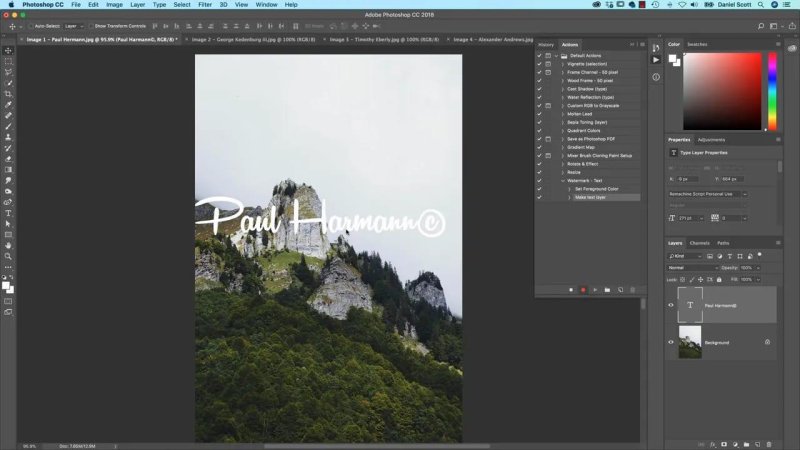
A text credit can sit across the photograph without taking over the image.
Do not worry if you changed your mind about the opacity or position while recording. Those adjustments may appear as extra steps in the action. You can tidy them up afterwards, but you do not have to if the action produces the result you want.
Play the action on another image
Switch to a second image, select the action name in the Actions panel and press Play. Be careful where the grey selection sits: if an individual step is selected, Photoshop may start there instead of running the whole action. Selecting the action itself gives it the full sequence to follow.
Make a separate action for a logo watermark
A logo follows much the same idea, but you place an existing graphic instead of typing a name. Start with a clean image, create a new action called something like Watermark Logo, and click Record.
Choose File > Place Embedded and select your logo file.
Size the logo, then press Enter to confirm its placement.
Lower the logo layer’s opacity. The example uses roughly 40%.
Add a drop shadow if it helps the white logo show against different parts of the image.
Click Stop, select the action name, and test it with Play.
That gives you a reusable logo watermark, though its position can be more useful if it responds to the edges of each image. A placement that looks right on one photograph may not suit a portrait or an image with a different shape.
Add bottom-right positioning to the logo action
You do not need to rebuild the logo action to improve it. Select the point at the end of the existing action and start recording again. The next steps will be added to its list.
For the alignment method used here, first unlock the photograph’s Background layer by double-clicking it and confirming the change. Then use Select > All Layers. With both the photograph and logo selected, use the alignment controls at the top of Photoshop to align them to the right and then to the bottom.
Now select only the logo layer and move it slightly up and left, so it is not pressed against the edges. In the example, that inset is about 32 pixels up and 44 pixels left. Click Stop when the position looks right.
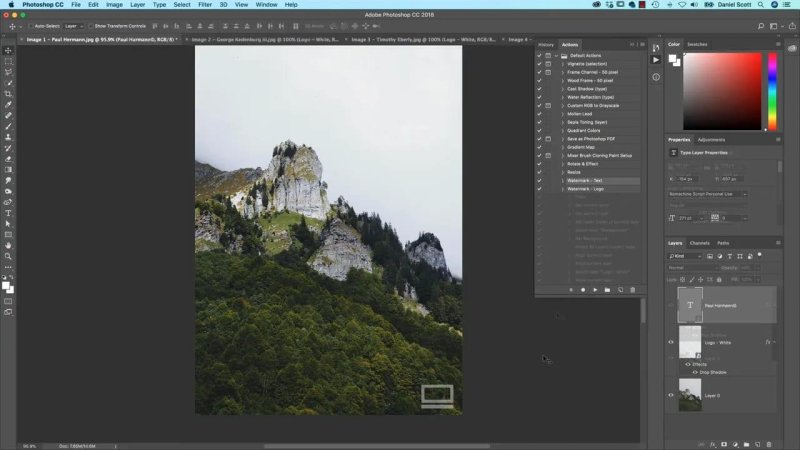
Aligning to the image edges, then adding a small inset, keeps the logo neatly in the corner.
Test the updated action on images with different proportions. The useful part is the order: align to the image first, then add the inset. That lets the logo find the bottom-right corner of each photograph before it moves away from the edges.
For now, Play applies the action to one open image at a time. Once the action works as intended, it is ready to be used in a batch workflow for a larger collection of images.
Key terms
Action
A saved sequence of Photoshop steps that you can replay. The Actions panel shows both the action name and the steps recorded inside it.
Opacity
A layer setting that controls how transparent the watermark appears. Lowering it helps the credit or logo sit more subtly over a photograph.
Place Embedded
The Photoshop command used here to bring an existing logo file into the image while recording the action.
FAQs
Why does my Photoshop action run only one step?
Check what is selected in the Actions panel. Select the action name, rather than an individual recorded step, before pressing Play.
Can I edit an action after recording it?
Yes. Select where you want to continue, start recording again, make the additional changes and press Stop. Those steps are added to the action.
Why add a drop shadow to a white watermark?
White text or a white logo can become hard to see on a light area of a photograph. A drop shadow helps it remain visible while keeping the watermark subtle.
Written by Daniel Walter Scott — Founder of Bring Your Own Laptop & Chief Instructor
