How to create the 3D glasses Anaglyph effect in Adobe Photoshop
Questions


Student Gallery
Course info
Overview
By the end of this course you'll posess super skills!
- Learn the skills to mask anything… including the dreaded hair.
- Using your amazing new masking skills, you will be able to clearcut images.
- You will learn how to make type interactive.
- Together we will look at popular current visual styles and learn the tools and tricks necessary to recreate them.
- There is a fun section where you will learn how to distort, transform and manipulate images.
- We will create our own graphics using simple techniques from scratch.
- I will teach you to retouch photographs like a professional..
- Finally - any good Photoshop user should know how to put an island inside a bottle!
There are exercise files available to download so that you can follow along with me in the videos. There are lots of assignments I will set so that you can practice the skills you have learned.
Course duration 8 hours 35 mins + your study.
Get the completed files here.
Awarded the Best Photoshop Course by Learnopoly in 2023

Daniel Walter Scott
Founder of Bring Your Own Laptop & Chief Instructor
I discovered the world of design as an art student when I stumbled upon a lab full of green & blue iMac G3’s. My initial curiosity around using the computer to create ‘art’ developed into a full-blown passion, eventually leading me to become a digital designer and founder of Bring Your Own Laptop.
Sharing and teaching are a huge part of who I am. As a certified Adobe instructor, I've had the honor of winning multiple Adobe teaching awards at their annual MAX conference. I see Bring Your Own Laptop as the supportive community I wished for when I was first starting out and intimidated by design. Through teaching, I hope to bring others along for the ride and empower my students to bring their stories, labors of love, and art into the world.
True to my Kiwi roots, I've lived in many places, and currently, I reside in Ireland with my wife and kids.
Certificates
We’re awarding certificates for this course!
Check out the How to earn your certificate video for instructions on how to earn yours and click the available certificate levels below for more information.
Downloads & Exercise files
Transcript
Hi there, it's this effect, it's actually called Anaglyph. Nobody can remember, or at least I can't. Whenever I Google it I always have to type in '3D glasses effect'. You can see, there's a mixture of this red and cyan side by side making it give it that 3D look. We'll do it with images, we'll also show you how to do it with type. I say this in lots of videos, but it is super easy, it's a cool effect. Let's jump in now and learn how to make it.
Let's open up our images, 'File', 'Open'. In '11 Visual Styles', open up 'Anaglyph 01' and '02'. This is the second one, we're going to work on this one first. For this to work we need to unlock the background and we do that, we know, by just double clicking the word 'background' and giving it a name. We're going to call it 'Red', we're going to right click 'Red', duplicate that layer, and call it 'Cyan'.
So the way for this to work, is you select on 'Red', and you come down to this 'fx' and go to 'Blending Options'. What we do is, under 'Advanced Blending', there's this one called 'Channels'. For the red one, turn off green and blue, we're just leaving the red channel on. Channels can be complicated, but for this effect we don't need to know anything about them. Similar process for cyan. Click on it, go down to 'Effects', 'Blending Options', and in here we want to turn just red 'off'. That leaves us with the cyan color, mixing green and blue. Click 'OK'. Now we just need to offset them.
Basically we need to move one one way, and one the other way. It really depends on how advanced you want this effect. I'm going to undo, put it back. You can just be super subtle. And with the Move Tool it's easier with your keyboard, just use your right arrow. So I've got cyan selected, use your right arrow. I'm just kind of tapping it to the right. Now that's kind of like a subtle effect. Can you see, it's kind of, you see it all in there, right? Or you can go a bit further, and just kind of really drag it out there. Now it is subtle, move it across a little bit. Tappy tappy tap.
Now one thing you might notice is-- see this red band that appears? It depends on which way you went with it, left or right. Or you might end up with a cyan band. You have to just trim that up using the Crop Tool. So make sure you go a little bit of extra space. I'm just going to trim that up. Using my Crop Tool, hit 'return', you're away. Let's go a little bit further, let's go to 'Anaglyph 02'. Now we could just do this image. You don't have to but I quite like it when it gets either black and white, or quite low colors. It really accentuates the cyan and the red. You could go to 'Adjustments', and do 'Black and white'. There's a little option here. We did have it a million years ago, way back at this course. I'm going to go to 'Edit, 'Step Backwards'.
What I often like doing is under 'Adjustments' using 'Vibrance'. And just lowering the vibrance rather than like making it completely black and white. I like to have there a little bit of subtle colors still in there. Now the one thing we need to do is we've got this, like very non-destructive vibrance layer that we can turn on and off, and that's very good, but doesn't work for this effect. So what I have to do is click 'Vibrance', hold 'Shift', click 'Background'. Right click the two of them, and say 'Merge Layers'. It's bad and destructive, but we just need it for this effect to work. Just double click this first layer, let's call it 'Red'. Let's right click him, duplicate him, and let's go to 'Cyan'.
The same principle's here. 'Cyan' layer selected, I'm going to go to 'fx'. I'm going to go to 'Blending Options', and I want red 'off', gives me cyan and the red layer, everything but-- so I just want everything but red, not everything but, just want red. So cyan is red off, and red is just red on. That's not helping you at all, is it? So I'm just going to move it left and right, just kind of see where we get. Now in this case you can kind of see, the cropping are going on over to here. So 'Crop Tool', tidy it in, it should snap to the edge nicely.
Let's look at doing text, it has the same principle. So let's grab my 'Type Tool', I'm going to click once. Well, it's a big font. I'm going to go down to, I don't know, maybe 500. Let's type in-- still too big. Find an appropriate Font Size, not 500, not even 200. I think mine's dealing with-- because I transformed it last time. I'm just going to scale it down using 'Command T' or 'Control T'. I'm going to pick a font color that's not red. You can see it's actually white. It's because I'm in between these two layers.
So the text has to be on top for this to work. And I know, there's my Scott Shoes. Scott Shoes. To your horror I'm going and picking fonts now instead of just getting on with it. Just getting it down again. So I've got, I don't even know where this is going to go, there it's going to go. Hit 'return'. So it's the same principle from now on. We just duplicate it and then play with those advanced Blending Modes. So right click it, I'm going to duplicate this layer. This one's going to be 'Shoes Red'. This is going to be-- I double click the word 'Shoes' and this one's going to be 'Shoes Cyan'. So this one here, I click on 'fx', 'Blending modes', cyan is red off. The red one, is just red on. Go away, go away.
Then we can just offset it again using my arrows. Again, depends on how-- I'm going to stick both of them together so I can move them around. And that is the Anaglyphic effect. If you're like me, you'll never remember the word Anaglyphic. I always have to Google, "What is the 3D glasses effect?" 1980s, generally something will pop up called Anaglyph. If you do have some of those glasses, nobody does, I couldn't find any to make it work but apparently this actually works. Get some 3D glasses, order them from eBay or Amazon. Put them on, and apparently it's all ready for 3D. I'm watching Ghostbusters in 3D, super cool, and frightening. I still get nightmares from one of those early Ghostbusters movies. The one with the painting, and it came out. I was young. I'm babbling now let's get on to the next video.
How do you make the red and cyan 3D glasses effect in Photoshop?
Duplicate your image or text layer, then use Advanced Blending to keep only the red channel on one copy and the green and blue channels on the other. Move the copies slightly apart horizontally to reveal the red and cyan edges, then crop any unwanted colour bands around the image.
How to Create an Anaglyph Effect in Photoshop for Images and Text
Key takeaways
Create the anaglyph effect with two layers and a few channel settings.
Control the intensity with small horizontal movements.
Use black and white or reduced vibrance to make the colour separation stand out.
Apply the same technique to text, with one important layer-order check.
Tidy up the coloured borders left by shifting your image layers.
That slightly misaligned red and cyan look has a name: anaglyph. I can never remember it when I need it. Searching for “3D glasses effect” usually gets me there.
It is a surprisingly easy effect to build in Photoshop. You do not need to become an expert in colour channels, and the same basic process works for both photographs and type. The trick is to separate the colour information across two identical layers, then nudge them out of alignment.
1. Prepare two copies of your image
Open your photograph using File > Open. The first example uses a portrait against a light background, which makes the coloured edges easy to spot.
In the Layers panel, double-click the word Background to unlock the layer.
Name the unlocked layer Red.
Right-click the Red layer and choose Duplicate Layer.
Name the duplicate Cyan.
You now have two identical photographs sitting directly on top of each other. Nothing looks different yet. That is exactly what we want.
2. Split the red and cyan channels
The settings we need are inside Blending Options, under Advanced Blending. There is a Channels section with checkboxes for red, green and blue.
Set the Red layer
Select the Red layer.
Click the fx button at the bottom of the Layers panel and choose Blending Options.
Under Advanced Blending, leave R enabled.
Turn off G and B, then click OK.
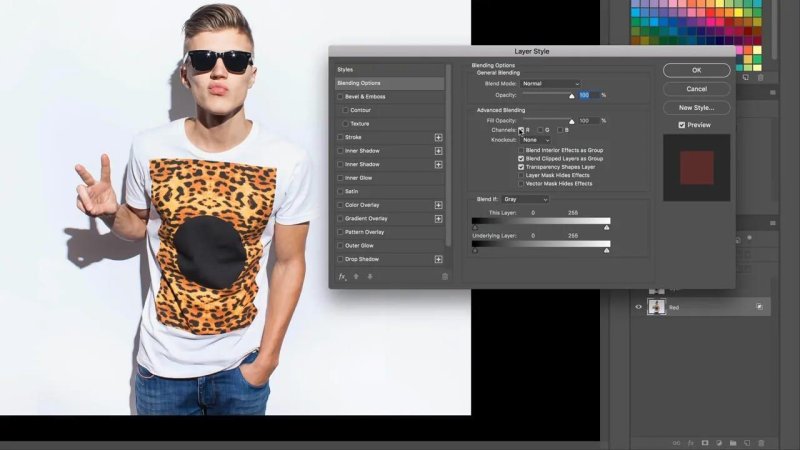
The Red layer needs only its red channel enabled.
Set the Cyan layer
Select the Cyan layer.
Open fx > Blending Options.
Turn off R.
Leave G and B enabled, then click OK.
Green and blue together give us cyan. So the little rule to remember is:
Red layer: red on, green and blue off.
Cyan layer: red off, green and blue on.
It is very easy to talk yourself into the wrong combination. Keep that checklist handy rather than trying to remember “everything except” something.
3. Offset the layers to reveal the effect
With the copies still perfectly aligned, you may see very little difference. The effect appears when you move them apart.
Select the Cyan layer and activate the Move tool. Tap the right arrow key a few times. Small keyboard nudges are much easier to control than dragging if you want a subtle result.
You can move one layer while leaving the other in place, or move the two layers in opposite directions. What matters is the distance between them.
A small offset produces a fine red and cyan fringe around details.
A larger offset creates a much more obvious doubled-image look.
I prefer a fairly subtle separation. A few taps, check the result, then perhaps a few more. You can drag the layers much further apart, but it quickly becomes a very different-looking effect.
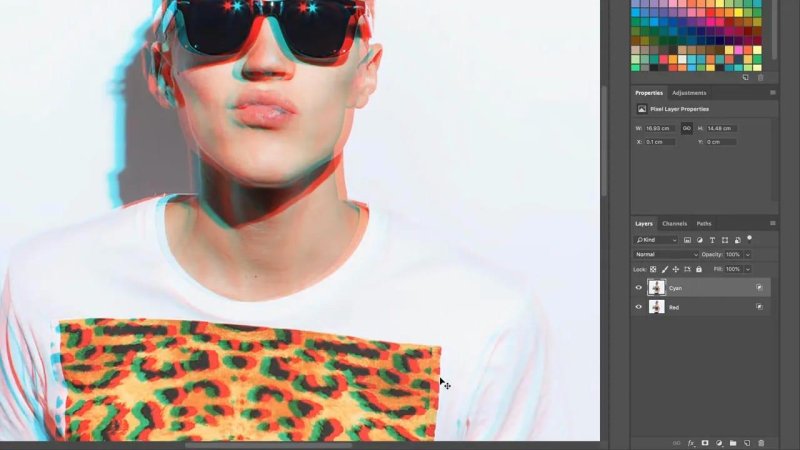
A small horizontal offset is enough to reveal coloured edges around the portrait.
Crop away the coloured border
Shifting a full-image layer can leave a red or cyan band along the edge of the canvas. Which colour appears depends on which layer you moved and in which direction.
Select the Crop tool and bring the crop boundary just inside that unwanted band. Press Return or Enter to commit the crop.
It helps to start with a little spare space around your subject. That gives you room to tidy the edges without cutting into anything important.
4. Make the colour separation stand out with reduced vibrance
You can apply this effect directly to a full-colour photograph. There is no requirement to remove the colour first. But I quite like it on a black-and-white image, or on one with only a little colour left, because the red and cyan become much more noticeable.
For the second example, a portrait with a red hat and a dark background, there are two options:
Add a Black & White adjustment to remove the original colours.
Add a Vibrance adjustment and lower the vibrance to retain some subtle colour.
My preference here is the second option. Lowering vibrance takes the edge off the original colours without making the portrait completely monochrome.
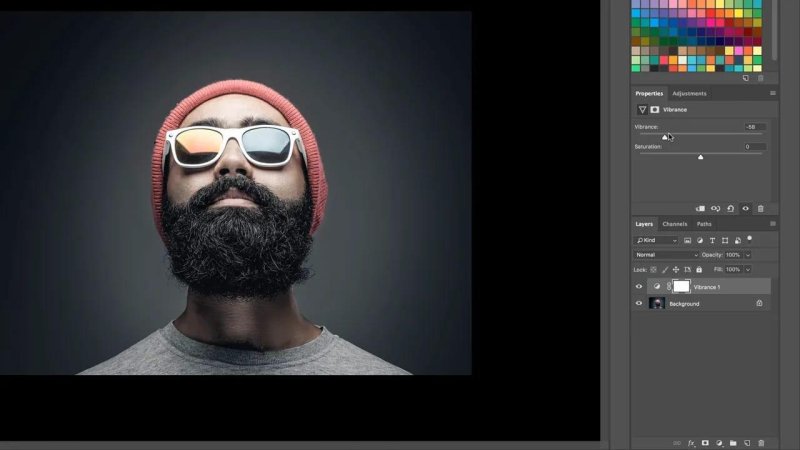
Lowering vibrance leaves a little original colour while giving the red and cyan more room to stand out.
Merge the adjustment for this workflow
A separate Vibrance adjustment layer is useful because you can switch it on and off or change it later. For the straightforward workflow here, though, merge that adjustment with the photograph before making the channel-separated copies.
Select the Vibrance adjustment layer.
Hold Shift and select the Background layer so both are selected.
Right-click the selected layers and choose Merge Layers.
This is a destructive step: the vibrance change becomes part of the merged image rather than remaining a separate, editable adjustment. That is the trade-off in this version of the process.
Now repeat the same setup: name the merged layer Red, duplicate it as Cyan, and set the channel checkboxes. Red keeps only R; Cyan keeps G and B. Offset the copies horizontally, then crop away any exposed edge bands.
5. Apply the anaglyph effect to text
Type works on exactly the same principle. In this example, the words SCOTT SHOES sit near the bottom of the portrait, with a bold treatment for the first word and a lighter treatment for the second.
Create and position your type first
Select the Type tool, click on the canvas and enter your wording.
Choose your font and a suitable size.
If the text is far too large, use Command + T on Mac or Control + T on Windows to scale it down.
Use white text for the treatment shown here.
Place the text layer above both image layers in the Layers panel.
That last point is important. If the text sits between the Red and Cyan image layers, those layers can interfere with how it appears. Check the layer order before getting lost in colour settings.
Get the wording, font size and placement sorted before duplicating it. There is no magic font size for this effect; choose what fits your document.
Duplicate the text and separate its channels
Duplicate your finished text layer.
Name one copy Shoes Red and the other Shoes Cyan.
For Shoes Red, open Blending Options and leave only R enabled.
For Shoes Cyan, turn R off and leave G and B enabled.
Select one text copy, activate the Move tool and nudge it horizontally with the arrow keys.
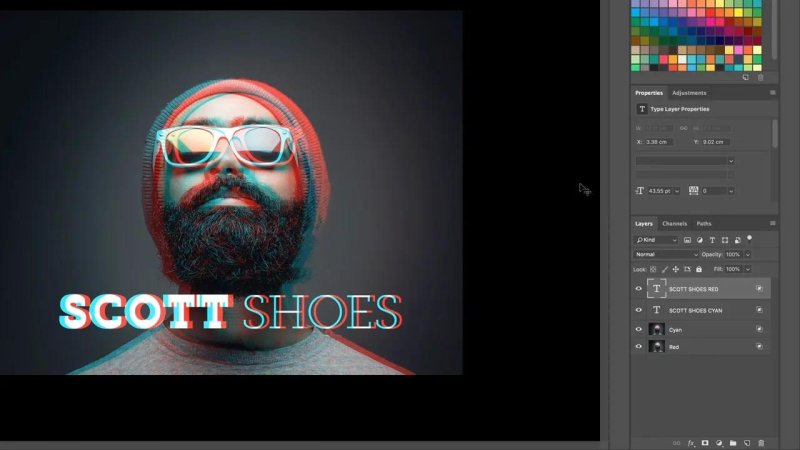
The same channel settings give the lettering a red and cyan offset to match the portrait.
Again, the distance controls the intensity. Keep the separation small if you want the words to remain easy to read.
Once you like the result, select both text layers together when repositioning the wording. That lets you move the pair without accidentally changing the offset between them.
A simple effect with plenty of control
The whole technique comes down to duplicate, separate the channels, offset and tidy. You can keep the original colour, mute it with vibrance, or remove it entirely. Then give your text the same treatment if the composition needs it.
It has that familiar retro 3D-glasses feel. I did not have a pair of red and cyan glasses handy to test the result, so the practical aim here is the visible anaglyph-style treatment.
And if the name escapes you next time, “red and cyan 3D glasses effect” is still a perfectly useful thing to search for.
Key terms
Anaglyph
The red and cyan colour-separated look associated with 3D glasses. This Photoshop technique recreates that appearance by offsetting two channel-separated copies.
Colour channels
The red, green and blue components used in this effect. Keeping red on one layer and green plus blue on another creates the two colour contributions.
Advanced Blending
A section within Photoshop’s Blending Options that includes the channel checkboxes used to build this effect.
Offset
The positional difference between the two copies. Increasing the horizontal offset makes the red and cyan separation more pronounced.
Destructive editing
An edit that becomes part of the image rather than remaining separately adjustable. Merging the Vibrance adjustment with the photograph is the destructive step in this workflow.
FAQs
Which channels should be enabled for the anaglyph effect?
On the Red layer, enable R and disable G and B. On the Cyan layer, disable R and enable G and B. Use the same settings for duplicated text layers.
Does the photograph have to be black and white?
No. Full-colour photographs work too. Black and white or reduced vibrance simply makes the red and cyan separation stand out more clearly.
Why is there a coloured strip at the edge of my image?
Moving one image layer exposes an area where the two copies no longer overlap. Use the Crop tool to trim away that red or cyan strip.
Why does my text look wrong before I apply the effect?
Check that the text is above both channel-separated image layers. Text placed between them can have its appearance affected by the image layer above it.
Written by Daniel Walter Scott — Founder of Bring Your Own Laptop & Chief Instructor
