How to put images inside a bottle using Photoshop
Questions


Student Gallery
Course info
Overview
By the end of this course you'll posess super skills!
- Learn the skills to mask anything… including the dreaded hair.
- Using your amazing new masking skills, you will be able to clearcut images.
- You will learn how to make type interactive.
- Together we will look at popular current visual styles and learn the tools and tricks necessary to recreate them.
- There is a fun section where you will learn how to distort, transform and manipulate images.
- We will create our own graphics using simple techniques from scratch.
- I will teach you to retouch photographs like a professional..
- Finally - any good Photoshop user should know how to put an island inside a bottle!
There are exercise files available to download so that you can follow along with me in the videos. There are lots of assignments I will set so that you can practice the skills you have learned.
Course duration 8 hours 35 mins + your study.
Get the completed files here.
Awarded the Best Photoshop Course by Learnopoly in 2023

Daniel Walter Scott
Founder of Bring Your Own Laptop & Chief Instructor
I discovered the world of design as an art student when I stumbled upon a lab full of green & blue iMac G3’s. My initial curiosity around using the computer to create ‘art’ developed into a full-blown passion, eventually leading me to become a digital designer and founder of Bring Your Own Laptop.
Sharing and teaching are a huge part of who I am. As a certified Adobe instructor, I've had the honor of winning multiple Adobe teaching awards at their annual MAX conference. I see Bring Your Own Laptop as the supportive community I wished for when I was first starting out and intimidated by design. Through teaching, I hope to bring others along for the ride and empower my students to bring their stories, labors of love, and art into the world.
True to my Kiwi roots, I've lived in many places, and currently, I reside in Ireland with my wife and kids.
Certificates
We’re awarding certificates for this course!
Check out the How to earn your certificate video for instructions on how to earn yours and click the available certificate levels below for more information.
Downloads & Exercise files
Transcript
First up, let's open up the files that we're going to be using. Let's go to 'File', 'Open'. In your 'Exercise Files', under '10 Blending Modes' we'll open up all these ones that say Bottle Island. So there's 1, 2, 3, 4, and 5. The 4th one's by Tim Marshall; thanks, Tim. We're going to start with this glass bottle here. We're going to put in '02', so we're going to grab this island and stick it in. We're going to use the Quick Selection Tool. In terms of the brush, something about 50. 50 is always a good number. Click, hold, and drag across our island. It's up to you whether you want the sand or not.
In terms of how hard core we're going with this, we're not going very hard core at all. All these selections around here, we could use the Select and Mask, but in this particular case, like the first one, the thing you saw at the beginning there, it's quite forgiving with Layer Masks. So we could double back and fix up the layer if you find we got a little too fast here. I'm going to grab the sand , just because. I'll get a really small paintbrush and go into these corners. I'll get the editor to speed this bit up.
So got my selection, if I wanted to do better what I could do is I could go to my Layer Mask button here. Then go to Select and Mask, and try and work it out a bit better. Looks pretty good, and because it's the blue showing through the trees it's going to look fine because we've got a blue sky to go behind it anyway. So with our Move Tool, click, hold, drag, drag, drag to 'Bottle 01', and down here. It's the wrong size, so to be fancy we're going to right click 'Layer 01' and say, you need to be a Smart Object. Then I'm going to use my Transform Tool, using 'Command T', or 'Control T' on a PC. I'm going to get it till it fits in here. Hit 'return'. So there's my Island.
Next bit is the sky. I'm just going to close down Island 02, not so good, just to make things tidy along the top here. So we're going to use Bottle Island 03. We used this image earlier on in a different project. So what we're going to do is grab the 'Move Tool'. Click, hold, drag. The first tab, holding down, and let go. I'm going to kind of drag it up and have it just behind the island there. Now what you'll notice is I'm missing a chunk here, just not quite big enough. If I could just transform, I'm pretty sure nobody would know that I stretched a little bit, but what I'm going to do is -- I'm going to show you-- we're going to double back on some of the skills we've learned so far just to compound those.
So I want a bit more sky. So remember, I can use the Crop Tool, it's quite a cool way of doing that. The Crop Tool, make sure that along here, Content Aware is turned on. I'm just going to drag a little bit that way and a little bit that way. Then hit 'return', and hope Photoshop doesn't make a mess of the sky. It's pretty good with clouds. It's pretty good, I think that's pretty awesome. Nice work, Photoshop. It's kind of weird down here. I'm happy with it. So back to my Move Tool, click, hold drag, back into here. What I might do is, that first layer here I'm going to just click on the trash can. So this guy now is in the reasonable right place. Just using my arrow keys just to tap it around.
So now what I need to do is mask it inside the bottle. Like I do in lots of things, we need to mask all sorts of stuff inside the bottle. So what we're going to do is create a Selection and reuse it a few times. It's a bit of a new skill. First up, be on the Background Layer, let's grab our Quick Selection Tool. I'm going to turn Auto Enhance off only because I need to be really rough in this case and it slows down my computer while I'm recording. Brush size, I'm going to increase up. I'm using my square brackets next to my P key. I'm grabbing everything, I don't want the lid. I'm going to get close to the lid, so I want the lid to shine through, right? I just want select the glass parts of this bottle.
Trying to get it all. It's hard to know sometimes if you got at all. A nice little trick is, you can just click on this gently. See this little icon here, it's called Quick Mask. We're not going to use Quick Mask, it's just an oldest technique for doing masking, but what's really cool is it's quite obvious where I haven't selected. Don't double click it fast, it loads up the settings. Just toggle it once, gentle. Just the nice way of going, I've missed you. Toggle it once again, on. I feel I can see two more parts. That's good enough for me. If you see some bits that are missing, you could spend a lot more time here, and you should.
So I got the bottle selected, but I want to use this a couple of times because we're going to use this to trim the sky, but we're also going to use it to trim the water. So there's a cooler option here, it says, 'Select', 'Save Selection'. I'm going to give this a name, I'm going to call this 'Bottle Selection'. Just means, later on whenever needed I can go back to 'Selection', and say actually load that selection I made earlier. So I've got it up once, I'm going to click on my Sky Layer. I'm going to actually start naming layers in here to help you guys. Just to make it easier to follow, so there's the sky, and this is the island. The background is going to be named 'Bottle'. Awesome!
So Sky Layer selected, got my selection, I'm going to click on 'Layer Mask'. You can see, it's a bit rough along the top there. I'm not worried because we're going to use our Blending Modes. Now with Blending Modes we've got two things over here, we've got the Mask and we've got the actual image itself. So a Blending Mode on this is different from a Blending Mode on my actual image, and that's what I want. I want my sky selected because that's what I want to blend underneath with my bottle. I was going to kind of work away through, and Dissolve may work. Darken's pretty cool, you can start to see that kind of nice interaction with glass. Blending Modes are perfect for glass, anything that's transparent.
You just kind of work your way through until you're, "I quite like that Linear Burn." I'm just toggling down now. If you've forgotten the shortcut, you probably have because that's a tough one. If you are sick of doing this, clickety click. So what you can do is click on one of them, make sure you're on your Move Tool, hold down your 'Shift' key, then tap the '+' key on your keyboard. You can see, it just keeps toggling through. I'm going to use Linear Burn because I like it and I practiced already. I've got it written right here, use Linear Burn. It will depend on your sky and the bottle.
Next bit is the water. I'm going to close down my clouds, bye bye, don't save. In here there's my water, I'm going to grab Rectangle Marquee Tool, I'm just going to grab, I don't want the whole thing, I just want a chunk of it. I don't want all this stuff at the top. I grab my 'Move Tool', drag it across. In there, and it's not quite big enough. Now this is where I'm going to cheat. I should go and use the Content Aware cropping like we did with the sky. It's going to be so forgiving, nobody's going to notice it went that big. I share that secret with you, you should properly go back and do it but just a little bit of a transform that size, nobody's going to notice.
Here's my Move Tool to kind of drag-- I like the bubbles, someone kind of peeps at the bubbles in there. Now I want to use the same Mask Edit for the sky. This is where this awesome thing comes in. 'Select', 'Load Selection'. Which one? I want from where it says 'Channel', say 'Bottle Selection', that's the one I want. Thank you very much. Now I can hit 'Layer Mask'. Now I'm on my Move Tool and I'm playing with the Blending Modes. Just kind of toggling through to see which one I like. I know exactly which one I like because I've got it written down. I'm going to start with Multiply. The thing is, it's going to be like the under island, like you saw at the beginning there. So I might have to change as we go along.
Multiply looks average now but I feel like it looks better later on when we get our under island bit in. But know, if you've picked different water it's going to be a different Blending Mode. So we've done him, thank you very much. And the last one, 'Island 05'. I just went through stock library sites and tried to find something that looked like the underneath of an island. Looks pretty good. Well, I've tested it, and it works pretty well. I'm using my Quick Selection Tool. I'm getting really rough with this because who knows what this is, like it doesn't have to be perfect. It's going underwater. Looks good to me. I love it because it's got this kind of, like this colored, where it's against the waterline, that's going to look cool.
So same thing, make a selection, 'Layer Mask', grab my 'Move Tool'. Drag it in over here. I have to scale it, so before I scale it I'm going to right click it and say, you are a Smart Object, my friend. I'm going to double click him, we're going to call him 'Lower Island'. Not sure what to call that. You can give this guy the name 'Water'. So Lower Island, let's rotate you and scale you. I'm using 'Command T' on a Mac, 'Control T' on a PC. You can see I'm holding 'Shift' while I'm dragging the edges here. Far out it was rotation, and click on this dot here to get Transform. Bit further out, rotation, right on the dots, Transform. You really need that Cool! Awesome!
Then it comes down to the Blending Mode again. So back to my 'Move Tool', and just cycle through until you find something you like. That looks cool. That's not even what I had in my little list here. This off light's going to work. So we could be there, I'm going to share with you one more little trick. I find that when you're dealing with glass you can often get the darks and shadows working well with the Blending Mode. Or you can get that kind of highlights from the glass working well. But never on the same Blending Modes.
What I find cool is this last layer here, we're going to right click it and duplicate it. This is going to be 'Bottle Highlights'. All I'm going to do is drag it to the top. I'm going to move this up so you can see in my layers. So I've got the bottle at the bottom, he's kind of filling in the back there, and I've got this guy I'm adding to the top. What happens is I can use the Blending Mode on this to try and find something that's going to help with the highlights. I think, let's turn it off and on. I'm on Darken, that's not doing anything, right? Another Multiply is not what I want. I want to find something that's kind of helping with the lights. Doing nothing. Let's find one.
Too much, too much. It's kind of cool, Overlay. Probably a little bit-- I might use Overlay and just lower down the Opacity. Soft Light, similar, but don't have to lower the Opacity down. You can see it's changed the water quite a bit. You can cycle through, I know that Soft Light works for me in this case. Brings just some of the highlights back in the glass here. Now it's looking good. I should have spent a little bit more time on my Mask when I said, "Don't worry about it." I lied. There's quite a clear contrast between these two.
Now that could be it for us. If you’re happy with that, we're done. It's reasonably complex, we've thrown in a few of the tricks we've learned throughout this course. Got masking, we learned how to save a selection using Blending Modes, which you're using more and more, right? Let's do kind of two last little things that you might use to tidy it up that I really want to do, I hope it doesn't get too advanced
Next one is, we've got this kind of Bottles Highlight layer and it's doing some cool stuff, but it doesn't just have to be one on the top and one on the bottom. Often, depending on the image I'll make a couple on the top here and mix Blending Modes. There's no absolute rule how many you should have and what they should be but I'm going to duplicate this one and we're going to put in the darker tones again which I'll call the 'Shadows'. On the top here I'm going to cycle back through it again just to find something that has Fills-- I feel like that soft light kind of lightened it up too much. That back over the top again. I think gives it a bit more fullness.
So you can kind of see that's how he had it when we started. It looks quite obvious now, it's quite weak with the highlights. I added this one here as a Soft Light, and I kind of filled it out but a little bit too much. Then I put another one on top, back to being, it's this Multiply. It just kind of fills it in again. It gives that a little bit more substance, and the edges a bit more substance, and hide some of my bad selections. The last little touch-ups are going to be the Dodge and Burn Tool. Pretty much just going to use the Burn Tool to darken edges.
So with a Burn Tool I'm going to work on the sky first. So I've got the Sky Layer selected. If you converted it to a Smart Object, like I said, because that's really good, you need to right click it and say, 'Rasterize Layer' but our sky doesn't have a Smart Object. I'm going to grab my Burn Tool. It's this guy here, under Dodge, grab 'Burn'. Now up here, I'm going to make sure it's on highlights because I want to try and darken the highlights, which is the sky here. Exposure is probably a little high on 100% but it will give you an example of what I want to do. You probably do yours, and build those up a little slower.
Change the brush size, got a really big brush. 800, I'm just making sure it's got a nice fluffy edge but the Hardness down at the 0. I'm just trying to do that, trying to darken those edges so it's not so crisp on the edge. Same with the water, kind of go and darken the edges up. Now because these aren't particularly highlights I'm going to try the Mid Tones or Shadows to darken the edges. And Mid Tones work. I want the depths to be a little darker down the bottom here as well. Looks quite cool. Darker, anyway. That is going to be it, probably needs a Lens Flare. You're more than welcome to add a Lens Flare to your version.
What we'll do in the next video though is we'll set a proper class exercise. So work your way through this one. Actually, last thing before I go. The island here is really sharp, and that's fine, but with the Island Layer selected I'm going to play with a Blending Mode of this as well. Just, I don't know, I feel like it needs to be blending with the background a little better. Yes, last little bit. Maybe super high contrast, like Linear Light. I like that, Multiply, it will depend on your island and how good your selections are. I think that looks kind of cool. Before. After. It's so subjective. That is going to be the end of putting an island in a bottle. Really loved making this course. It's not often I get to put stuff in a bottle. I'll see you in the next video.
How Do You Create an Island Inside a Bottle Composition in Photoshop?
Create an island inside a bottle by combining separate photographs of glass, an island, sky, water and rock. Use layer masks to contain the scene, then experiment with blending modes to bring the glass detail back through. Finish with separate highlight and shadow layers, plus gentle edge darkening for depth.
How Do You Create an Island Inside a Bottle in Photoshop?
Create an island inside a bottle by combining separate photographs of glass, an island, sky, water and rock. Use layer masks to contain the scene, then experiment with blending modes to bring the glass detail back through. Finish with separate highlight and shadow layers, plus gentle edge darkening for depth.
Key Takeaways
Build a miniature island scene from five separate images.
Save one bottle selection and reuse it for multiple layer masks.
Blend sky, water and rock with the original glass texture.
Restore highlights and shadows using duplicates of the bottle photograph.
Use the Burn Tool to soften crisp edges and deepen the water.
The fun part of this Photoshop composite is getting separate photographs to feel as though they belong inside the same piece of glass. A mask gets everything inside the bottle shape, but blending modes do much of the work of making that bottle feel transparent again.
There is no magic blending mode that works for every photograph. I’ll give you the settings that work for this combination, but the useful skill is learning to cycle through the options, compare the result and make a judgement. Sometimes the setting you stumble across looks better than the one you planned. Excellent. Keep it.
1. Open the Images and Place the Island
You need five images: a glass bottle, a tropical island, a cloudy sky, underwater water texture and a rocky formation to become the underside of the island.
If you’re using the exercise files, go to File > Open, find the Ten Blending Modes folder and open the five files named Bottle Island. The fourth photograph, the water image, is by Tim Marshall.
Select the island
Open the island photograph and choose the Quick Selection Tool.
Start with a brush size of about 50 px and drag across the trees and land.
Include the sand if you want a little beach beneath the trees. I’m keeping it.
Reduce the brush size to work into the smaller corners around the shoreline and foliage.
You don’t need to spend forever perfecting every palm frond at this stage. The original blue around the trees will sit against another blue sky, so this particular combination is fairly forgiving.
If the edge needs more attention, add a layer mask and use Select and Mask to refine it. We can come back to the mask later, although that is not a licence to ignore a clearly messy edge.
Move and resize it
Choose the Move Tool, drag the island onto the bottle document’s tab, hold until that document opens, then drag down onto the canvas and release.
Before resizing, right-click the island layer and choose Convert to Smart Object. Then use Command + T on a Mac or Control + T on a PC to open Free Transform. Scale the island so it fits across the inside of the bottle, around the level where you want the water surface, and press Return.
Name the layer Island. Naming layers becomes much more useful once there are several bits of blue scenery sitting on top of one another.
2. Add the Sky and Extend It with Content-Aware Crop
Move the cloudy sky photograph into the bottle document. Position it above the island, with its lower edge behind the island’s shoreline.
If the sky is not tall enough to cover the bottle’s shoulders and neck, you could stretch it slightly. Instead, this is a good opportunity to use Content-Aware Crop.
Return to the original sky document.
Select the Crop Tool and enable Content-Aware in the options bar.
Extend the crop boundary a little above and below the image.
Press Return and let Photoshop fill the added space.
Inspect the result, then bring the expanded sky into the bottle document.
Clouds are quite forgiving for this sort of fill. Photoshop does a nice job here, although you should still check for anything odd rather than assuming the result is perfect.
Delete the first, smaller sky layer if you already imported it. Name the replacement Sky, and use the Move Tool and arrow keys to nudge it into place.
3. Select the Glass Once and Save the Selection
Both the sky and the water need to follow the same bottle outline. Rather than selecting the bottle twice, we’ll make one selection and save it for reuse.
Select the original bottle layer and name it Bottle.
Choose the Quick Selection Tool.
Increase the brush size using the square bracket keys beside the P key.
Select the glass body, including the shoulders and neck, but leave out the lid.
The lid needs to remain visible from the original photograph. We’re filling the glass, not painting a sky over the cap.
You can turn off Auto-Enhance if it slows the selection process down. I’m working fairly roughly here, but take a little longer if your bottle has a more difficult outline.
Check for missed areas with Quick Mask
Click the Quick Mask icon once to inspect the selection as a coloured overlay. It makes little missed patches much easier to spot than the selection outline alone.
Click once again to return to the normal selection, fix any gaps, then toggle it back on to check. Avoid double-clicking the icon, as that opens its settings instead.
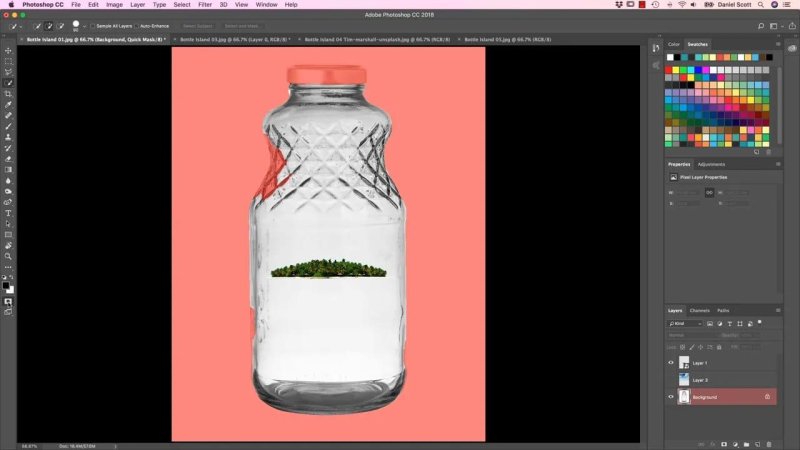
Quick Mask makes gaps around the bottle selection easier to spot.
Once you’re happy with the outline, choose Select > Save Selection. Name it Bottle Selection and confirm. We’ll use it immediately for the sky, then load it again for the water.
4. Mask the Sky and Blend It with the Glass
With the bottle selection still active, select the Sky layer and click Add Layer Mask. The sky should now appear only within the glass outline.
At first, it looks like a bottle-shaped cut-out of a sky photograph. That is expected. The mask controls where the sky appears; the blending mode controls how it interacts with the bottle beneath it.
Click the sky’s image thumbnail, rather than its mask thumbnail, before changing the layer blending mode. We want to blend the photograph with the glass, not work on the mask.
Try the blending modes in the Layers panel. Darken starts to reveal some nice interaction with the glass, and Linear Burn works well for this sky and bottle.
For a quicker way to compare modes, select the Move Tool, choose a blending mode, then hold Shift and tap + to cycle through the options.
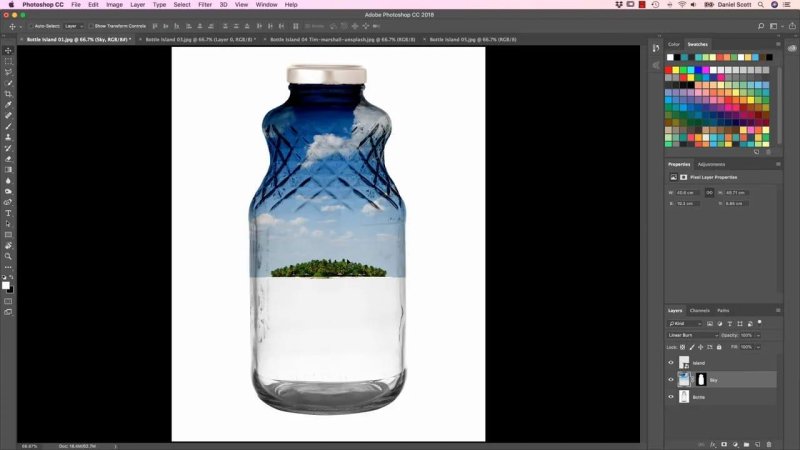
Linear Burn brings the bottle’s dark glass detail through the sky.
Don’t worry if another mode suits your photographs better. Linear Burn is a starting point for this combination, not a rule for every glass composite.
5. Add the Water and Reuse the Bottle Mask
Open the water photograph. Use the Rectangular Marquee Tool to select the underwater section you need, leaving out the unwanted material at the top.
Move that section into the bottle document and position its surface beneath the island. Keep some of the bubbles if you can. They help the lower half read as water rather than simply a blue background.
If the section is slightly too small, you can extend the source with Content-Aware Crop, as we did with the sky. I’m taking a small shortcut here and enlarging it with Free Transform. This water texture is forgiving enough that a modest stretch is not particularly noticeable.
Load the saved selection
Name the new layer Water.
Choose Select > Load Selection.
In the Channel menu, choose Bottle Selection.
Confirm, then click Add Layer Mask on the Water layer.
There we go: the water follows exactly the same bottle outline as the sky, without another round of selection work.
Choose the Water layer’s image thumbnail and try Multiply. It may look a little underwhelming before the rocky underside is added, so judge it again once that part is in place. Different water photographs may need a different mode.
6. Build the Underwater Half of the Island
The underside of the island starts as a rock formation photographed above water. Turned upside down and blended into the blue, it makes a convincing submerged landmass.
Open the rock photograph and use the Quick Selection Tool to select a suitable formation.
Add a layer mask to hide the surrounding scene.
Move the masked rock into the bottle document.
Convert it to a Smart Object before transforming it.
Name it Lower Island.
The discoloured band near the rock’s original waterline is a useful detail. Once rotated, it helps connect the rock with the surface beneath the tropical island.
Use Command + T or Control + T to rotate the rock upside down and scale it into position. Move the cursor outside the transform handles to rotate; use the handles themselves to resize. Align the broad edge beneath the island and let the point extend down into the water.
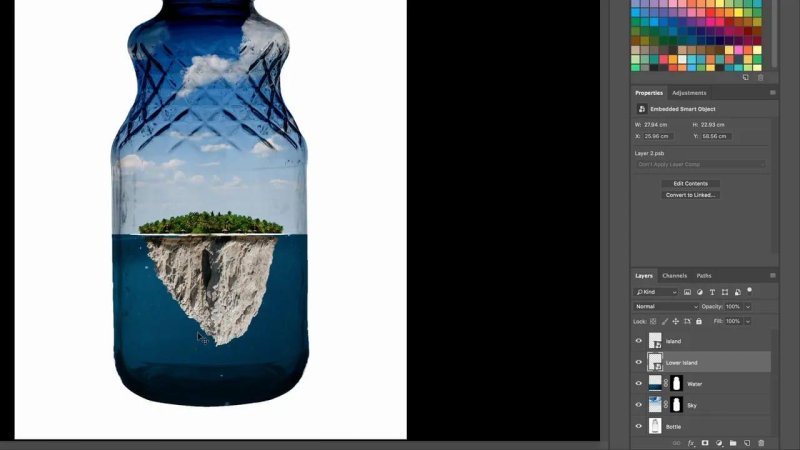
An upside-down rock gives the island a substantial underwater base.
Now cycle through the Lower Island layer’s blending modes. Soft Light works nicely here, letting the water colour influence the rock instead of leaving it looking like a bright object pasted on top.
This was one of those happy little discoveries during the build. Try the options rather than getting too attached to your original plan.
7. Bring Back the Bottle’s Highlights and Shadows
Here is a useful trick for glass: one blending mode often handles the dark detail well, while another handles the highlights. Trying to get both from a single layer can be frustrating.
Instead, use extra copies of the original bottle photograph above the composite.
Add a highlight layer
Right-click the original Bottle layer and choose Duplicate Layer.
Name the copy Bottle Highlights.
Drag it to the top of the layer stack.
Experiment with its blending mode to bring back the lighter glass detail.
Overlay gives an interesting result, although it can be strong enough that you’ll want to reduce the opacity. Soft Light gives a gentler result here without needing that same reduction.
Toggle the layer’s visibility off and on. Notice the highlights returning to the glass, but also check the water: the highlight layer affects the overall appearance, not just a few bright edges.
Add a separate shadow layer
If Soft Light makes the bottle feel a little too light or thin, duplicate that bottle copy again and name it Bottle Shadows. Keep it above the other layers and try Multiply.
The Soft Light copy brings back brightness, while the Multiply copy restores darker tones and gives the bottle edges more substance.
There is no fixed number of bottle copies you must use. Depending on the image, mixing a couple of modes can work better than forcing everything through one. It can also make minor selection imperfections less obvious, although obvious masking problems still deserve fixing.
8. Darken the Edges and Make the Final Adjustments
The main composite is in place. The last job is to make the edges feel less crisp and give the lower water a little more depth.
For this, I’m using the Burn Tool, found beneath the Dodge Tool in the toolbar.
Burn the sky edges
Select the Sky layer’s image thumbnail.
If it is a Smart Object, right-click and choose Rasterize Layer before directly using Burn. This commits that layer to pixel editing.
Select the Burn Tool and set its range to Highlights.
Use a large, soft brush. Around 800 px works for this image, with Hardness at 0%.
Brush gently around the sky’s outer edges to darken them.
An Exposure of 100% makes the effect very obvious, but it is strong. For your own version, use a lower exposure and build the result gradually rather than trying to finish it in one pass.
Deepen the water
Select the Water layer and repeat around its edges. This time, Midtones works better than Highlights for the blue water. You can compare Shadows too, but Midtones gives the useful darkening here.
Darken the bottom a little more to suggest depth. Keep the brush soft so the darkening blends into the scene rather than leaving an obvious painted border.
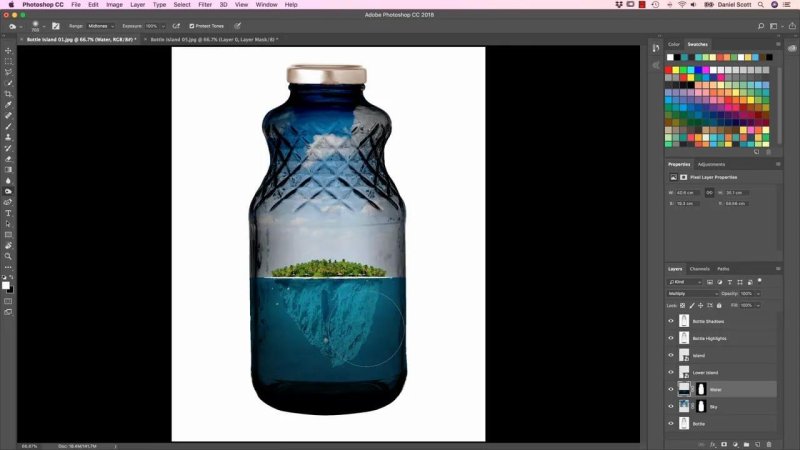
Soft edge darkening gives the glass more weight and the water more depth.
Check the island’s contrast
Finally, select the original Island layer and try its blending modes as well. If the trees look too sharp against the background, a different mode may help them sit more comfortably in the scene.
Linear Light is worth testing for a punchier, higher-contrast treatment, while Multiply offers another option. Compare the result with the original appearance and choose what works with your island and selection quality.
This last choice is very subjective. The important thing is that the trees, water, submerged rock and glass feel like one image. And if you feel it absolutely needs a lens flare, you’re more than welcome to add one. I’m happy with the island in its bottle.
Key Terms
Layer mask
A mask controls which parts of a layer remain visible without deleting the hidden image content. Here, masks contain the sky and water within the bottle and isolate the island and rock.
Saved selection
A stored selection that you can load again later. Saving the bottle outline lets you create matching masks on different layers.
Blending mode
A setting that changes how a layer interacts with the layers beneath it. Linear Burn, Multiply and Soft Light help combine the scenery with the glass detail in this project.
Smart Object
A layer container that preserves source image content while you transform it. It is useful before resizing and rotating the island pieces.
Content-Aware Crop
A Crop Tool option that fills space added beyond an image’s original boundaries. We use it to extend the cloudy sky.
Burn Tool
A tool for darkening image areas within a selected tonal range. A large, soft brush helps deepen the water and darken the composite’s edges gradually.
FAQs
Which blending modes work best for an island inside a bottle?
For these images, use Linear Burn for the sky, Multiply for the water and Soft Light for the submerged rock. A Soft Light bottle copy restores highlights, while a Multiply copy adds shadows. Treat these as starting points, because the best combination depends on your photographs.
How do I use the same bottle outline on several layers?
Select the glass body and choose Select > Save Selection. When you need it again, choose Select > Load Selection, pick the saved name from the Channel menu and add a layer mask to the relevant layer.
Why does the bottle look flat after adding the scenery?
The inserted photographs can obscure the original glass highlights and shadows. Duplicate the original bottle photograph, move the copies above the scene and use separate blending modes to restore the light and dark detail.
Do all the selections need to be perfect?
The blue sky behind the trees and the underwater blending make some edges forgiving. However, strong contrast can reveal rough masks, particularly around the bottle outline, so revisit any visibly untidy areas before calling the composite finished.
Written by Daniel Walter Scott — Founder of Bring Your Own Laptop & Chief Instructor
