Advanced Paragraph Styles In Adobe InDesign CC
Questions



Student Gallery
Be the first to share something.
Course info
Overview
- You will need a copy of Adobe InDesign 2018 or above. But you find that 95% of all the features in this course will work with earlier version of InDesign (e.g. CS6). A free trial can be downloaded from Adobe.
What am I going to get from this course?
- 70 lectures 5+ hours of well structured content.
- Create PDF Forms
- Master Long Documents.
- Advanced Fonts
- Master Styles
- Shortcut Sheet
- Create Charts & Infographics
- Create Interactive Documents
- Workflow Tactics
- Shortcuts & Speed Tips
- Advanced Creative Cloud Features
- Tips for working with Photoshop & Illustrator
- Using Scripts
- Exporting, Prepress & Printing tricks
- You will get the finished files so you never fall behind.
- Downloadable exercise files & cheat sheet.
- Forum support from me and the rest of the BYOL crew.
- Techniques used by professional graphic designers.
- Professional workflows and shortcuts.
- A wealth of other resources and websites to help your accelerate your career.
What is the target audience?
- This course is for people who already know InDesign and want to take their skills and speed to the maximum level.
- This is an advanced InDesign course, so you’ll need basic InDesign skills to find this course useful.
- This course is perfect for anyone that already knows how to insert images & add text.
- If you a completely new to InDesign try my InDesign Essentials course before starting this one.
- This course is perfect for anyone that has completed my InDesign Essentials course.
Course duration 7 hours 45 mins + your study.

Daniel Walter Scott
Founder of Bring Your Own Laptop & Chief Instructor
I discovered the world of design as an art student when I stumbled upon a lab full of green & blue iMac G3’s. My initial curiosity around using the computer to create ‘art’ developed into a full-blown passion, eventually leading me to become a digital designer and founder of Bring Your Own Laptop.
Sharing and teaching are a huge part of who I am. As a certified Adobe instructor, I've had the honor of winning multiple Adobe teaching awards at their annual MAX conference. I see Bring Your Own Laptop as the supportive community I wished for when I was first starting out and intimidated by design. Through teaching, I hope to bring others along for the ride and empower my students to bring their stories, labors of love, and art into the world.
True to my Kiwi roots, I've lived in many places, and currently, I reside in Ireland with my wife and kids.
Downloads & Exercise files
How do I find paragraph style overrides in InDesign?
Turn on the style override highlighter while working in Normal mode, not Preview mode. InDesign will mark text with local formatting changes in bright blue, making accidental tracking, italics, sizing, and other overrides very easy to spot before prepress.
How to Show Paragraph Style Overrides in Adobe InDesign
Key takeaways
Bright blue highlighting identifies text that no longer matches its assigned style.
Use the Paragraph Styles panel option to reveal local overrides quickly.
Press W to leave Preview mode if the highlighting does not appear.
A plus symbol beside a style is another clue that formatting has been changed locally.
The same override highlighting applies to both paragraph styles and character styles.
Why style overrides matter
That blue stuff is actually a very useful InDesign feature. It shows where paragraph style formatting has been overridden, so you can immediately see text that has drifted away from the style you intended.
This is particularly handy for prepress work, checking someone else’s file, or doing a final quality check on a long document. A document can look mostly fine while carrying small formatting inconsistencies that become a real problem later.
Local overrides are easy to create without meaning to. You might adjust tracking slightly, make a word italic, or alter a tiny font-size value. Then you copy that text somewhere else and keep typing. Before long, the wrong tracking or leading can spread through the document.
The override highlighter gives you a clear visual cue rather than making you inspect every paragraph manually.
Create a few overrides to see how it works
To understand what InDesign is flagging, make a few deliberate changes to text that already has a paragraph style applied. For example, adjust the tracking with Option + Right Arrow on Mac or Alt + Right Arrow on Windows.
You can also change a text fragment to italics or alter an unusual font-size value. These are all local changes, meaning they modify the selected text without editing the paragraph style definition itself.
Normally, such adjustments can be difficult to notice, especially in dense body copy. The override highlighter makes them impossible to miss.
Turn on the blue override highlighting
The process is quick, although there are two small details that can catch you out.
Select the Selection tool, also known as the black arrow, and click away from the text.
In the Paragraph Styles panel, enable the option that shows style overrides.
Make sure the document is in Normal mode.
Once enabled, InDesign highlights overridden text in blue. The blue areas indicate text whose local formatting differs from the applied paragraph style.
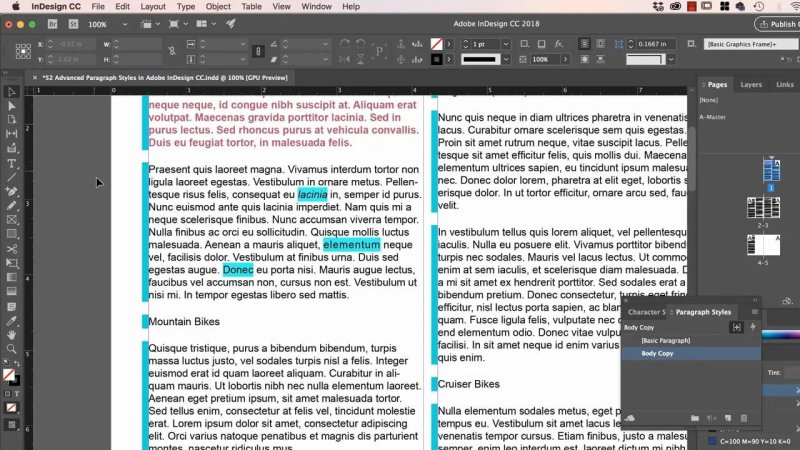
The bright blue markings reveal exactly where local paragraph-style overrides are sitting in the layout.
If nothing turns blue, check Preview mode
If you have enabled the option but cannot see any highlighting, you are probably in Preview mode. The override display does not work there.
Press W to switch back to Normal mode. Once you are out of Preview mode, the blue highlights should become visible, assuming there are local overrides in the text.
This is also the answer if a document suddenly appears covered in blue and you are wondering what happened. The style override display has simply been turned on. Disable the same panel option when you no longer need it.
Use the plus symbol as a second warning
There is another useful signal in the Paragraph Styles panel. When text has a local formatting change, the applied style shows a small plus symbol. That plus means the selected text is not an exact match for the style.
The blue highlight is ideal for scanning the page. The plus symbol is useful when you click into a particular paragraph and want confirmation that something has changed.
Together, they make a fast checking workflow:
Turn on override highlighting to scan for problem areas.
Click within suspicious text.
Check for the plus symbol beside the applied style.
Review the local formatting that has been changed.
Paragraph styles and character styles use the same display
This is not limited to paragraph styles. The same blue highlighting works with character styles too. Once the override display is turned on, it applies across both style systems rather than being a separate setting for each one.
That is useful in files where italic emphasis, bold text, special terms, or other inline formatting relies on character styles. If someone changes the tracking or another attribute locally, the blue highlight exposes it just as clearly.
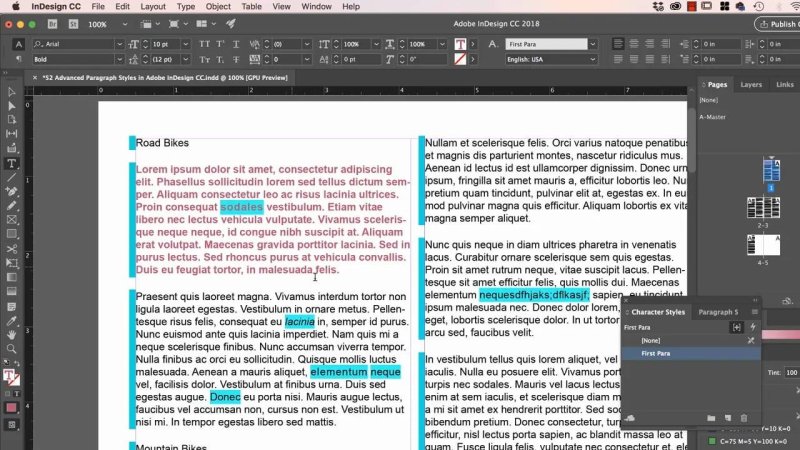
Character-style overrides are highlighted by the same setting, so inline formatting problems are just as easy to find.
Make this part of your prepress check
It is worth turning this on before handing off a file or sending it to print. Small accidental changes can survive for a long time because they do not always look obviously wrong at first glance.
A quick override scan catches those hidden adjustments before they multiply through copied text or create inconsistent typography across the document. It is one of those small InDesign checks that can save a lot of cleanup later.
Key terms
Paragraph style
A paragraph style is a saved collection of formatting settings for a whole paragraph, such as font, size, leading, alignment, and spacing.
Character style
A character style applies formatting to selected characters within a paragraph, such as italic emphasis or a specific text treatment.
Local override
A local override is a manual formatting change applied directly to text, causing it to differ from its assigned paragraph or character style.
Tracking
Tracking changes the spacing across a range of characters. A small accidental tracking adjustment can be hard to notice but can still create an unwanted style override.
Prepress
Prepress is the checking and preparation stage before a document goes to print. Identifying unintended formatting changes is a useful part of that process.
FAQs
Why is my text blue in InDesign?
Blue text markings indicate that style override highlighting is enabled. They show text with local formatting that differs from its applied paragraph style or character style.
Why can’t I see paragraph style overrides in InDesign?
Check that override highlighting is enabled and that you are in Normal mode. The display does not appear in Preview mode, so press W to switch back.
What does the plus symbol next to an InDesign style mean?
The plus symbol means the selected text has a local override. One or more formatting attributes no longer match the applied style definition.
Does InDesign show character style overrides too?
Yes. The same override-highlighting setting works for paragraph styles and character styles, helping you find inconsistent inline formatting as well as paragraph-level changes.
Written by Daniel Walter Scott — Founder of Bring Your Own Laptop & Chief Instructor
