Paragraph Vs Single Line Composer In Adobe InDesign CC
Questions


Student Gallery
Be the first to share something.
Course info
Overview
- You will need a copy of Adobe InDesign 2018 or above. But you find that 95% of all the features in this course will work with earlier version of InDesign (e.g. CS6). A free trial can be downloaded from Adobe.
What am I going to get from this course?
- 70 lectures 5+ hours of well structured content.
- Create PDF Forms
- Master Long Documents.
- Advanced Fonts
- Master Styles
- Shortcut Sheet
- Create Charts & Infographics
- Create Interactive Documents
- Workflow Tactics
- Shortcuts & Speed Tips
- Advanced Creative Cloud Features
- Tips for working with Photoshop & Illustrator
- Using Scripts
- Exporting, Prepress & Printing tricks
- You will get the finished files so you never fall behind.
- Downloadable exercise files & cheat sheet.
- Forum support from me and the rest of the BYOL crew.
- Techniques used by professional graphic designers.
- Professional workflows and shortcuts.
- A wealth of other resources and websites to help your accelerate your career.
What is the target audience?
- This course is for people who already know InDesign and want to take their skills and speed to the maximum level.
- This is an advanced InDesign course, so you’ll need basic InDesign skills to find this course useful.
- This course is perfect for anyone that already knows how to insert images & add text.
- If you a completely new to InDesign try my InDesign Essentials course before starting this one.
- This course is perfect for anyone that has completed my InDesign Essentials course.
Course duration 7 hours 45 mins + your study.

Daniel Walter Scott
Founder of Bring Your Own Laptop & Chief Instructor
I discovered the world of design as an art student when I stumbled upon a lab full of green & blue iMac G3’s. My initial curiosity around using the computer to create ‘art’ developed into a full-blown passion, eventually leading me to become a digital designer and founder of Bring Your Own Laptop.
Sharing and teaching are a huge part of who I am. As a certified Adobe instructor, I've had the honor of winning multiple Adobe teaching awards at their annual MAX conference. I see Bring Your Own Laptop as the supportive community I wished for when I was first starting out and intimidated by design. Through teaching, I hope to bring others along for the ride and empower my students to bring their stories, labors of love, and art into the world.
True to my Kiwi roots, I've lived in many places, and currently, I reside in Ireland with my wife and kids.
Downloads & Exercise files
Why does InDesign move words to a different line when there seems to be enough room?
InDesign uses the Paragraph Composer by default, which evaluates line breaks across the entire paragraph rather than one line at a time. It may move a word or even a couple of letters to improve the overall balance, even when that particular line appears to have space available.
InDesign Paragraph Composer vs Single Line Composer
Ever had a line of text where the last word, or just a couple of letters, seems to have been pushed to the next line for no obvious reason? You look at the line and think, “That absolutely fits.” Technically, it probably does.
The reason is that InDesign is not always making a decision based solely on that one line. By default, it uses the Adobe Paragraph Composer, which considers the line breaks throughout the whole paragraph. Its job is to produce a more balanced block of text overall.
That means InDesign might choose a slightly shorter first line if doing so creates better spacing and fewer awkward line endings elsewhere in the paragraph. This is often useful in body copy, particularly in justified text, where uneven spacing can become very noticeable.
The slightly frustrating part is that it can feel as though InDesign is ignoring an obvious fit. If you have ever tried to fix this with soft returns, manual line breaks, or non-breaking spaces, the composer may be the real reason the text is behaving differently from what you expect.
Paragraph Composer vs Single Line Composer
There are two primary composition options for Roman alphabet languages in InDesign:
Adobe Paragraph Composer considers the entire paragraph and adjusts line endings to create a more evenly composed result.
Adobe Single-line Composer makes each line independently, using the available space on that individual line.
Single-line Composer works more like the behaviour most people expect at first. If a word fits on the current line, InDesign is more likely to keep it there. Changing the composer can therefore cause words to move up or down between lines, even when no other type settings have changed.
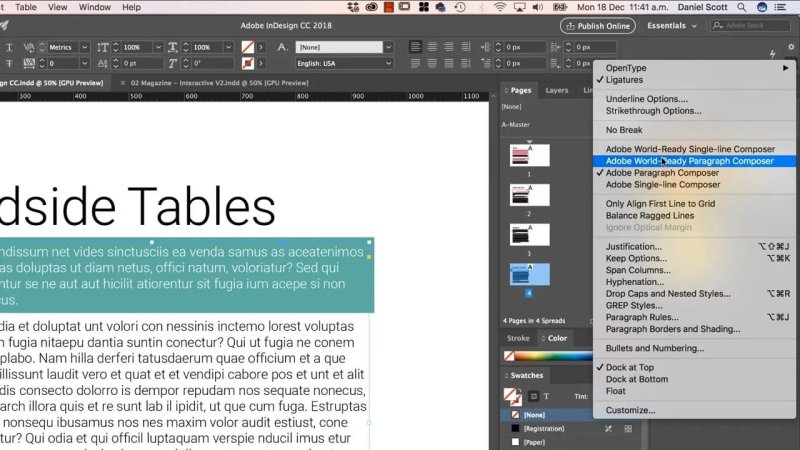
The panel menu gives you direct control over whether InDesign composes the full paragraph or each line separately.
How to Change the Composer for Selected Text
You can change the composer for a paragraph without changing the default for every future document.
Select the paragraph with the Type tool.
Open the panel menu, often called the burger menu, from either the Character or Paragraph controls.
Choose Adobe Paragraph Composer or Adobe Single-line Composer.
The change applies to the selected paragraph. When you switch to Single-line Composer, look closely at the line endings. A word or small fragment that had been forced down may now move back up because InDesign is evaluating that line on its own.
The menu also contains World-Ready composer options. Those are intended for languages with additional typographic requirements, including Arabic, Hebrew, and Japanese. For English and other Roman alphabet languages, the standard Paragraph and Single-line Composer options are normally the relevant choices.
When to Use Each Option
Use Paragraph Composer for a balanced text block
Paragraph Composer is generally a great default when you want InDesign to take care of the bigger typographic picture. It can make a paragraph feel more even because it weighs the consequences of one line break against the lines around it.
This is particularly helpful when you are setting longer passages of body text and want the paragraph to look consistently balanced without manually adjusting every line.
Use Single-line Composer for hands-on line control
Single-line Composer is useful when you care more about the exact break on a specific line. It makes it easier to take control with break characters and make deliberate adjustments yourself.
If Paragraph Composer keeps placing letters or words in a spot that drives you mad, switching to Single-line Composer can be the simplest solution. You can then make local refinements rather than having InDesign continually rebalance the whole paragraph around your edits.
Neither setting is universally better. Sometimes the paragraph-wide balance is exactly what you want. Other times, it feels as though InDesign is forcing text where it does not belong. Pick the one that gives the layout the result you want.
How to Set Single-line Composer as the Default in InDesign
Changing the composer from the panel menu affects the current selected paragraph. If you know you prefer Single-line Composer most of the time, set it as the default in Preferences.
On macOS, go to InDesign > Preferences > Advanced Type.
On Windows, go to Edit > Preferences > Advanced Type.
Find the Default Composer setting.
Change it from Paragraph Composer to Adobe Single-line Composer.
Confirm the preference change.
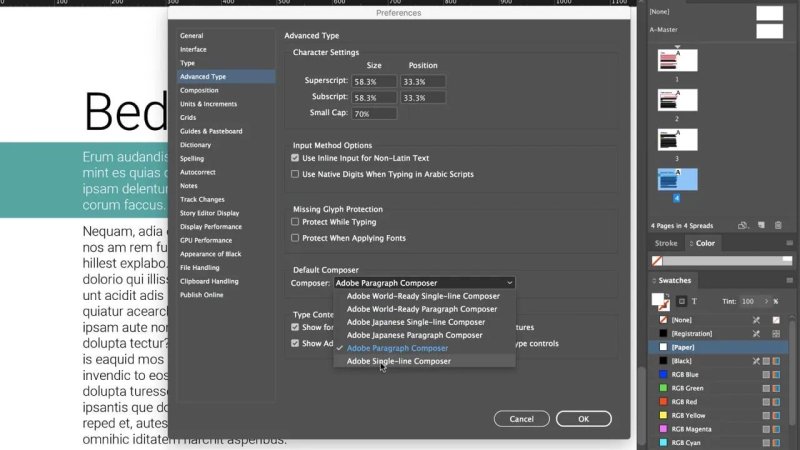
Set the Default Composer in Advanced Type preferences when you want new text to use Single-line Composer automatically.
Once this is set, new text will use Single-line Composer by default. You can still override it paragraph by paragraph whenever a particular block of copy needs the balancing behaviour of Paragraph Composer.
Do Not Use Manual Breaks as the First Fix
Manual line breaks, soft returns, and non-breaking spaces all have their place. But they should not be the first response when a line break seems strange. First, check which composer is active.
If Paragraph Composer is causing the result, a manual break may fix one line while creating a less balanced paragraph overall. If Single-line Composer is active, manual breaks can be a more intentional way to control a specific line ending.
The key is knowing that InDesign is making a typographic decision, not randomly refusing to fit text that appears to have room.
FAQ's
What is the default composer in InDesign?
InDesign uses Adobe Paragraph Composer by default. It evaluates line breaks across the entire paragraph to produce a more balanced overall result.
How do I change InDesign to Single-line Composer?
Select the paragraph with the Type tool, open the Character or Paragraph panel menu, and choose Adobe Single-line Composer.
Can I make Single-line Composer the default?
Yes. Go to Preferences, open Advanced Type, and change Default Composer to Adobe Single-line Composer. On Windows, Preferences is found under the Edit menu.
Which composer should I use in InDesign?
Use Paragraph Composer when you want a paragraph to be balanced as a whole. Use Single-line Composer when you want each line treated independently and prefer more direct control over individual line breaks.
Written by Daniel Walter Scott — Founder of Bring Your Own Laptop & Chief Instructor
