Amazing file management tricks to save the day in Premiere Pro

Course contents
SECTION: 4
Preferences 10:03
SECTION: 10
Freeze, Hold & Pause 7:20
SECTION: 14
Storyboarding / Planning 3:04
SECTION: 21
Workspaces 2:38

Questions

0
You are not following this thread
1
You are not following this thread

Course info

146 lessons / 17 hours 49 quiz questions 14 projects Certificate of achievement

Overview

Hi there, my name is Daniel Walter Scott & I’m an award winning Adobe Certified Instructor. Welcome to the Premiere Pro Advanced Course.

This course is aimed at people who already know the fundamentals of Adobe Premiere Pro. If you have developed your own way of doing things but you realise there are so many tools, updates & time saving techniques that you haven't had time to explore then this course is definitely for you.
• We look at the best productivity hacks & little known features to super speed your timeline editing. 
• We explore color management, color grading, color replacement & skin tone correction.
• You will master all the new Lumetri color methods and harness the power of scopes. 
• You will learn new ways to successfully create traditional & new style transitions. 
• You will quickly become a master at fixing shaky handheld and drone footage.
• There won’t be anything you can’t mask or blur.
• We will get your computer running at warp speed using Proxies, Scratch Disk & Cache management. 
• You’ll master high frame rate footage to enable you to produce spectacular slow motion video. 
• You will create high quality professional motion graphics & data driven infographics. 
• You’ll learn all about Premiere Pro’s responsive time and design tools so you can make graphics & animation once that can be used across multiple future productions. 
• You will learn file and footage techniques which will enable you to work with multiple editors. 
• Multi-camera editing will be a breeze. 
• You will learn stunning techniques to help clean up your audio by removing noise, hiss & echo. 
• Learn how to manipulate & extend your music in Premiere Pro & also in Adobe Audition. 
• You’ll learn which tools & techniques are best for removing the monotony of repurposing the same footage across multiple sizes for social media. 
• Learn about markers, subtitles and amazing plugins, 
• You will learn all the best tricks and settings which will enable you to get the most from your rendering in Premiere Pro and also in Adobe Media Encoder.   
We cover all these topics and more in this course. 
Take a look at the contents and read reviews from other students and you’ll see this is the course that will get you from adequate - to EXCELLENT in Premiere Pro.

In this course we use real world, practical projects and use exercise files which you can download and then work alongside me.

If you can’t remember the last time you sat down & went through the features & updates in Premiere Pro, let this course be your all-in-one professional development & upgrade.  

You owe it to yourself -  sign up and get ready to become a Premiere Pro Super Hero.
Daniel Walter Scott

Daniel Walter Scott

Founder of Bring Your Own Laptop & Chief Instructor

I discovered the world of design as an art student when I stumbled upon a lab full of green & blue iMac G3’s. My initial curiosity around using the computer to create ‘art’ developed into a full-blown passion, eventually leading me to become a digital designer and founder of Bring Your Own Laptop.

Sharing and teaching are a huge part of who I am. As a certified Adobe instructor, I've had the honor of winning multiple Adobe teaching awards at their annual MAX conference. I see Bring Your Own Laptop as the supportive community I wished for when I was first starting out and intimidated by design. Through teaching, I hope to bring others along for the ride and empower my students to bring their stories, labors of love, and art into the world.

True to my Kiwi roots, I've lived in many places, and currently, I reside in Ireland with my wife and kids.

Certificates

We’re awarding certificates for this course!

Check out the How to earn your certificate video for instructions on how to earn yours and click the available certificate levels below for more information.

How to earn your certificate

Work your way towards your certificate for this course by following these simple steps.

  • Watch the course videos
  • Complete the Class Projects - look out for the videos marked with
  • Upload your class projects into the My Projects area in your account
  • Complete and pass the Knowledge Quiz (Merit level courses only)
  • Complete the Distinction Certificate Project (Distinction level courses only) - look out for the video marked with
  • Upload your Distinction project to the My Projects area in your account
  • Request your certificate when you've completed the requirements for the certificate level you're working towards

Good luck!

Pass certificates

We're awarding 'Pass' level certificates for this course.

You can work your way towards your 'Pass' certificate by following these simple steps.

  • Watch the course videos
  • Complete the Class Projects - look out for the videos marked with
  • Upload your class projects into the My Projects area in your account
  • Don't forget to request your certificate when all your projects are complete

Good luck!

Merit certificates

We're awarding 'Merit' level certificates for this course.

You can work your way towards your 'Merit' certificate by following these simple steps.

  • Watch the course videos
  • Complete the Class Projects - look out for the videos marked with
  • Upload your class projects into the My Projects area in your account
  • Complete and pass the Knowledge Quiz
  • Don't forget to request your certificate when you have passed the quiz and completed all your projects

Good luck!

Distinction certificates

We're awarding 'Distinction' level certificates for this course.

You can work your way towards your 'Distinction' certificate by following these simple steps.

  • Watch the course videos
  • Complete the Class Projects - look out for the videos marked with
  • Upload your class projects into the My Projects area in your account
  • Complete and pass the Knowledge Quiz
  • Complete the Distinction Certificate Project - look out for the video marked with
  • Upload your Distinction project to the My Projects area in your account
  • Don't forget to request your certificate when you have passed the quiz and completed all your projects

Good luck!

Downloads & Exercise files

Transcript

Hi everyone, welcome to the amazing File Management tricks, that are going to save the day in Premiere Pro. I'm trying to sex up this video, it's got some amazing tips and tricks in it, but I kind of had it down as file management, it was like, it's the subgroup that it's in, and I don't want you to go like, "Oh, geez." I'm going to skip old file management, because there's some good ones in here. All right, let's get started. 

So first up, if you're playing along, I'm using the last video from the last file, It's got a bunch of stuff that I imported, I'm actually going to import some more of the same, it's going to be weird. So 'Command I', and I'm going to move more from Donut Dynamite. Let's say I wasn't sure, I was like, "Have I got this in here?" I'll just import it again. The weird thing about Premiere Pro, it'll import it twice, which can be really annoying. So what you can do, make sure you're in your 'Project', go to 'Edit', and you can go in here and say, 'Consolidate Duplicates', watch, they just get rid of them all, nice. 

The next one is my favorite, no, I've put them in some sort of order of my favorites. So this, this video is destined to get less and less interesting towards the end. There's good ones, I've not included any bad ones, I think, but anyway, my next most favorite one, is when, let's say that I've got this, I'm going to add a couple of bits of B-roll here. So let's say we're cutting up some bad transitions, I'm just, let's just dump a few of them in here, onto my Timeline, and then you're like, "Actually, I've got all this other junk, what is it?" "Do I need it? Is it in the sequence?" 

Make sure your 'Project' window is selected, you can go to 'Edit', and you can say, 'Remove Unused', it just deletes them, unless they've been used on a sequence, in this project, cool. That one's a bit, I don't know, I feel like that is too rash and harsh. Often I just want to know, like what's been used, and what's not being used. So what you do is, basically you do the exact same thing, and then go 'Edit', 'Undo', because then they're back in there, but they're highlighted, and that's kind of enough for me, I'm like, okay, I know that one's not being used, and maybe I should have, like, "Oh, why haven't I used the Mix Butter ones, the best one." I have no idea whether it's good or not, but you get the idea, right? You can remove them, but if you undo it straight away, it'll just highlight them, and I find that's quite useful. 

Next is, what I normally call packaging your document, it's from like graphic design lingo, where we need to kind of, we've got a project file and we've got videos, probably everywhere, some on our desktop, some on our downloads folders, some are on a hard drive, somewhere on the SD card. We just want to get them into one place, because we either need to archive it, or we need to send it to somebody else, or just look less like a messy person. So you can do that easily in Premiere Pro, have the project you want to tidy up open, have it selected down here in the 'Project' panel, go to 'File', go to 'Project Manager', click the sequence you want to backup, all of them, one of them, I've only got one. 

Over here I want to exclude any unused clips, depending on what you want to do. I'm going to exclude them, I'm going to include the Audio Conforms, and the preview files, and rename. I haven't renamed in my files and my clip name, so it doesn't really matter. These preview files, we talked about them earlier, remember, Premiere Pro couldn't, doesn't like to read an mp3, let's say. So it creates this wav file or unpacks it as a, I can't remember the extension, but unpacks it, into a format it can use. So do you want to include those, you don't need to, because Premiere Pro will generate them again afterwards, so it's up to you. 

Collect Files to a New Location, so you're going to have a copy, that's the big one, it's going to collect them and copy. So you're going to have duplicates of all of this, it's kind of way of getting it off onto a backup drive, that's what I do. So you clicked it all, stick it onto a backup drive, and then you know you have to go and find everything, try and drag it, and links break, and you have missing files. I'm going to stick mine on my 'Desktop', let's go have a look how it gets created. 

So there it is there, that's the name of my file, my project, I'm using the project names as the video names as well, so ignore that. This might be like, I don't know, 'Co Working Space' video', and inside of there you've got a copy of your project file, dot pr, prog j. Those are the previews that we brought along for the ride. There's the videos that are being used, these are all the videos that are being used, you will notice, I was going to, I wasn't sure if I put this in or not, but I guess I should. All the mp4s just get dumped in the file format, these movs in the project, some of the mov, some of the mp4s, these are using an underlying codec called avchd, and they, the way Premiere Pro needs to deal with them, is it needs to put them in this BDMV folder, inside Stream, and there it is there, that's the file that you are working with. 

If you want to tidy things up for whatever reason, you can drag them out. Premiere Pro won't like it because it'll be missing them, but you can link them, it's up to you whether you want to keep them in these, like, I don't know, messy folders, or not, but anyway now I can grab this thing here and I can say, Zip, and on Mac it's called Compress, on a PC I think it's Send to WinZip, or this Compress Folder, I can't remember what is on PC, it's in here somewhere, and you can then zip it all up and send it off, or stick it on a disk, you know what to do with it, but just remember it's a copy, and you will never remember, it is under 'File', 'Project Manager', which doesn't seem, I don't know, seems a bit ambiguous, but really handy to tidy up those messy files. 

All right, the next one, we've done maybe once or twice during the course, but let's put it all in File Management, is Reveal in Finder, so in here, and you're like, "Where did this one, where did I get this from?" I can go right click, and somewhere in here, Reveal in Finder, I'm not sure what it is on a PC, is it Reveal in Windows? You'll know, because it'll say Reveal in something, Finder is a Mac thing, I thought. It'll open up, let's open up my other window here, my other screen, there it is, it's just telling me where it is. 

You can do it from over here as well, you can right click it and say, actually, show me this in the Finder, towards the bottom, Reveal in Finder, you can also Reveal in Project. So Reveal in Finder gets us back to the exact same place, but Reveal in Finder, let's look at something else, it'll highlight it over here, which is handy, Reveal in Project, there you go. 

Next tip, the next one is searching in here. I've made it bigger to make it-- we're going to do a lot down here in the Project panel, so we did searching or finding here in the Timeline, remember it was just Command for Mac, Ctrl for PC, F, and you could do finding stuff. We did that earlier, you can do it over here as well. So just whatever you've got selected, will activate that, using that same shortcuts. So over here, on my Mac, 'Command F', 'Ctrl F' on a PC, and I can do my Find, I want to find everything that has the word butter in it. 

Now one thing can be a bit confusing, is that, it's got two things here, and if you've adjusted it like we did earlier, it's going to go fine. Mine makes a happy little noise, it's the computer butt hitting against the glass. I can't find it, I know there's the word butter there, it's because we've gone, match this, so all, it needs to match all of these things, I want to say match any of these two, this or that, any of them, and it's highlighted over here. 

There's an easier Find in this one, you can just use it up here. So let's type "butter," and there you go. The strange thing though is that it doesn't turn off, ever, you have to like remember to hit the cross to get rid of it. It's pretty good, you can search for frames per second, so 25 is weird, like it's bringing me everything, that has anything to do with 25. So this has 25 somewhere in the Meta data, it's not the frames per second, these ones are perfect, there's something in there, you can see it, can you see it, I can't see anything in there, it says 25, something in the Meta data finds it, so it's pretty-- tries to find everything, but if we do 25.00, still has it in there. I'm not sure why that one's appearing, just make sure you delete it when you're finished. 

You can be thinking camera model, if that Meta data is included in the video, the different camera models, maybe the date, anything you can search in there. His little friend over here is quite interesting, this one creates a search bin, we know bins is like little folders, so what you can do is, click this, and say we get kind of a similar search as we had before. So find all the Meta data that has that 25 frames per second, and this, no, just all of that, and let's click 'OK', and you can see over here, it's weird, it's created a little bin with a little, can you see the little spy glass in it, this bin has grabbed a bunch of files, that have the word 25 in there somewhere, this random guy, but weirdly, look, there's--

Let's look at Color Correction 02, that's something that you won't have in yours, because I randomly imported that before, but you can see here, it's there and there. Have I got duplicates now? No. This is just like this permanent search, it's always running, well kind of, it's like a saved search. It means that if I add something else later on, it'll appear in here as well, just kind of like a way of segmenting things. It's not a duplicate, I can use it out of here, but it's just like a-- it's not a copy, I don't want to use a copy, it's like a-- what's the word I want, another iteration of this, if that's a word, I don't think that's the right word, but hopefully you get what I mean. 

It's just showing you another way of looking at this, and you can open it up separately, you can double click on it, and just look at this stuff, I can go back up to my original one, and let's say I do add something else to it. So something else, 25 frames-ish, so this Color Correction H, I'm hoping is 25 frames, I'm not going to drag it into that folder, it's not a folder, like we've been using, it's a search bin. So if I drag it down here, it is 25 frames, and you're like, "Oh, didn't appear in here." This thing is not-- oh, it did appear, it's not very quick, just give it a second. It eventually does the search again, I have no idea, like the time difference, I end up just kind of clicking on it, and going and clicking things, and it seems to happen. I don't think my clicking helps, there is just a timer that goes--

I'm going to go search some more, but I think it's controlled by hamsters, so just be patient and wait for it to update. How to get rid of it? You can just delete it, and you're not actually deleting your files, it's just a different search. You might have a search bin that has 1080p, or, actually drop this down, there's quite good stuff in here, depending on the Meta data of your original footage, is in Frame Rate, hopefully that'll clean it up, and get rid of that guy, it did finally. So I've just got those ones with 25 frames per second. All right, that is doing some extreme searching, let's get on to the next trick. 

The next one is to do with the Meta data, across the top here, we've looked at, kind of adjusting this in the past, but you can save it, so, let's change it a little bit. So let's say that, for us, Frame Rate is not that important, or it is, but there's other stuff, so let's just turn on something else. You right click any of these guys along the top here, top of the columns, pick something else, let's have a look at Basic. What else we want? Let's use, say-- whether the video and audio being used, and maybe, what video codec is using. So we can click 'OK', get it in the right order, by scrolling left and right, I'm using that scroll wheel mouse, you can just drag a bit left and right, I'm using that scroll wheel mouse, I can hold 'Shift' and drag it up and down a little, scroll wheel, that's a handy trick, and pretty much most of these, if you hold Shift down and scroll left and right, it'll scrub left and right on them. 

When I say scrub left and right, I mean, scroll wheel, holding shift, up and down, up and down on the scroll wheel, goes left and right. So I'm going to go along to this end point, where is it, here, I want to move all these along, it's a bit of a pain, kind of getting them all the way along, but it works eventually. Did I select all of those, did I? Video usage, it might be the audio channel as well. Okay, we've got there, kind of shuffle them all along. You can save the layout, you can click on this option here and say, 'Save As New View Preset', so I can say, this is my, I don't know, "Assembly." When you're doing kind of-- is that Assembly, that looks good to me. So it might be Assembly, you might have, I don't know, it might be an audio version, where the audio information is closer, or you just might have one that you use all the time, the Dan one, and I'm going to not do that. 

You can obviously set a preset, remember, do that, then go into your keyboard shortcuts, find the words Project View, and then turn it into a shortcut. I'm unlikely to ever do that, I don't switch them enough, click 'OK'. So it just means that later on, I can switch them back and forth between different ones, if you do need to load a different one, because you've saved a different one, you can go back to this. 

The other thing to note is that this view here, is also tied in where my workspace is, so Dan - Editing, if I save the changes to this work space now, it will remember this as well. So video usage, I'm going to drag it all the way over here, and Media End, Back End. So this one here is kind of in the wrong spot now, so if I go back to my 'Window', 'Work Spaces', and say, actually, let's 'Reset to Saved Layout', you'll notice that it all comes back to normal. So you might have your, remember, editing version, you might have it, your version for audio, and switch these around, spend a bit of time getting it right, Color Correction 01, just so that you can see what you need to, codecs or frame rates, whatever it is, and they will save and connect to the work space. 

All right, the next one is kind of tricky, you can get yourself into problems with it, it's pretty easy to do. Let's say that you're working on stuff, and you've got a bunch of stuff that you have already used on the Timeline, and it's really messing, you're like, "Actually, I just don't need any of this, that, and that, I just don't need to see it," just need the interview, and all the stuff can go away. You can right click any of them, and go to 'Hide', look at that, nice, tidy Project panel. The problem is, is the next person to come along, that you send it to, goes, "Where's all the footage?" I can see it over here, it's not here, where is it gone? So make sure you tell the person you're sending it to, and you can, to get it back, you just right click anywhere in here, and say 'View Hidden', and toggles it back on, and it is a toggle switch. 

So let's say you just turn it on for a second, to start checking these things in the Source monitor, and adding them, and then you actually, want to go back to your tidy option. If you go 'View Hidden' again, it toggles back and forth. All right, I'm going to turn that off, 'View Hide', it is a nice way of tidying up a project. I'm too scared to turn it on myself, for fear of losing stuff, and spending ages trying to find it. 

All right, next tip, next thing is a quick easy one, finding footage, right clicking it, and instead of trying to like search the Meta data, and turn it all on, on these little columns, you can actually just find properties. So right click the 'File', go to 'Properties', sometimes you need to give it a second, for it to go through and figure it out, and this is the stuff, that this file, Premiere Pro knows about your document, all in just one big lump, rather than trying to turn things on and off, and depending on how it was shot, how much Meta data the camera put into it, or what's been stripped out in the editing process, you might find lots in here, you might find very little, but that's the way to do it. 

Let's close that down, oh, one thing I thought of is, there's actually a panel for Meta data as well. So let's select on this one, go to 'Window', go to 'Metadata', mine's already on somewhere, if it's ticked on it's just on somewhere, that it can't-- oh, there it is, you turn it on and off, so you can see it all, there is a panel as well, and the cool thing about this, the problem with this is, you've got to kind of do a bit of searching through, to find the stuff that's actually applied, but you can actually add stuff to this. So you can start deciding-- adding Meta data this way, using this panel here. All right, let's go back to my Source window, and next tip. 

All right, this last one I hope you never need, if you're, for whatever reason Premiere Pro crashes, it will try and load up our version, it tries to say, "Hey, I've got this version, let me try and load it", and you say, "Yes please, please," and you cross your fingers and you go, "Please, please, please,” and you hope it loads with all of the changes. If that's not the case, or just something happens, know that this is the file, the project file, the main file, that we'd be working from, but there's this other file called Auto Save, and in here are a bunch of versions. So the current one plus all the ones, and it's kind of, they're time and dated backwards, they're in sort of chronological order. 

These are actually just separate project files, you can open them up separately, just to see if there's one of them in there that, you know, has the thing you wanted or at least, maybe you were part way through, something that you plan to undo, but it crashed. So have a look through those, just in case there are other versions, not just the original pr, prog. 

All right, thanks for sticking with this one, it was a long one, that is file management, and I hope you learned something. Hope it wasn't too boring, let's get into the next video.

Written Guide

How do I organise and clean up files in Premiere Pro?

Use Consolidate Duplicates and Remove Unused to tidy your Project panel, then use Project Manager to collect your project and media into one location. Search bins, metadata views and Reveal commands help you find footage quickly, while the Auto-Save folder gives you earlier project versions to try if something goes wrong.

Premiere Pro File Management Tricks That Actually Save You Time


Key Takeaways

  • Clear duplicate imports and identify footage you have not used.

  • Package a project and its media for archiving or handing over.

  • Find clips using file locations, searches and automatic search bins.

  • Save useful metadata layouts for different editing tasks.

  • Reveal hidden footage and recover earlier project versions.

File management does not sound terribly exciting. Fair enough. But there are some genuinely handy Premiere Pro tools tucked away under that rather dull heading, including a couple that can tidy a messy project in seconds.

The trick is knowing what each command changes. Removing an unused item from your project, hiding a clip and copying media to a backup drive are very different things. Once those differences are clear, organising your footage becomes a lot less nerve-racking.


1. Clear Duplicate Imports with Consolidate Duplicates

Ever looked at a clip, wondered whether you had already imported it, and imported it again just to be sure? Premiere Pro can happily give you another project item for the same media. Now you have two entries and a slightly messier Project panel. Nice.

There is a quick clean-up command:

  1. Click inside the Project panel to make it active.

  2. Open Edit.

  3. Choose Consolidate Duplicates.

Premiere Pro consolidates the duplicate project items. You do not need to hunt through the list and remove each repeated import manually.

Make the Project panel active first. That small detail matters for several of these tricks, particularly when commands and shortcuts depend on the panel you have selected.


2. Remove Unused Clips, or Just Highlight Them

Once you have an interview and a few bits of B-roll on your timeline, the Project panel can still contain a mountain of material. Which clips are actually being used? Which ones are just sitting there?

With the Project panel active, choose Edit > Remove Unused. Premiere Pro removes project items that are not being used in a sequence within that project.

This is a project clean-up operation, not a command to delete the original footage from your drive. It also considers usage across the project, rather than simply asking whether a clip appears in the sequence currently in front of you.


The less drastic trick: remove, then undo

I often find Remove Unused a little too enthusiastic. Sometimes I do not want to clear everything out. I just want to know what I have overlooked.

  1. Choose Edit > Remove Unused.

  2. Immediately choose Edit > Undo.

  3. Look at the restored items in the Project panel. They come back selected.

That selection is the useful bit. You can see the unused footage without committing to removing it.

For example, a clip with “mix butter” in its name might suddenly catch your eye. Why have you not used that shot? Is it worth another look? This little remove-and-undo trick turns a clean-up command into a way of rediscovering material.


3. Package Your Project with Project Manager

This is what I tend to call “packaging”, borrowing the term from graphic design. You have a project file, but its media is scattered everywhere: the Desktop, Downloads, another hard drive, perhaps even an SD card.

You want the project and its footage in one place so you can archive it, send it to somebody else, or simply look a bit less like a messy person.

The tool you need is File > Project Manager. Not the most obvious name for “please gather all my stuff”, but there it is.


Collect the project and media into a new location

  1. Open the project you want to package and make its Project panel active.

  2. Choose File > Project Manager.

  3. Select the sequence or sequences you want to include.

  4. Choose Collect Files and Copy to New Location.

  5. Decide whether to enable Exclude Unused Clips.

  6. Review the options for audio conform files, preview files and renaming media to match clip names.

  7. Choose a destination, such as a backup drive, and confirm.
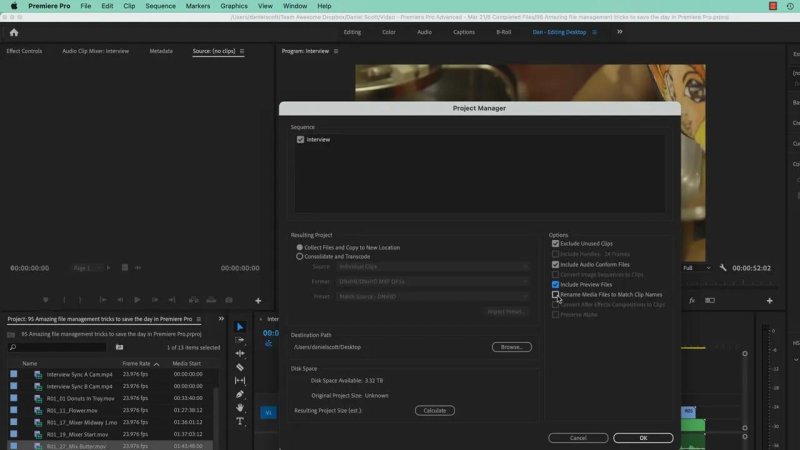
Premiere Pro interface displaying the open Project Manager window over the workspace, configuring options to collect files to the Desktop with

Project Manager gathers the selected sequences and their media into a new location.

The important word is copy. Project Manager creates another set of files at the destination. It is not moving all your originals out of their existing folders.

That makes it useful for backups and handovers. Rather than manually finding every source file, dragging it somewhere else and discovering that links have broken, you let Premiere Pro collect the media it needs.


Choose what belongs in the package

Exclude Unused Clips is useful when you only want the material required by the selected sequences. Whether you enable it depends on what you are trying to preserve or pass on.

You can also include Audio Conform Files and Preview Files. These are supporting files Premiere Pro generates for working with your media. They are not the same thing as the original source footage, and Premiere Pro can generate them again if you leave them out.

The rename option is relevant if you have changed clip names inside Premiere Pro and want the copied media names to match. If you have not renamed anything, it may make little difference to your package.


Understand the collected folder structure

The resulting folder contains a copy of your .prproj project file, the collected media and any supporting files you chose to include.

Do not be surprised if every media file is not sitting neatly at the top level. Some footage can be collected within an AVCHD-style structure, including BDMV and STREAM folders.

It is tempting to drag those files out to make things look tidier. You can rearrange them, but Premiere Pro will then be looking in the old locations and you will need to relink the media. Leaving the collected structure alone avoids that extra job.

Once everything has been collected, you can compress the folder into a ZIP archive for transfer or storage. On a Mac, that is the Finder’s Compress command. Just remember that you are working with a collected copy, not relocating the original project and footage.


4. Find a Clip on Your Drive or Inside Your Project

There are two different “where is this?” questions in Premiere Pro:

  • Where does this source file live on my computer?

  • Where is this timeline clip listed in my project?

The Reveal commands answer those separately.


Reveal in Finder

Right-click a clip and choose Reveal in Finder on a Mac, or the corresponding Explorer command on Windows. Premiere Pro opens its location in your computer’s file browser and highlights the source file.

You can use this from the Project panel or from a clip in the timeline. It is handy when you cannot remember whether that shot came from Downloads, a media folder or somewhere rather more mysterious.


Reveal in Project

Right-click a timeline clip and choose Reveal in Project to highlight its project item in the Project panel.

That is the distinction: one command finds the file on your drive; the other finds the item inside Premiere Pro.


5. Search the Project Panel Without Getting Caught Out

You have both a Find dialogue and a quick search field available in the Project panel. They are useful for slightly different jobs.


Use Find for search conditions

Click inside the Project panel, then press Command + F on a Mac or Control + F on Windows.

The active panel determines where the shortcut operates. If the timeline is active instead, you are asking Premiere Pro to find something there.

In the Project panel’s Find dialogue, you can search for a word such as “butter”. If an item you know exists is not being found, check the relationship between your search conditions:

  • Match All: the item must satisfy every condition.

  • Match Any: the item can satisfy either condition.

A leftover second condition combined with Match All can be the reason Premiere Pro insists it cannot find something that is sitting right there. Change the conditions or use Match Any when you mean “this or that”.


Use the search field for quick filtering

For a simple filter, type directly into the Project panel’s search field. Entering “butter”, for example, narrows the visible items to matching results.

The catch is that the filter stays active until you clear it. Click the cross in the search field when you are finished. Otherwise, it is very easy to wonder where the rest of your footage has gone.

Search is not limited to clip names. It can also find information in the available metadata, such as camera models or dates, if those details are present.

That broad matching can produce odd results. Searching for 25 might find your 25 fps footage, but it can also find a completely different item with “25” somewhere else in its metadata. Even making the number more specific does not necessarily identify the field you intended.

When you need a precise result, such as clips with a particular frame rate, use a condition tied to that metadata field rather than relying on a general number search.


6. Create Search Bins for Searches You Use Repeatedly

A search bin is a saved search that looks rather like a normal bin, with a little magnifying-glass icon to distinguish it.

Instead of repeating the same search every time you need a group of clips, create a search bin and let Premiere Pro gather the matching project items for you.

  1. Click the Create Search Bin button in the Project panel.

  2. Set the metadata field and search condition.

  3. Confirm the search.

  4. Open the resulting bin to work with the matching items.

For example, you could create a search bin for footage whose Frame Rate matches 25 fps. Choosing Frame Rate specifically avoids the stray results that can appear when you search all metadata for “25”.


A search bin does not duplicate your footage

You may see a clip in its original location and again inside the search bin. That does not mean you have imported it twice.

A search bin is another way of looking at the same project items. It does not make another media copy, and you can use the clips from those results.

Newly imported material that matches the conditions can appear in the bin automatically. You do not drag it into the search bin as though it were a normal folder.

Give it a moment to update, though. The refresh is not always immediate. Clicking around impatiently probably does not help, even if it feels productive. The little hamsters doing the searching just need a second.

You can double-click a search bin to open its results separately. If you no longer need the saved search, delete the search bin itself. That removes the saved search, not the original files.


7. Customise Metadata Columns and Save Your Views

The default Project panel columns are not necessarily the ones you need for every editing task. An assembly might benefit from usage information; audio work might need audio details closer to the clip names.

Rather than constantly scrolling past information you do not need, customise the layout.

  1. Switch to the Project panel’s list view.

  2. Right-click a column heading to open the metadata display settings.

  3. Enable the fields you want, such as Video Usage, Audio Usage or Video Codec.

  4. Confirm, then drag the column headings into a useful order.

Moving columns across a wide panel can be a bit fiddly. A useful mouse trick is to hold Shift while scrolling the mouse wheel to scroll horizontally in panels that support it.


Save a Project view preset

Once the columns are arranged, use Save New View Preset from the Project panel’s view options. Give it a name that means something to you, such as “Assembly” or “Audio”.

You can then switch between saved arrangements instead of rebuilding them. If you swap views often, open Keyboard Shortcuts, search for Project View and assign a shortcut to the relevant preset command.

I would only bother with that shortcut if I were switching regularly. A preset you use occasionally is still useful without another keyboard combination to remember.


Save the arrangement with your workspace

The Project panel view is also connected to your workspace. Saving changes to the workspace preserves that arrangement too.

If you shuffle the columns around and want your saved arrangement back, choose Window > Workspaces > Reset to Saved Layout.

Spend a little time putting the important information where you can actually see it. Frame rates, codecs, usage and audio details are much more helpful when they are not several screens away to the right.


8. Hide Clips Without Removing Them

If the Project panel is cluttered but you do not want to remove anything, select the items you do not need to see, right-click and choose Hide.

The panel becomes tidier, while clips already used in the timeline remain there.

There is a catch, of course. The next person who opens the project may see footage in the timeline but be unable to find it in the Project panel. That can lead to a fairly understandable “where has everything gone?” moment.

If you hide project items before a handover, tell the other editor.

To show them again, right-click an empty area of the Project panel and choose View Hidden. This is a toggle:

  • Turn it on to display hidden items so you can inspect or use them.

  • Choose it again to return to the tidier view.

It is a useful feature, although I am always slightly nervous about hiding things from my future self. If you use it, remember the command that brings them back.


9. Inspect Properties and Add Metadata

Sometimes you just want to know what Premiere Pro knows about a file, without turning on a dozen columns.

Right-click the project item and choose Properties. Give Premiere Pro a moment if it needs to gather the information. The dialogue brings the available file details together in one place.

How much information appears depends on the source media. A camera may have recorded plenty of metadata, or very little. Some information may also have been stripped out during earlier processing or editing.

For a dedicated panel, choose Window > Metadata and select a clip.

The Metadata panel lets you inspect the available fields and add information in editable fields. You may need to work through the categories to find the populated details, but it is useful when you want to do more than simply read a file’s properties.


10. Look in Auto-Save When Recovery Does Not Give You What You Need

This is the one I hope you never need. Premiere Pro crashes, offers to recover a version, and you say yes while crossing everything you can cross.

If that recovered version does not contain the changes you need, do not assume the main project file is your only option.

Look in the project’s Auto-Save folder. It can contain multiple saved versions with dates and times that help you identify when they were created.
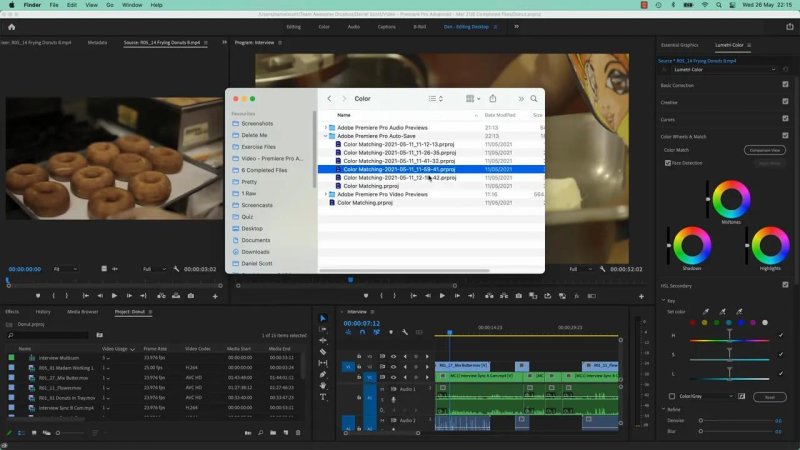
macOS Finder window overlaying the Premiere Pro timeline and color workspace, showing timestamped .prproj backup files within the

Earlier saved project files give you more than one version to try after a crash.

These are separate project files, not just a list of changes. You can open them individually and check which one contains the work you are trying to recover.

You might find a more useful recent version, or an earlier stage of the edit that you wanted to return to anyway. Either way, it is worth checking the saved versions rather than relying entirely on the recovery prompt.

File management may still not be the glamorous part of editing, but finding the right clip, making a clean handover and recovering an edit are all pretty good reasons to give it a little attention.


Key Terms

Project item

An entry in Premiere Pro’s Project panel, such as an imported clip. Removing an entry from the project is different from deleting its source file from your drive.

Project Manager

The tool under the File menu that can collect selected sequences and copy their associated media to a new location. It is useful for packaging projects for backup or handover.

Search bin

A saved metadata search displayed as a bin. It shows matching project items without making duplicate media files.

Metadata

Information associated with media, such as frame rate, codec, dates or camera details. The available information depends on what the source contains and what has been retained.

View preset

A saved Project panel column arrangement that you can return to for a particular task, such as assembly or audio work.

Auto-Save

Saved project versions that you can open separately to look for an earlier or recoverable state of your edit.


FAQs

How can I identify unused clips without leaving them removed?

Make the Project panel active, choose Edit > Remove Unused, then immediately undo. The restored items come back selected, making it easier to identify footage that has not been used.

Does Project Manager move my original media?

No. Collect Files and Copy to New Location creates a collected copy at your chosen destination. Your original files remain in their existing locations.

Why does a frame-rate search return unrelated clips?

A general search for a number such as 25 can match that number anywhere in the searchable metadata. Use a search condition specifically targeting the Frame Rate field for more precise results.

Why is some footage missing from my Project panel?

Check whether a search filter is still active and clear it if necessary. If the items have been hidden, right-click an empty area of the Project panel and enable View Hidden.

Can I open Premiere Pro Auto-Save files directly?

Yes. They are separate project files. Open the saved versions individually and check their contents to find the state of the edit you need.

Daniel Walter Scott

Written by Daniel Walter Scott — Founder of Bring Your Own Laptop & Chief Instructor

  • Powered by Marvin
  • Terms of use
  • Privacy policy
  • Cookie policy
  • © Bring your Own Laptop Ltd 2026