How to export small animated Gif in premiere pro
Questions
Student Gallery
Be the first to share something.
Course info
Overview

Daniel Walter Scott
Founder of Bring Your Own Laptop & Chief Instructor
I discovered the world of design as an art student when I stumbled upon a lab full of green & blue iMac G3’s. My initial curiosity around using the computer to create ‘art’ developed into a full-blown passion, eventually leading me to become a digital designer and founder of Bring Your Own Laptop.
Sharing and teaching are a huge part of who I am. As a certified Adobe instructor, I've had the honor of winning multiple Adobe teaching awards at their annual MAX conference. I see Bring Your Own Laptop as the supportive community I wished for when I was first starting out and intimidated by design. Through teaching, I hope to bring others along for the ride and empower my students to bring their stories, labors of love, and art into the world.
True to my Kiwi roots, I've lived in many places, and currently, I reside in Ireland with my wife and kids.
Certificates
We’re awarding certificates for this course!
Check out the How to earn your certificate video for instructions on how to earn yours and click the available certificate levels below for more information.
Downloads & Exercise files
Transcript
How do I export an animated GIF from Premiere Pro that is small enough for email?
Export the sequence as an Animated GIF, then focus on the two settings that really matter: pixel dimensions and frame rate. For email, start around 540 pixels wide and 10 frames per second, then export a few versions and choose the best balance between file size, motion, and acceptable GIF-quality colour.
How to Export a Small Animated GIF in Premiere Pro
Key takeaways
Animated GIFs have serious colour limitations, so simple designs export best.
Width and frame rate have the biggest impact on GIF file size.
For an email GIF, about 540 pixels wide is a useful starting point.
Use 10 fps as a practical default, but test 5 fps and 25 fps for your particular animation.
Do not trust the Media Encoder preview alone. Export the files and inspect the real results.
Reducing a GIF by 40 pixels can be an easy way to shave off a little extra file size.
GIFs Are Brilliant, Slightly Terrible Little Things
An animated GIF is ideal for a punchy sale graphic, a quick bit of motion in an email, or a small looping social asset. It can feel lively without asking someone to press play. The catch is that GIF is an old format with some very real limitations.
The biggest one is colour. A GIF can use only 256 colours. Your original Premiere Pro sequence may contain millions of colours, gradients, glows, photo detail, and sparkly fireworks. Once it becomes a GIF, all of that has to be squeezed into 256 colours. It is going to look different. Possibly a lot different.
That is not necessarily a disaster. A little jitteriness and reduced smoothness are part of the animated GIF charm. The goal is not to create a pristine video file. The goal is to create something energetic, clear, and small enough to use where it needs to go.
Start with a GIF-Friendly Design
For this example, the design is a Black Friday sale graphic with animated fireworks behind bold text. It is exactly the kind of thing that feels appropriate for a sale, even though fireworks are not particularly kind to the GIF format.
Detailed animation, sparkles, texture, and shifting gradients use up colours quickly. The result can look rough because the GIF has to simplify those subtle variations. If visual quality matters most, build with the format in mind from the start:
Use a plain or mostly solid background.
Choose a small palette of bold, high-contrast colours.
Keep text large and clear.
Avoid delicate gradients and fine photographic detail where possible.
Use motion that still reads well when it becomes a little jumpy.
The nicest animated GIFs are often surprisingly simple. A couple of solid colours, a bold message, and an uncomplicated animation can look much better than a detailed design fighting against the 256-colour limit.
Prepare the Sequence in Premiere Pro
Create or open the sequence you want to animate. For a sale graphic, that might mean a background video or animation, a text layer, and a graphic template from the Essential Graphics panel.
In the Essential Graphics panel, use the Browse tab to locate a suitable template, then customise the copy, colours, and fonts. The exact template is not important. What matters is that the message is readable at a small size, because this is headed for an email layout rather than a giant display.
Once the animation looks right in the Program Monitor, select the sequence and open the Export Settings window:
Mac: press Command + M
Windows: press Control + M
Choose Animated GIF in Export Settings
At the top of the Export Settings window, set Format to Animated GIF. There are no complicated preset decisions to make here. Choose the format, select where the file should be saved, and concentrate on the video settings.
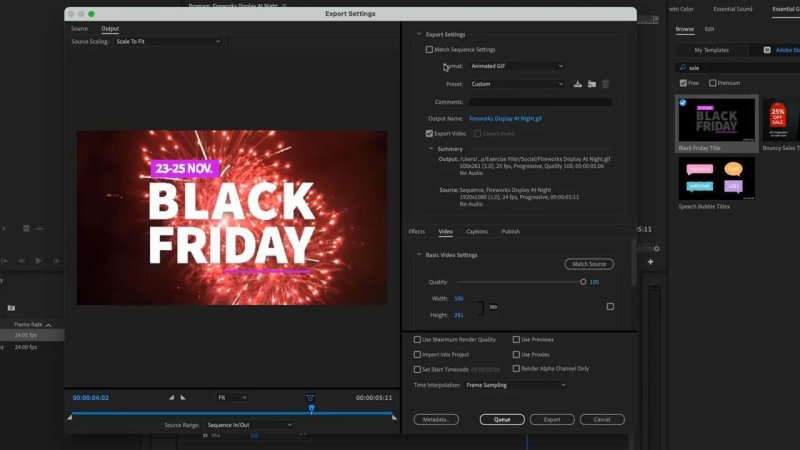
Choose Animated GIF as the export format, then spend your energy on dimensions and frame rate.
For GIF exports, two controls do most of the heavy lifting:
Frame size
Frame rate
Both affect how the GIF looks, but they also affect the file size. That file size matters a lot, especially for email.
Set a Sensible GIF Size for Email
Email platforms often have limits on the total message size. A file size around 10 MB is a common practical ceiling, so the animated GIF needs to fit comfortably within whatever else the email contains.
A width of roughly 540 pixels is a useful starting point for an email graphic. It is large enough to present nicely across common email clients such as Gmail and Outlook, without creating a needlessly huge animation.
As you reduce the dimensions, GIF quality becomes more obvious. That is normal. At 100 percent preview size, the limited colours can look a bit grim, especially with a fireworks background. But do not judge the file too harshly from the export preview. The final rendered GIF is the thing that counts.
Why Fireworks Look Rough in an Animated GIF
A fireworks animation contains lots of glowing particles, colour variations, soft light, and moving detail. That is a lot for a 256-colour format to manage. The GIF encoder has to make compromises, and you will see them.
This does not mean you cannot use fireworks. For a Black Friday graphic, fireworks can still be the right creative choice. It just means you need to be realistic about the outcome. If you need a clean, polished-looking GIF, use fewer colours and a less detailed background.
Think of the available colours as a limited budget. Do not spend all of them on frivolous fireworks if crisp quality is the priority.
Lower the Frame Rate to Reduce the File Size
A normal video frame rate, such as 25 frames per second, is usually overkill for a GIF. It makes the motion smoother, but it also makes the file much larger.
For small animated GIFs, 10 fps is an excellent default. It normally retains enough motion to feel animated while keeping the file size under control. If you want the very short version of this whole process, start at 10 fps.
That said, there is no single magic number. Different animations behave differently. A simple text movement may look fine at 5 fps. Fast particles or a rapid transition may need 10 fps or more. The only sensible way to decide is to compare exported files.
Test several frame rates instead of guessing
Send the GIF to Adobe Media Encoder, then duplicate the queue item so you can create several versions of the same animation. For example, export:
25 fps for the smoothest option
10 fps as the practical middle ground
5 fps for the smallest, deliberately choppy option
In the example, the 25 fps version came in at about 9.4 MB, just under a 10 MB target. Reducing the frame rate to 10 fps and then 5 fps produced a substantial reduction in file size.
The 25 fps version felt more like ordinary video, albeit with reduced colour. The lower-frame-rate versions felt more like proper animated GIFs: a little stunted, a little jittery, but still fun and perfectly usable.
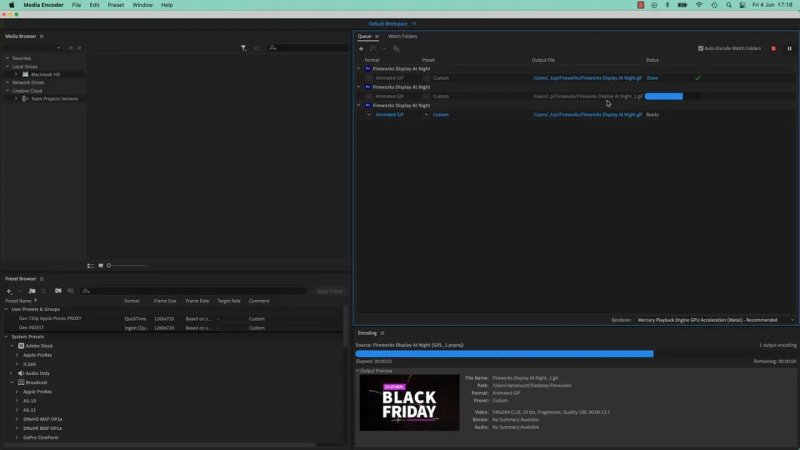
Queue several frame-rate versions together so the trade-off between smoothness and file size is easy to compare.
If a single GIF is going into an email, 10 fps may be the sweet spot. If the email includes several animated GIFs, 5 fps might be a compromise worth making to keep the whole email lightweight.
Do Not Rely on the Media Encoder Preview
The preview inside Media Encoder is not a trustworthy final-quality reference for animated GIFs. It can make the GIF appear worse than the actual rendered output, and changing settings may not visibly update the preview in a useful way.
That applies especially to the quality control. Moving the quality slider may appear to do very little, if anything, to the on-screen preview. In testing, multiple quality settings resulted in GIFs that looked the same and had the same file size.
So do not waste ages trying to interpret that preview window. Export the candidates, open the actual files, and judge the real rendered result. That is the only comparison that matters.
What About the Quality Slider?
You can certainly duplicate a Media Encoder job and experiment with different quality values. There is no harm in testing. But do not expect the slider to solve the main limitations of the GIF format.
A GIF still has 256 colours to work with. In this particular workflow, adjusting quality did not change the exported file size or produce a visible quality difference. Your result may vary, but the settings that consistently make the meaningful difference are still dimensions and frame rate.
Set quality to 100 if you like, then focus on the changes that reliably help.
Need Just a Tiny Bit More File Size Savings?
When an export is only slightly too large, do not immediately wreck the animation by dropping the frame rate dramatically. First, reduce the physical dimensions by a small amount.
For example, changing a GIF from 540 pixels wide to 500 pixels wide can make it a little smaller without creating an obvious difference in an email. Most people will not notice 40 pixels in that context, but the file-size saving may be enough to get under the limit.
Use this order when optimising:
Export at the target email width, around 540 pixels as a starting point.
Test 10 fps before assuming you need a smoother rate.
Check the actual exported file size and appearance.
If needed, shave a small amount off the width.
Only then consider reducing the frame rate further.
Small reductions add up. The goal is to find the smallest adjustment that gives you the file-size breathing room you need while keeping the animation enjoyable.
A Practical Animated GIF Export Workflow
Here is the full process in one tidy checklist:
Create a clear, bold animation in Premiere Pro.
Use a limited colour palette if you want the GIF to look its best.
Select the sequence and press Command + M on Mac or Control + M on Windows.
Set the format to Animated GIF.
Choose the output folder and filename.
Set a suitable email width, such as 540 pixels.
Start with 10 fps.
Send the job to Media Encoder.
Duplicate it and test alternatives, such as 5 fps and 25 fps.
Export all versions.
Compare the actual GIFs, their file sizes, and how the motion feels.
Reduce dimensions slightly if you need to squeeze out a little more file size.
The best export is not automatically the smoothest or the sharpest. It is the one that communicates the message clearly, feels good enough in motion, and fits the delivery requirements without causing trouble.
Key Terms
Animated GIF
A looping image format made from multiple frames. It is widely supported in email and on the web, but it is limited to 256 colours.
Frame rate
The number of animation frames shown each second. Higher frame rates look smoother but create larger GIF files.
Frame size
The pixel dimensions of the GIF, such as 540 pixels wide. Lower dimensions generally reduce file size and are often appropriate for email.
Adobe Media Encoder
Adobe's export queue application. It is useful for creating multiple versions of the same GIF and comparing settings without repeatedly setting up exports from scratch.
FAQs
What frame rate should I use for an animated GIF in Premiere Pro?
Start with 10 fps. It is a strong general-purpose setting for small GIFs because it keeps motion readable while reducing file size substantially compared with 25 fps.
Why does my Premiere Pro GIF look worse than my original video?
GIFs are limited to 256 colours, while video can display millions. Detailed footage, gradients, glows, and fireworks are therefore simplified during export.
What GIF size should I use for email?
About 540 pixels wide is a useful starting point for an email GIF. If the file is just too large, reducing the width to around 500 pixels can provide extra savings with little noticeable difference.
Does the quality slider reduce animated GIF file size in Media Encoder?
It may be worth testing, but it did not make a visible or file-size difference in this workflow. Dimensions and frame rate are the controls that have the clearest effect.
Should I trust the GIF preview in Adobe Media Encoder?
No. The preview is not a reliable indicator of the final GIF appearance. Export your test versions and inspect the real files before deciding which settings to use.
Written by Daniel Walter Scott — Founder of Bring Your Own Laptop & Chief Instructor
