How to use match frame to find original footage in Premiere Pro
Questions


Student Gallery
Be the first to share something.
Course info
Overview

Daniel Walter Scott
Founder of Bring Your Own Laptop & Chief Instructor
I discovered the world of design as an art student when I stumbled upon a lab full of green & blue iMac G3’s. My initial curiosity around using the computer to create ‘art’ developed into a full-blown passion, eventually leading me to become a digital designer and founder of Bring Your Own Laptop.
Sharing and teaching are a huge part of who I am. As a certified Adobe instructor, I've had the honor of winning multiple Adobe teaching awards at their annual MAX conference. I see Bring Your Own Laptop as the supportive community I wished for when I was first starting out and intimidated by design. Through teaching, I hope to bring others along for the ride and empower my students to bring their stories, labors of love, and art into the world.
True to my Kiwi roots, I've lived in many places, and currently, I reside in Ireland with my wife and kids.
Certificates
We’re awarding certificates for this course!
Check out the How to earn your certificate video for instructions on how to earn yours and click the available certificate levels below for more information.
Downloads & Exercise files
Transcript
How do I find where a timeline clip came from in Premiere Pro?
Put the playhead over the clip in your timeline and press F. Premiere Pro’s Match Frame command jumps to the matching moment in the original source footage, which is brilliant when a long interview has been chopped into dozens of little edits.
How to Use Match Frame and Reverse Match Frame in Premiere Pro
Key takeaways
Use F to locate the original source footage behind a timeline edit.
Match Frame follows the playhead position, not the clip you have selected.
Track targeting determines which clip Premiere Pro matches when clips overlap.
Avoid double-clicking timeline clips when you only need to locate their source.
Use Reveal in Project to find a clip inside a chaotic Project panel.
Use Shift+R for Reverse Match Frame, but know its limitations for B-roll.
What Match Frame Does in Premiere Pro
Match Frame is one of those little Premiere Pro shortcuts that becomes ridiculously useful once you are editing longer projects. Imagine a long interview that has been cut into lots of short pieces across a timeline. At some point, you will look at one of those pieces and wonder where it lives in the original recording.
That is exactly what Match Frame is for. Put the current-time indicator, also called the playhead, directly over the clip you want to investigate and press F. Premiere Pro opens the original source clip in the Source Monitor at the precise corresponding frame.
Zoom out in the Source Monitor and you can immediately see the bigger picture. That tiny timeline clip may be sitting somewhere inside a much longer interview, which makes it much easier to find surrounding material and make better editorial decisions.
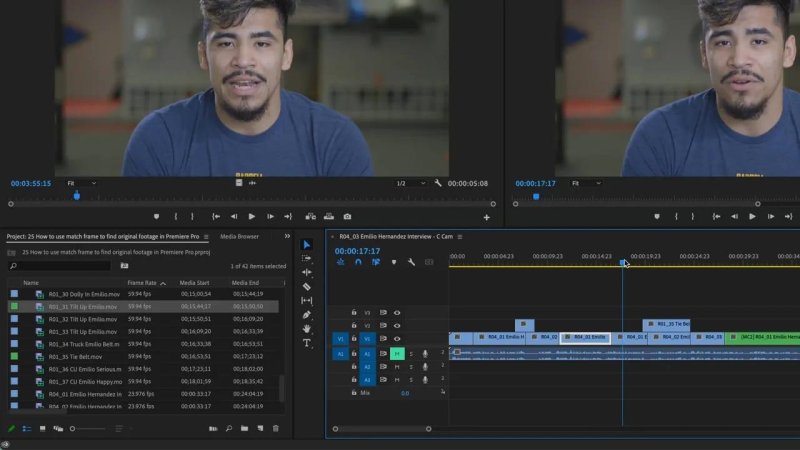
Match Frame connects a small timeline edit back to its place in the original source clip.
How to Use the F Key for Match Frame
Move the playhead over the frame in the timeline that you want to trace back.
Press F.
Premiere Pro loads the source footage in the Source Monitor at that matching frame.
Zoom out if needed to see where that moment sits within the full original recording.
You do not need to select the timeline clip first. In fact, that is an important thing to remember: Match Frame is based on where the playhead is, not on which clip happens to be selected.
Use it as often as you like. Move to another chopped-up section of the interview, hit F, and Premiere Pro takes you to that part of the original footage. It is a quick way to rebuild your mental map of a heavily edited sequence.
Track Targeting Can Change the Match Frame Result
There is one catch. Match Frame pays attention to track targeting. If you have clips stacked on multiple video tracks at the playhead position, Premiere Pro matches the clip on the targeted track.
So if you press F and Premiere Pro seems to grab the clip underneath the one you expected, check the track-targeting buttons on the left side of the timeline. Turn off the target for the unwanted track, target the track you actually need, then press F again.
This is especially relevant in edits with B-roll, adjustment layers, graphics, or multiple camera angles piled on top of one another. The command is doing what the track targeting tells it to do, even if that is not what you meant at first.
Why Double-Clicking a Timeline Clip Is Different
You might think double-clicking a timeline clip does the same thing as Match Frame. It looks similar at first, because something opens in the Source Monitor. But the difference matters.
When you double-click a clip in the timeline, Premiere Pro opens that timeline instance of the clip. It is the already-trimmed section you placed in the sequence, not the complete original source clip.
That means if you adjust the In and Out points in the Source Monitor after double-clicking, you are changing that timeline instance. You can accidentally alter the edit when all you really wanted was to find the original footage.
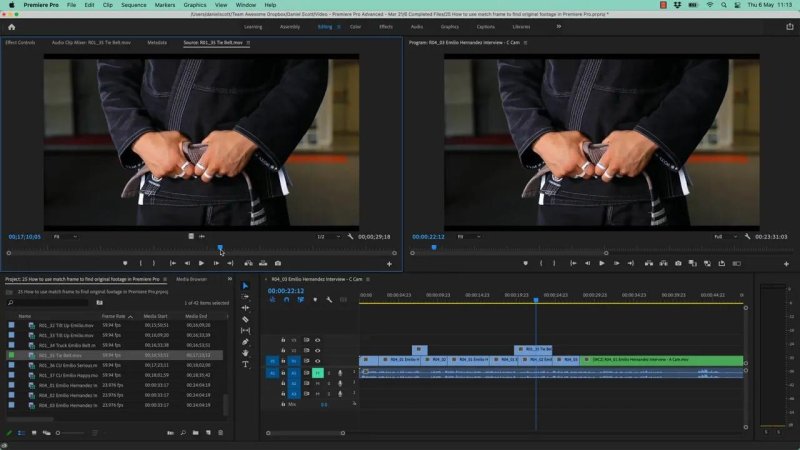
The Source Monitor can look similar in both cases, but Match Frame protects the timeline edit while you inspect the original footage.
Use Match Frame Instead of Double-Clicking
The safer editing habit is simple: do your actual editing in the timeline, and use F when you need to inspect the original source.
Match Frame still shows the location of the existing edit, so you can see what part of the footage is currently being used. But you can also search around the source clip for a better start, a better end, or another useful moment without directly changing the clip already in the sequence.
That distinction can be a little confusing at first, but it saves a lot of accidental trimming later. Basically, do not double-click stuff unless you genuinely want to open and modify that specific timeline instance.
How to Find the Original Clip in the Project Panel
Sometimes finding the source timecode is not enough. You may want to know where the original media file is in the Project panel, especially when the project bins have turned into one giant pile of clips. No judgement. It happens.
For that, use Reveal in Project:
Select the clip in the timeline.
Right-click it.
Choose Reveal in Project.
Premiere Pro highlights the original project item in the Project panel.
From there, you can see the bin where it lives, move it to a more sensible place if needed, or double-click the project item to load the original clip into the Source Monitor.
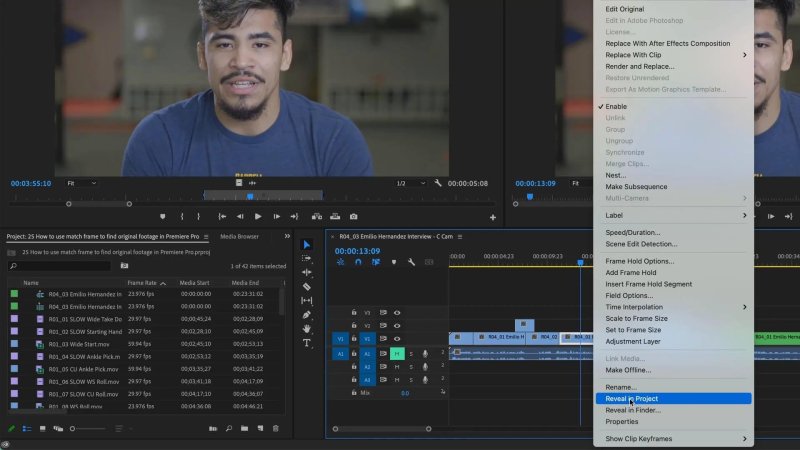
What Reverse Match Frame Does
Reverse Match Frame goes the other direction. Instead of starting with a timeline clip and finding its source footage, you start with a source clip and ask whether that moment has been used in the timeline.
Open the source footage, position the current-time indicator over the moment you are checking, then press Shift+R. If that source frame has been used, Premiere Pro jumps to its location in the timeline.
That can be useful when you have found a nice piece of B-roll and cannot remember whether it already appears in the edit. For example, if you have lots of familiar shots such as somebody typing at a computer or pointing over someone’s shoulder, Reverse Match Frame can help confirm whether you used a specific moment.
Why Reverse Match Frame Can Be Frustrating for B-Roll
Reverse Match Frame is not terrible, but it is not the most elegant tool for checking B-roll usage. The main issue is that you need to have the correct timeline open, and you need to land on a frame that was actually used.
If the footage has been used in several small sections, or if you are not sure which exact part made it into the edit, you can end up repeatedly trying Shift+R on different frames. Shift+R, Shift+R, Shift+R, and eventually you find it. Maybe.
It works best when the source clip contains a clear, distinct moment and you have a fairly good idea where that moment may appear in the sequence. It is less useful for longer B-roll clips with several possible cut points, zooms, or repeated actions.
Match Frame Is the Real Everyday Shortcut
Reverse Match Frame may have a use case in your workflow, particularly for checking whether a specific source frame made it into an edit. But Match Frame is the clear winner for everyday timeline work.
Whenever you need to know where a timeline moment came from, place the playhead over it and press F. It is fast, precise, and perfect for navigating a long interview that has been cut into lots of little sections.
Key Terms
Match Frame
A Premiere Pro command that opens the original source footage at the same frame currently under the timeline playhead. Its default shortcut is F.
Reverse Match Frame
A command that searches the active sequence for the source frame under the Source Monitor playhead. Its default shortcut is Shift+R.
Current-Time Indicator
The current-time indicator, often called the playhead, marks the exact frame position currently being inspected in a timeline or monitor.
Track Targeting
Track targeting tells Premiere Pro which timeline tracks should receive or respond to certain editing commands. It affects which overlapping clip Match Frame finds.
Source Monitor
The Source Monitor is where Premiere Pro displays original clips for previewing and selecting footage before or while editing.
FAQs
What is the shortcut for Match Frame in Premiere Pro?
The default shortcut for Match Frame is F. Put the playhead over a timeline clip and press F to open its original source footage at the matching frame.
Why does Match Frame select the wrong clip?
Match Frame follows track targeting when clips overlap at the playhead. Check the targeted video tracks on the left side of the timeline and enable the track containing the clip you want to match.
Does Match Frame use the selected clip?
No. Match Frame uses the position of the current-time indicator, not the clip selection. Place the playhead over the correct clip frame before pressing F.
What is the Reverse Match Frame shortcut in Premiere Pro?
The default shortcut for Reverse Match Frame is Shift+R. It takes a frame from a source clip and tries to locate its use in the active timeline.
How can I find a timeline clip in the Project panel?
Select the timeline clip, right-click it, and choose Reveal in Project. Premiere Pro highlights the original project item so you can identify its bin and source media.
Written by Daniel Walter Scott — Founder of Bring Your Own Laptop & Chief Instructor
