How to import & style captions subtitles SRT in Premiere Pro
Questions
Student Gallery
Be the first to share something.
Course info
Overview

Daniel Walter Scott
Founder of Bring Your Own Laptop & Chief Instructor
I discovered the world of design as an art student when I stumbled upon a lab full of green & blue iMac G3’s. My initial curiosity around using the computer to create ‘art’ developed into a full-blown passion, eventually leading me to become a digital designer and founder of Bring Your Own Laptop.
Sharing and teaching are a huge part of who I am. As a certified Adobe instructor, I've had the honor of winning multiple Adobe teaching awards at their annual MAX conference. I see Bring Your Own Laptop as the supportive community I wished for when I was first starting out and intimidated by design. Through teaching, I hope to bring others along for the ride and empower my students to bring their stories, labors of love, and art into the world.
True to my Kiwi roots, I've lived in many places, and currently, I reside in Ireland with my wife and kids.
Certificates
We’re awarding certificates for this course!
Check out the How to earn your certificate video for instructions on how to earn yours and click the available certificate levels below for more information.
Downloads & Exercise files
Download Files
Please confirm you would like to download this file, some files can be large. You maybe want to consider downloading on wifi rather than mobile data.
Large file sizes may also take a while to download depending on your internet speed.
Name:
Size:
Download Files
Please confirm you would like to download this file, some files can be large. You maybe want to consider downloading on wifi rather than mobile data.
Large file sizes may also take a while to download depending on your internet speed.
Name:
Size:
Can you import an SRT subtitle file into Premiere Pro?
Yes. Premiere Pro can import an SRT file created by a subtitler, captioning service, or automatic transcription tool, then place the timed captions on a caption track. You can also add a second subtitle track for another language and apply a font and track style that supports its writing system.
How to Import and Style SRT Subtitles in Adobe Premiere Pro
Key takeaways
Import an SRT through the Captions workspace rather than typing every caption manually.
Keep the default import settings unless you already have a caption style ready to use.
Add separate subtitle tracks when your project needs more than one language.
Only one subtitle track can be enabled for display at a time in this workflow.
Choose a font that supports the language and script in the imported captions.
Create a track style so formatting applies consistently across the entire subtitle track.
Start with your video and SRT files
An SRT file is one of the most common subtitle formats. It contains the subtitle text along with the exact timings for each caption, so Premiere Pro knows what should appear and when.
This is ideal when captions have already been prepared by a subtitle professional, supplied by a captioning service, or generated elsewhere. Rather than recreating every line manually, you can bring that timed subtitle work directly into your edit.
First, import your video into Premiere Pro and make sure it is in a sequence. Then switch to the Captions workspace if you are not already there. This puts the captioning tools and caption list where you need them.
Import an English SRT subtitle file
In the Captions workspace, choose Import captions from file, then locate and select the English SRT file.
Premiere Pro will show import options. In most cases, the defaults are exactly what you need. The one setting worth changing is the style option, but only if you have already created a caption style you want to use. Otherwise, import the file with the standard settings and adjust the look afterwards.
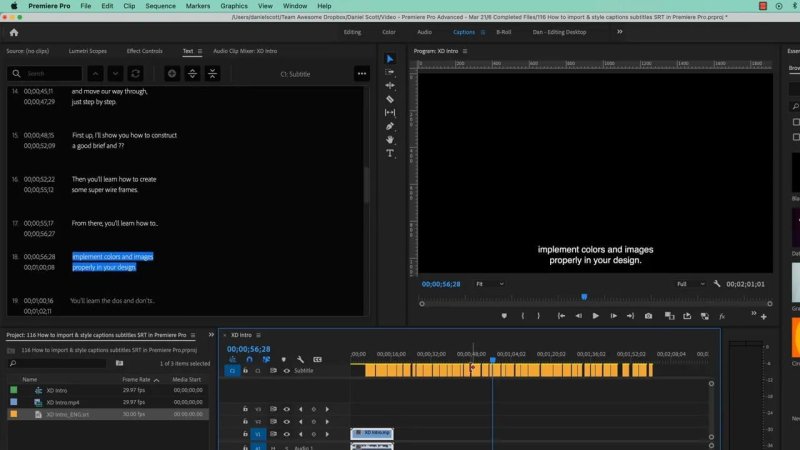
Once the SRT is imported, its timed captions appear as a complete caption track in the sequence.
After importing, the caption segments appear across the timeline and the caption text is available in the captions panel. Play through a few sections of the sequence to check that the words appear at the right moments.
That quick check matters. The timings may be beautifully prepared, but they still need to match the specific version of the edit sitting in your sequence. If the video was trimmed after the SRT was created, the captions can end up out of sync.
Add a second subtitle language
Multiple languages need separate subtitle tracks. Importing the first SRT through the caption import command is straightforward, but bringing in another language can feel a little less obvious depending on the Premiere Pro version.
For the second file, import the other SRT into the project, then add a new subtitle track in the timeline:
Find the subtitle track area in the timeline.
Right-click it.
Choose the option to add another subtitle track.
Leave the standard settings unless your delivery requires something different.
Drag the second language subtitle item onto the new subtitle track.
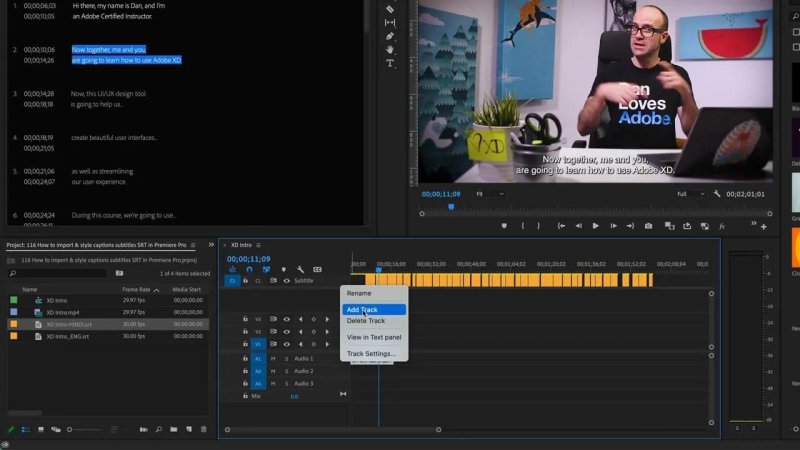
Create a separate subtitle track before placing the SRT for the additional language.
Line up the second language captions with the first track so their timing matches. If both SRT files were generated from the same source video, they should align well. Still, check a few points in the edit rather than assuming everything is perfect.
Toggle between subtitle tracks
You can have two subtitle tracks in the project, but only one can be switched on for display at a time. Use the visibility control on the subtitle tracks to toggle between them.
That is useful when you are checking English, Hindi, or any other language one at a time. It also keeps the programme monitor readable while you review the caption timing and styling.
Use a font that supports the subtitle language
Importing a foreign-language SRT is only half the job. The text also has to display correctly.
A default font such as Helvetica may not contain the characters required by the language you are using. The caption text can be correct in the captions panel while appearing incorrectly in the programme monitor simply because the selected font does not support that script.
Select a font that includes the right character set. Your computer may already have a suitable font installed, so try the available font list first. For Hindi captions, you need a font that supports the Devanagari script.
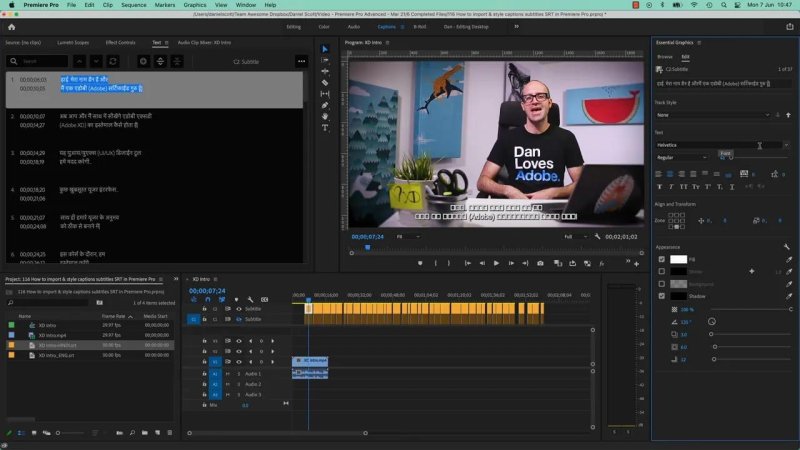
A subtitle font must support the characters in the language, not merely match the visual style you want.
If you do not have a suitable font, choose Add Adobe Fonts. This opens Adobe Fonts, where you can filter typefaces by language and writing system.
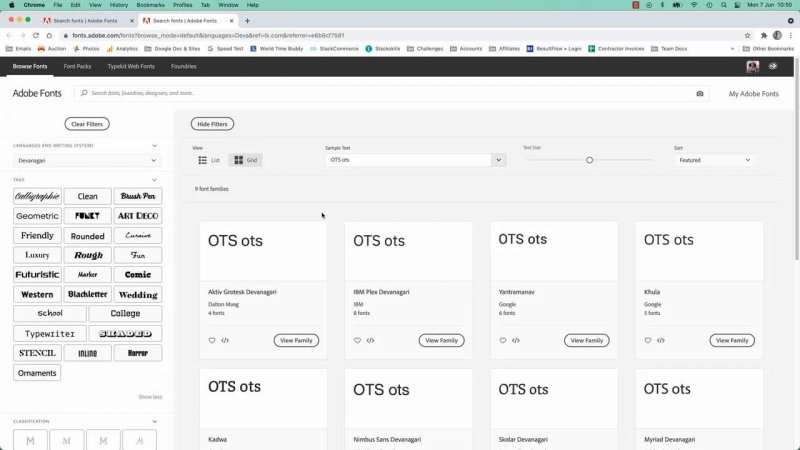
Filter Adobe Fonts by writing system to find typefaces designed for the script in your subtitles.
Find the language or writing system you need, activate an appropriate font, and give it a moment to load into Premiere Pro. Then return to the caption styling controls and apply that font to the subtitle track.
For Hindi, a Devanagari-capable font is essential. However, if you do not read the language yourself, do not treat correct-looking characters as proof that everything is accurate. Get the captions checked by someone who understands the language before delivery.
Create a track style for consistent subtitles
Once the second language is displaying properly, format one caption exactly how you want it to look. Choose the font, weight, size, and background treatment that work for the final destination.
Size is especially important when subtitles will be burned into a video for social media. Captions that look reasonable in the editing interface may be too small on a phone, so make them large enough to be comfortably read.
When the first caption looks right, go to Track Style and choose Create New Style. Premiere Pro can apply that style across the entire subtitle track, saving you from formatting captions one by one.
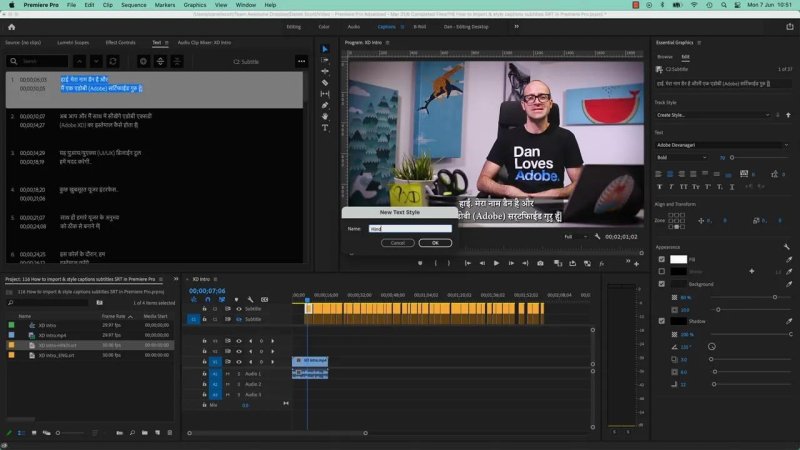
A track style applies the chosen subtitle formatting across the full language track instead of caption by caption.
This is the cleanest way to keep every caption consistent. Build the look once, then let the track style carry it across all the subtitles on that track.
A practical checklist before moving on
Confirm the imported SRT captions align with the edited video.
Make sure each language has its own subtitle track.
Enable one track at a time when reviewing language versions.
Check that every character displays properly in the programme monitor.
Use a font designed for the relevant language or writing system.
Apply a track style to keep font, size, and background settings consistent.
Have a fluent speaker verify any language you cannot personally review.
Key Terms
SRT file
A standard subtitle file format containing caption text and timing information. It allows timed captions to be imported without manually creating each subtitle.
Caption track
A dedicated timeline track that holds timed captions or subtitles. Separate tracks make it possible to organise different languages independently.
Devanagari
A writing system used for Hindi and other languages. Captions written in Devanagari require a font with support for those characters.
Track style
A reusable set of caption formatting choices, such as font, size, and background. Applying it at track level keeps every subtitle visually consistent.
FAQs
What file format should I use to import subtitles into Premiere Pro?
SRT is a commonly used subtitle format for importing timed captions into Premiere Pro. It can be supplied by a subtitler, a captioning service, or an automatic captioning tool.
Can I add English and Hindi subtitles to the same Premiere Pro project?
Yes. Create a separate subtitle track for each language, then place the relevant SRT captions on its own track. Toggle track visibility to review one language at a time.
Why are my Hindi subtitles not displaying correctly?
The selected font may not support Devanagari characters. Choose an installed font that supports the script or activate a suitable typeface through Adobe Fonts.
How do I apply the same subtitle formatting to every caption?
Format a caption with the font, size, and background you want, then create a new Track Style. This applies the styling consistently across the subtitle track.
Written by Daniel Walter Scott — Founder of Bring Your Own Laptop & Chief Instructor
