How to remove Echo in video in Premiere Pro
Questions

Student Gallery
Be the first to share something.
Course info
Overview

Daniel Walter Scott
Founder of Bring Your Own Laptop & Chief Instructor
I discovered the world of design as an art student when I stumbled upon a lab full of green & blue iMac G3’s. My initial curiosity around using the computer to create ‘art’ developed into a full-blown passion, eventually leading me to become a digital designer and founder of Bring Your Own Laptop.
Sharing and teaching are a huge part of who I am. As a certified Adobe instructor, I've had the honor of winning multiple Adobe teaching awards at their annual MAX conference. I see Bring Your Own Laptop as the supportive community I wished for when I was first starting out and intimidated by design. Through teaching, I hope to bring others along for the ride and empower my students to bring their stories, labors of love, and art into the world.
True to my Kiwi roots, I've lived in many places, and currently, I reside in Ireland with my wife and kids.
Certificates
We’re awarding certificates for this course!
Check out the How to earn your certificate video for instructions on how to earn yours and click the available certificate levels below for more information.
Downloads & Exercise files
Transcript
How do you remove echo from audio in Premiere Pro?
Select your audio clip, tag it as Dialogue in the Essential Sound panel, then enable Reduce Reverb under Repair. Adjust the amount while listening to a short loop of speech, backing off if the voice sounds overprocessed. For recordings with background noise or hum, balance reverb reduction with gentle noise reduction and dehumming.
How to Remove Echo from Video in Premiere Pro
Key takeaways
Use Reduce Reverb to tackle the roomy sound commonly called echo.
Loop a short passage of dialogue so you can judge each adjustment consistently.
Avoid accidental keyframes when changing effect settings during playback.
Balance reverb, noise and hum reduction rather than pushing one effect to maximum.
Check that your repair effects are enabled before exporting.
I recorded an introduction in my kitchen, and the audio was wonderfully echoey. Lovely setting for an intro. Not such a lovely setting for recording speech.
Premiere Pro can remove a surprising amount of that room sound. You can also overcook the repair quite easily, which I managed to do a little myself. The trick is not simply getting rid of as much sound as possible. It is getting the recording cleaner without making your voice sound worse.
First, call it reverb
Most of us describe a recording like this as having echo. For this kind of lingering room sound, though, the term you need in Premiere Pro is reverb. That matters when you are trying to find the right control.
My kitchen recording is a good example of why the recording location matters. Hard surfaces make for a reverberant space, so even an introduction that looks great can sound pretty bad. If you can avoid recording dialogue in your kitchen, do. Fixing it afterwards is useful, but it has limits.
With a badly affected recording, you may still hear a hint of reverb after processing. In my experience, getting rid of every last trace can be pretty much impossible. Aim for a useful improvement, not a miracle.
1. Set up a short dialogue loop
Before touching any effects, give yourself a repeatable bit of audio to work with. Listening to the same sentence makes it much easier to hear whether an adjustment is helping.
Import the recording. For my example, I use a file called Echo from the sound folder.
Create a new sequence from the clip. This gives you a straightforward timeline for testing the repair.
Zoom in on the audio. I use Option and the plus key to get a closer look at the waveform.
Set an In point and an Out point. Use the I and O keys around a short section of speech.
Enable Loop Playback. Repeat that passage while assessing your changes.
The example sentence is an introduction to choosing fonts. The subject does not matter here. What matters is that it is actual dialogue, with enough speech to hear the room sound around the voice.
Judge reverb reduction on speech, not on an empty pause. You need to hear how the effect changes both the room sound and the voice you want to keep.
2. Apply Reduce Reverb in Essential Sound
Select the audio clip, open the Essential Sound panel and assign it the Dialogue audio type. Under Repair, enable Reduce Reverb.
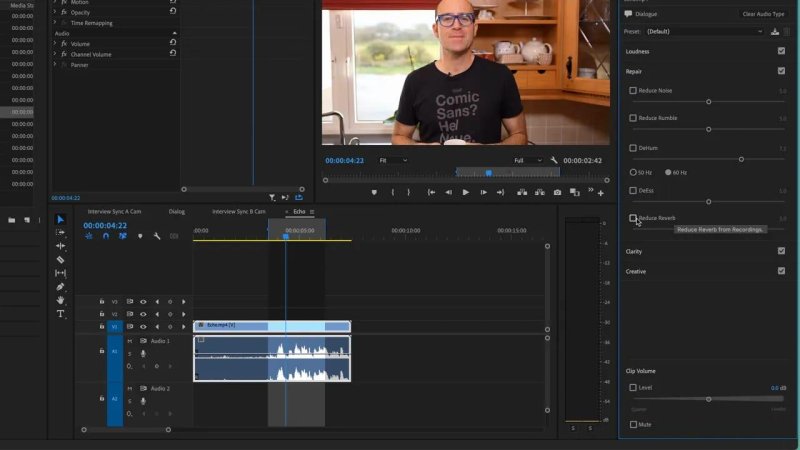
Reduce Reverb sits alongside the other dialogue repair controls.
The main adjustment is simple: move the amount slider and listen. There is not a complicated set of decisions to make at this stage.
Try a high amount briefly so you can hear how much room sound the effect can remove. It is pretty impressive. It may also sound far too processed, so do not mistake the strongest setting for the best setting.
Find the amount by ear
I like starting at the high end and gradually lowering the amount until the repair feels less obvious while the reverb is still sufficiently reduced.
You can approach it from the other direction too: increase the processing until you notice it doing too much, then come back a little. Either way, you are listening for a balance between less room sound and a believable voice.
Does the sentence sound less roomy?
Does the voice still sound natural?
Is a stronger setting genuinely better, or just more heavily processed?
Keep comparing the effect on and off. A setting can seem excellent on its own, then sound a bit much when you compare it with the original.
3. Be careful with accidental keyframes
Adjusting the amount during playback is handy because you can hear the change immediately. There is a catch, though: if animation is enabled for the parameter, your adjustments can create keyframes.
Instead of choosing one consistent amount, you end up recording the slider movements over time. On the next playback, the amount rises and falls as Premiere follows those keyframes. That is a pain when all you wanted was to find a good setting.
If you notice the amount changing by itself:
Inspect the effect in Effect Controls.
Check whether the Amount parameter has keyframes.
Turn off animation for that parameter and remove the unwanted keyframes, confirming their deletion if prompted.
Set a fixed amount and listen to the loop again.
Once those accidental changes are cleared, you can get back to judging the repair rather than wondering why your settings keep moving.
4. Use DeReverb directly if you prefer
Essential Sound is a convenient route, especially when you are combining several dialogue repairs. If you already know that you only need reverb reduction, you can go straight to the effect.
Open the Effects panel.
Search for DeReverb.
Drag the effect onto your audio clip.
Open its controls in Effect Controls and choose Edit to access the effect window.
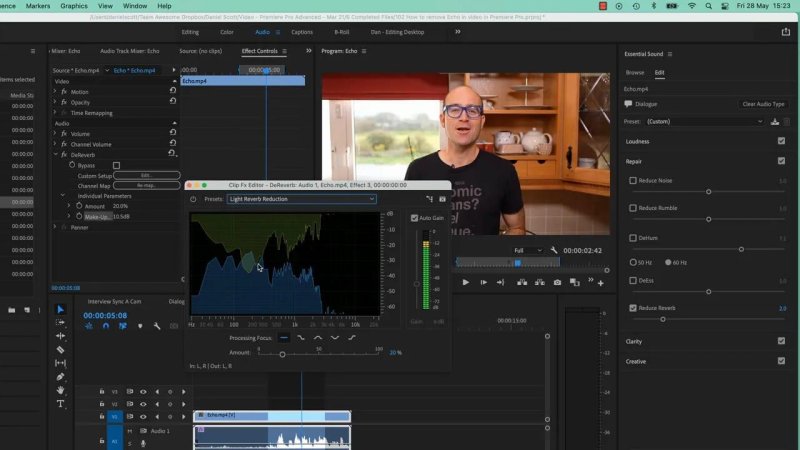
The direct DeReverb window gives you another route to adjusting the repair.
This is not a different magic fix. It is the same underlying reverb-reduction approach accessed directly rather than through the Dialogue repair controls.
For this task, the main adjustment is still the amount. The presets provide quick starting points, but you still need to listen and decide how much processing suits your recording.
5. Listen to the background noise separately
Real recordings rarely arrive with just one problem. My lapel microphone captured the speech reasonably well, but the kitchen recording also had background noise and hum.
To assess those, clear the dialogue In and Out points and find a quiet section before the speech begins. This is where a little pre-roll becomes useful: a few moments when you are not saying anything can reveal the background sound clearly.
Choose that section carefully. In my recording, some of the pauses include drinking and mouth noises. Those are not a clean example of the room noise, so I look for a passage without those distractions and loop it instead.
This gives you two useful listening checks:
A speech loop for judging reverb reduction and the naturalness of the voice.
A quiet loop for hearing the noise floor and any persistent hum.
6. Balance Reduce Noise and DeHum with the reverb repair
Do not flatten the background at the expense of speech
Turn on Reduce Noise and push it hard on a quiet section, and the background can become impressively flat. Job done? Not quite.
The same amount of denoising also affects the dialogue. In my example, heavy noise reduction makes my voice sound a little robotic. A beautifully quiet pause is not much use if the next sentence sounds unnatural.
Bring the noise reduction back down and replay the speech. Keep the reverb reduction at a sensible level, then find a noise setting that cleans things up without damaging the voice too much.
Use DeHum for the more specific problem
There is also a hum in my kitchen recording. I am in Ireland, so 50 Hz is the likely setting to test in this case. That is a choice based on where this particular recording was made, not a setting to copy blindly for every file.
Loop the quiet section and switch DeHum on and off. Listen for whether it is removing the sound you are trying to fix, then check the dialogue again.
The distinction is useful: a dehummer targets particular parts of the frequency range, whereas a denoiser works more broadly. Strong denoising can interfere with quite a lot of the voice. A more targeted hum repair may let you tackle that specific problem without asking the denoiser to do everything.
A little of each repair can work better than a lot of one. This is the balancing act:
Reduce the reverb until the speech sounds less roomy.
Add enough noise reduction to improve the background.
Use DeHum if there is a persistent hum that it can address.
Compare each effect on and off.
Return to the dialogue and back off anything that makes the voice sound unnatural.
There is no single amount that works for every situation. Keep moving between the quiet section and the speech until the whole recording sounds better, not just the gaps.
7. Check your effects before exporting
Here is the slightly embarrassing final lesson. This kitchen introduction was recorded for my Bring Your Own Laptop Show, a lighter, less software-focused series of short educational pieces. The published version still had the reverb in it.
Why? I had spent time fixing the audio, comparing the repair on and off, and then left the effect switched off when I rendered.
It happens easily in a longer edit with lots of small changes, particularly when you are doing the recording and editing yourself. You make the repair, check the original, get distracted by something else, and export the wrong state.
Before rendering, make one final pass:
Confirm that the repair effects you intend to use are enabled.
Listen to the dialogue with the final settings.
Check that the amount is not changing because of unwanted keyframes.
Once that version was published on YouTube, I could not replace the uploaded video file. All that audio repair work had not made it into the finished release.
Premiere Pro can do a surprisingly good job of reducing reverb. Just keep the processing gentle enough to preserve your voice, and make sure the fix is actually switched on when you export.
Key terms
Reverb
The lingering room sound around speech that is often casually called echo. In Premiere Pro, Reduce Reverb and DeReverb are the controls used to reduce it.
Noise floor
The underlying background noise you can hear even when nobody is speaking. A quiet section of the recording helps you assess it.
DeHum
A repair tool that targets hum at specific frequencies. It is more focused than broad noise reduction.
Keyframes
Points that make an effect parameter change over time. Unwanted keyframes can cause your repair amount to rise and fall during playback.
Pre-roll
The recorded material before the intended speech begins. If it contains a quiet passage, it can help you hear the background noise separately.
FAQs
Can Premiere Pro remove all the echo from a recording?
It can reduce a surprising amount of reverb, but a badly affected recording may retain some room sound. Pushing the repair harder is not always worthwhile if it makes the voice sound overprocessed.
Why does my voice sound robotic after noise reduction?
The noise reduction may be too strong. Lower the amount and assess it on actual speech, then use targeted repairs such as DeHum where appropriate instead of relying entirely on denoising.
Why does the DeReverb amount change during playback?
You may have created keyframes while adjusting the control with animation enabled. Check Effect Controls, turn off animation for the parameter and remove unwanted keyframes before setting a fixed amount.
Should I use Essential Sound or apply DeReverb directly?
Both routes provide the same underlying reverb repair. Essential Sound is convenient for combining dialogue repairs, while applying DeReverb from the Effects panel is a direct option when that is all you need.
Written by Daniel Walter Scott — Founder of Bring Your Own Laptop & Chief Instructor
