Adding lots of images at once to a timeline in Premiere Pro
Questions

Oops! You need to be a member to join in.
Feel free to browse but if you'd like to jump into the conversation you'll need to join our awesome student community.
Explore 30+ Essential and Advanced courses in Figma, Photoshop, Illustrator, Lightroom, Premiere Pro, Webflow, and more. Enjoy self paced learning, personalized support, earn certificates, and exciting community challenges.
Student Gallery
Be the first to share something.
Course info
Overview
I am here to help you learn Adobe Premiere Pro and to show you the tools you need to become a successful video editor. Premiere Pro is the industry standard used by professional designers to create stunning, high class videos and, after completing this course, you too can become a confident, skillful and efficient creator of stunning videos.
This course is aimed at people who are completely new to Premiere Pro.
If you are self taught using Premiere, this course will show you techniques you never dreamed were necessary or possible and will show you efficiencies to help speed up your workflow.
The course covers many topics - all of them on a step-by-step basis. We will use real world video editing examples to work through:
- An interview
- A wedding video
- A short commercial
- A documentary
- Social media advertising videos
- YouTube ‘how to’ videos
- Talking head footage mixed with screencasts and voiceovers
We will work with text, animation, motion gfx, special effects and we will add music to our video.
We will learn how to do colour correction, colour balancing and also how to create amazing video transitions within our movie. Technical ‘guru’ topics such as HD v 4K, frames per second, exporting work, fixing up bad audio, balancing and synching audio will all become manageable tasks for you. Best of all...I will show you amazing shortcuts and techniques to speed up your workflow.
Throughout the course we will work on mini projects and I will be suggesting assignments which will add value to your portfolio.
Start your Premiere Pro training now and fast track your career as a video editor.
* Please note, you have full permission to transform and upload any work using footage of Daniel as a part of this course.

Daniel Walter Scott
Founder of Bring Your Own Laptop & Chief Instructor
I discovered the world of design as an art student when I stumbled upon a lab full of green & blue iMac G3’s. My initial curiosity around using the computer to create ‘art’ developed into a full-blown passion, eventually leading me to become a digital designer and founder of Bring Your Own Laptop.
Sharing and teaching are a huge part of who I am. As a certified Adobe instructor, I've had the honor of winning multiple Adobe teaching awards at their annual MAX conference. I see Bring Your Own Laptop as the supportive community I wished for when I was first starting out and intimidated by design. Through teaching, I hope to bring others along for the ride and empower my students to bring their stories, labors of love, and art into the world.
True to my Kiwi roots, I've lived in many places, and currently, I reside in Ireland with my wife and kids.
Certificates
We’re awarding certificates for this course!
Check out the How to earn your certificate video for instructions on how to earn yours and click the available certificate levels below for more information.
Downloads & Exercise files
Download Files
Please confirm you would like to download this file, some files can be large. You maybe want to consider downloading on wifi rather than mobile data.
Large file sizes may also take a while to download depending on your internet speed.
Name:
Size:
Download Files
Please confirm you would like to download this file, some files can be large. You maybe want to consider downloading on wifi rather than mobile data.
Large file sizes may also take a while to download depending on your internet speed.
Name:
Size:
How do I put multiple images into a Premiere Pro timeline in the correct order?
You can select all the images in the Project panel and drag them straight onto the timeline, but the order depends on both the panel sort order and the order in which you make your selection. Sort by Name, then select from the first image to the last for a reliable alphabetical sequence.
How to Add Lots of Images to a Premiere Pro Timeline in the Right Order
When you are building a big image slideshow, start by creating a sequence that matches the project settings you are working with. In the Project panel, click New Item, choose Sequence, and select an appropriate preset.
For example, a DSLR 1080p sequence at 25 frames per second is a perfectly sensible starting point for a travel slideshow. Give the sequence a useful name that makes it easy to find later.
If you are exploring several creative directions for a client, name those versions clearly as you work. I tend to use names such as:
Option A, V1 for a first version of one creative direction
Option A, V2 for the next iteration of that direction
Option B for a genuinely different idea
The exact naming convention is not the important bit. The important bit is knowing whether you are making a minor revision or heading off in a completely different direction.
Import all your images at once
Bring the images into Premiere Pro before worrying about the timeline. Go to File > Import, find the folder containing the images, select the lot, and import them.
If the images are already inside the Project panel, you can select them there and drag any one of the selected thumbnails onto the timeline. Premiere Pro will place every selected image in sequence, one after another. That is the quick bit.
For a large slideshow, it is worth preparing the image dimensions first. Images that are roughly the size and aspect ratio of the sequence will fit far more cleanly, without requiring you to scale each image individually.
A quick way to prepare a large batch of images is Photoshop's batch processing feature. You can batch export images at a chosen size, which saves a huge amount of repetitive resizing before editing begins.
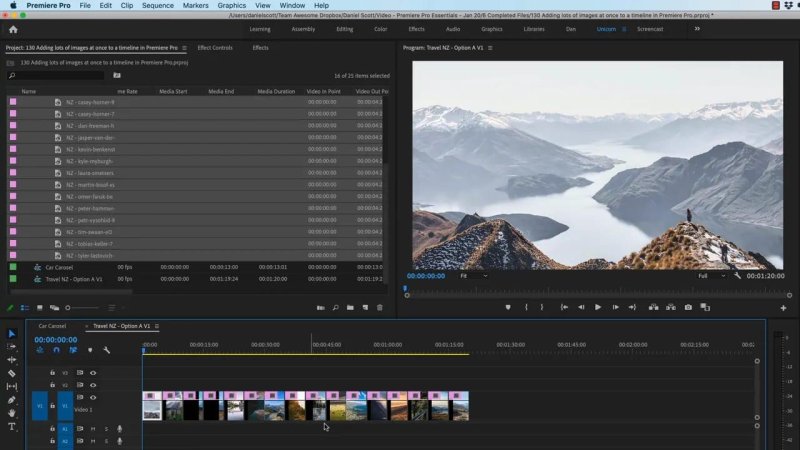
A single drag can place an entire selected set of images consecutively on the timeline.
Why images do not always land alphabetically
This is the bit that catches people out. Images sometimes appear alphabetically on the timeline, but that is not a guarantee. Premiere Pro uses the ordering currently applied in the Project panel, and that can be based on more than just the file name.
Your project items may be arranged by properties such as frame rate rather than an A to Z name order. If you drag a big collection in without checking, a slideshow can arrive in an order that seems completely random.
Before selecting anything, look at the column headings in the Project panel. If you need a precise alphabetical or alphanumerical order, click Name.
Check the sort direction too
Clicking the Name heading changes the sort direction. The small chevron next to the heading tells you whether the files are sorted ascending or descending.
For a typical slideshow that should run from A to Z, make sure the list begins with the first file and ends with the last file. Do not assume that clicking the column once has given you the direction you wanted.
This little check matters especially when image filenames contain numbers. A consistent naming and sorting approach gives you a much better chance of getting the sequence you expected.
The first item you click affects the timeline order
There is another Premiere Pro quirk to be aware of. The first item selected can become the first item placed on the timeline, even if it is not the first item in the displayed alphabetical list.
Say your list is sorted from Aaron through to Tyler. If you click Tyler first, then hold Shift and click Aaron, Premiere Pro can place Tyler first and then continue through the remaining images in alphabetical order. That produces an odd result: one image has jumped to the front while the rest continue normally.
To get a clean A to Z sequence, use this method:
Sort the Project panel by Name in the direction you need.
Click the first image in the list.
Hold Shift.
Click the final image in the list.
Drag the selected group onto the timeline.
That first click is important. Start at the beginning, then Shift-click the end. You will avoid the annoying situation where one image appears in a strange place for no obvious reason.
Create a custom image order with Command or Control
Alphabetical order is useful, but sometimes it is absolutely not the story you want to tell. Maybe you want a mountain image, then a lake, then a city shot, then back to another landscape. In that case, select images individually in the exact order you want them to appear.
Open the bin containing your images and switch to thumbnail view if that makes it easier to identify the shots. You can make the thumbnails smaller or larger depending on whether you need to see more files at once or inspect individual images more closely.
Then hold:
Command on a Mac
Control on a PC
Click each image in the order you want it to appear. If you click Aaron, then Kevin, then Martin, and finally Jasper, that is the order Premiere Pro will use when you drag the selection to the timeline.
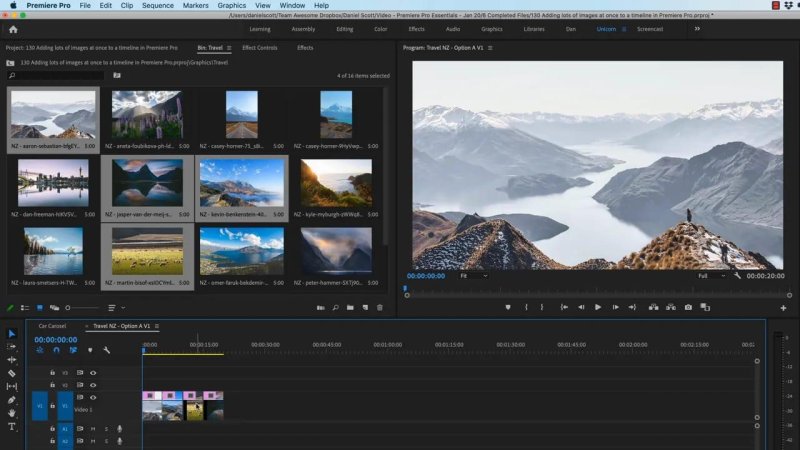
Selecting individual thumbnails gives you control over a slideshow order that does not need to follow the file names.
Make the timeline easier to inspect
When you drop a lot of still images onto the timeline, make the video track taller by dragging its top edge. This lets you see clip thumbnails more clearly, which is useful for checking whether the first and last images are where they should be.
Hovering over a clip can also reveal its filename. That gives you a quick way to confirm the order without needing to open every image.
For a large slideshow, this visual check is worth doing immediately after the drag. It is much easier to undo and fix a bad selection order now than to discover it after you have added music, transitions, animation, and titles.
A simple checklist before dragging a large set of images
Make sure the images have been imported and are roughly sized for your sequence.
Check which column is sorting the Project panel.
Click Name if you need alphabetical ordering.
Confirm the sort direction with the chevron.
For an alphabetical sequence, click the first file first, then Shift-click the final file.
For a custom sequence, use Command on Mac or Control on PC and click images in the desired order.
Increase the timeline track height and inspect the resulting thumbnails.
Bulk-adding images is incredibly quick in Premiere Pro. Just remember that the sort order and selection order are doing more work than they first appear to be. Get those right, and a huge slideshow lands in the timeline exactly where you want it.
FAQs
Why are my images in the wrong order in Premiere Pro?
Premiere Pro uses the current Project panel sort order and can also treat the first item you select as the first clip. Check that the panel is sorted by Name in the correct direction, then select from the first image to the last.
How do I select all images between two files in Premiere Pro?
Click the first image, hold Shift, and click the final image. This selects every item between those two files in the Project panel.
How do I arrange images in a custom order on a Premiere Pro timeline?
Hold Command on Mac or Control on PC, then click individual images in the order you want them placed. Drag the selected files onto the timeline and Premiere Pro follows that selection order.
Written by Daniel Walter Scott — Founder of Bring Your Own Laptop & Chief Instructor
