How to make images into a video in Premiere Pro
Questions


Oops! You need to be a member to join in.
Feel free to browse but if you'd like to jump into the conversation you'll need to join our awesome student community.
Explore 30+ Essential and Advanced courses in Figma, Photoshop, Illustrator, Lightroom, Premiere Pro, Webflow, and more. Enjoy self paced learning, personalized support, earn certificates, and exciting community challenges.

Oops! You need to be a member to join in.
Feel free to browse but if you'd like to jump into the conversation you'll need to join our awesome student community.
Explore 30+ Essential and Advanced courses in Figma, Photoshop, Illustrator, Lightroom, Premiere Pro, Webflow, and more. Enjoy self paced learning, personalized support, earn certificates, and exciting community challenges.


Oops! You need to be a member to join in.
Feel free to browse but if you'd like to jump into the conversation you'll need to join our awesome student community.
Explore 30+ Essential and Advanced courses in Figma, Photoshop, Illustrator, Lightroom, Premiere Pro, Webflow, and more. Enjoy self paced learning, personalized support, earn certificates, and exciting community challenges.
Student Gallery
Be the first to share something.
Course info
Overview
I am here to help you learn Adobe Premiere Pro and to show you the tools you need to become a successful video editor. Premiere Pro is the industry standard used by professional designers to create stunning, high class videos and, after completing this course, you too can become a confident, skillful and efficient creator of stunning videos.
This course is aimed at people who are completely new to Premiere Pro.
If you are self taught using Premiere, this course will show you techniques you never dreamed were necessary or possible and will show you efficiencies to help speed up your workflow.
The course covers many topics - all of them on a step-by-step basis. We will use real world video editing examples to work through:
- An interview
- A wedding video
- A short commercial
- A documentary
- Social media advertising videos
- YouTube ‘how to’ videos
- Talking head footage mixed with screencasts and voiceovers
We will work with text, animation, motion gfx, special effects and we will add music to our video.
We will learn how to do colour correction, colour balancing and also how to create amazing video transitions within our movie. Technical ‘guru’ topics such as HD v 4K, frames per second, exporting work, fixing up bad audio, balancing and synching audio will all become manageable tasks for you. Best of all...I will show you amazing shortcuts and techniques to speed up your workflow.
Throughout the course we will work on mini projects and I will be suggesting assignments which will add value to your portfolio.
Start your Premiere Pro training now and fast track your career as a video editor.
* Please note, you have full permission to transform and upload any work using footage of Daniel as a part of this course.

Daniel Walter Scott
Founder of Bring Your Own Laptop & Chief Instructor
I discovered the world of design as an art student when I stumbled upon a lab full of green & blue iMac G3’s. My initial curiosity around using the computer to create ‘art’ developed into a full-blown passion, eventually leading me to become a digital designer and founder of Bring Your Own Laptop.
Sharing and teaching are a huge part of who I am. As a certified Adobe instructor, I've had the honor of winning multiple Adobe teaching awards at their annual MAX conference. I see Bring Your Own Laptop as the supportive community I wished for when I was first starting out and intimidated by design. Through teaching, I hope to bring others along for the ride and empower my students to bring their stories, labors of love, and art into the world.
True to my Kiwi roots, I've lived in many places, and currently, I reside in Ireland with my wife and kids.
Certificates
We’re awarding certificates for this course!
Check out the How to earn your certificate video for instructions on how to earn yours and click the available certificate levels below for more information.
Downloads & Exercise files
Download Files
Please confirm you would like to download this file, some files can be large. You maybe want to consider downloading on wifi rather than mobile data.
Large file sizes may also take a while to download depending on your internet speed.
Name:
Size:
How do you turn a set of photos into a polished video in Premiere Pro?
Create a sequence that matches the final screen, place and crop each image deliberately, set a consistent duration, then add restrained transitions and music. The little details matter here, especially when your photos have wildly different aspect ratios and the finished video needs to loop smoothly.
How to Make Images Into a Video in Premiere Pro
Say you have been asked to make a looping car dealership video for a TV in a showroom. It is tempting to throw the photos into Premiere Pro, drag the first one onto the timeline and get moving.
Do not do that.
Dragging an image onto an empty timeline makes Premiere Pro create a sequence based on that photograph. That is normally not what you want because photographs almost never match standard video dimensions. Make the sequence yourself first, based on where the finished piece is going to play.
For a showroom TV, find out exactly what you are working with. Get the make and model if necessary, check the specifications, and confirm whether it is HD or UHD before you start designing. Making a lovely 4K video for an HD display, or the other way around, is a slightly annoying way to spend your afternoon.
Create a Custom Video Sequence
Create a new project and keep it tidy from the beginning. Separate your supplied assets into folders such as Graphics and Audio, then make a new sequence.
For this example, the target is an HD screen running at 25 frames per second. Name the sequence something meaningful. This is a car carousel, not technically a time lapse, despite any questionable project naming that might happen along the way.
The important bit is that your sequence settings match the final delivery screen. Once that is sorted, bring your photos into the timeline.
Why Photos Do Not Fit Video Frames Nicely
Video is fairly predictable. Photos are not.
Still images often use ratios such as 3:2 or 1.4:1, while a typical HD video uses a 16:9 frame. Portrait shots, landscape shots and images from different cameras can all behave differently. That means one automatic frame-fitting command will not make every photo look good.
Place the first image on the timeline and open Effect Controls. Use Scale and Position to make the photo work inside the frame.
You have two broad options:
Fit the whole image: You keep everything visible but may get empty bars at the sides or top and bottom.
Fill the video frame: You scale the image until it covers the frame, then reposition it to keep the important part visible.
For a full-screen dealership display, filling the screen generally makes more sense. Some images can become useful close-up details, while others need a wider crop. There is no magic button that replaces making a good visual decision per image.
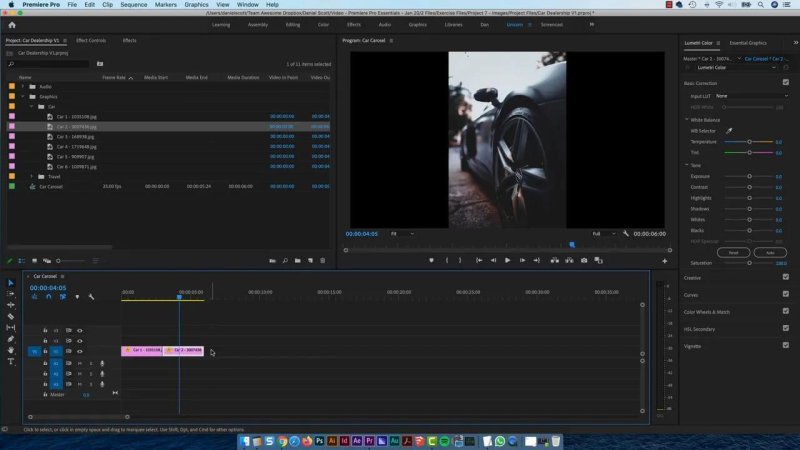
A portrait photo fitted to a landscape sequence leaves side bars, which is why scale and crop decisions matter.
Use Set to Frame Size as a Starting Point
If an image is enormous in the sequence, use Set to Frame Size to bring it down to something manageable. It is a useful starting point, but it is not necessarily the final look.
After that, increase the Scale value just enough to cover the edges of the programme monitor. Then adjust Position to keep the detail you care about in frame. A car wheel, grille, badge or headlight can make a great detail shot when you crop it with purpose.
If the Scale control feels annoyingly jumpy when you drag it, use the smaller scrubber control for finer adjustments. It gives you a bit more control when you only need a teeny tiny change.
Set a Consistent Duration for Every Photo
A slideshow starts feeling like a video when it has a rhythm. You need to decide how long each image should stay on screen based on the number of images you have and the kind of pacing you want.
For this car carousel, each image runs for three seconds. If you have only a few images, you may need longer holds. If you have lots, you can shorten them. The main thing is consistency.
You can set the timing in two ways:
Drag the edge of the image clip in the timeline until it reaches the correct duration.
Right-click the clip and choose Speed/Duration, then enter the duration directly.
Entering the duration is especially handy when you want precise repeats. Work in easy multiples, such as three, six, nine and twelve seconds, and the entire sequence becomes much easier to manage.
Do this for each photo, then check the flow. At this stage, it is just a sequence of images, but the structure is there.
Add Music That Can Survive a Loop
Bring your music into the timeline underneath the images. For a looping display, music is not just decoration. It affects whether somebody leaves the screen running or switches it off after fifteen minutes.
Think about Christmas songs in a shop. Fine once. Not always fine for the person who has heard them all day, every day, for what feels like one hundred years.
Choose music that supports the mood without being too intense, distracting or overly recognisable. A relatively neutral, polished track works well for this sort of car dealership carousel. It gives the sequence energy without demanding attention from everyone in the room.
Make sure the music extends across the whole image sequence. If the final piece will loop, consider how the end and beginning will feel when they repeat.
Choose Image Transitions Carefully
Photos often get paired with slide, push or pull transitions. They work, and they are very common. But common does not automatically mean beautiful.
A Push transition moves the new image across the old one. By default, it may travel in one direction, but you can select the transition and change its direction in Effect Controls. You can make it move from the opposite side, top to bottom, or bottom to top.
Alternating directions can make the movement feel more varied, but it can also get busy very quickly. For a showroom video that repeats continuously, a simpler approach is often better.
Copy Transition Durations Instead of Guessing
When you use the same transition more than once, do not eyeball the duration every time. Select the first transition, copy its duration value, select the next transition, paste the value and press Enter.
That gives you matching timing down to the frame. It is a small productivity trick, but it makes repetitive work much less repetitive.
Still, after trying a push transition, you may decide it is all a bit much. That is completely fair.
Why Cross Dissolves Usually Work Better
For this image video, a Cross Dissolve is the better choice. It fades one image into the next rather than shoving it out of the way. The result feels smoother and less aggressive, which suits a polished looping display.
Apply a Cross Dissolve at each edit point and make the transitions a little longer if the change feels too abrupt. Keep the durations consistent where possible so the pacing stays intentional.
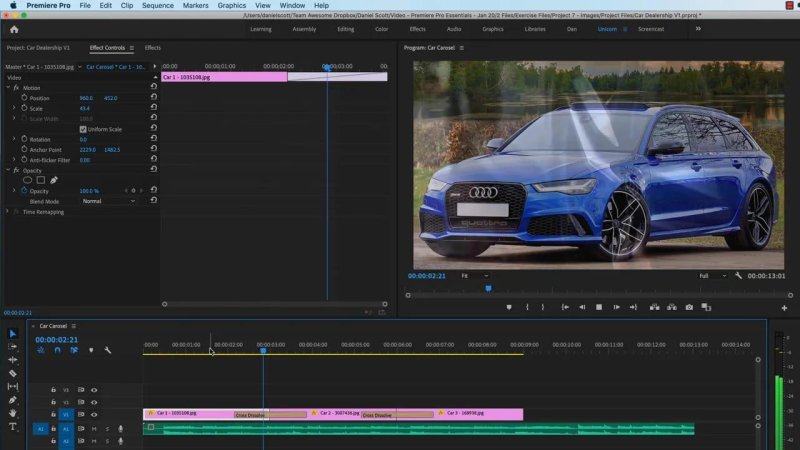
A cross dissolve gives still images a smoother handoff than a more forceful push transition.
The finished edit now has three key ingredients:
Photos that fill the correct video frame
Consistent clip durations
Simple cross dissolves and background music
That already takes a collection of stills a long way towards feeling like a proper video. From here, movement such as pans and zooms can add even more life, but the foundation is good framing, steady pacing and transitions that do not try too hard.
FAQs
Should I drag a photo onto an empty Premiere Pro timeline?
Not if you need a specific final video format. Create your own sequence first so it matches the HD or UHD display and frame rate required for delivery.
How long should each image stay on screen?
Three seconds per image works well for a simple carousel in this example, but the right duration depends on how many images you have and the pace you want. Keep the timing consistent unless there is a clear reason to vary it.
Why are there black bars around my photo in Premiere Pro?
Your photo aspect ratio does not match the video sequence. Scale the image up until it fills the frame, then reposition it so the important detail remains visible.
Which transition is best for a photo slideshow video?
Cross Dissolve is a strong default because it creates a smooth, unobtrusive change between images. Push and slide transitions can work, but they are more noticeable and can become tiring in a loop.
Written by Daniel Walter Scott — Founder of Bring Your Own Laptop & Chief Instructor
