How to compare before & after video in Premiere Pro
Questions



Student Gallery
Be the first to share something.
Course info
Overview
I am here to help you learn Adobe Premiere Pro and to show you the tools you need to become a successful video editor. Premiere Pro is the industry standard used by professional designers to create stunning, high class videos and, after completing this course, you too can become a confident, skillful and efficient creator of stunning videos.
This course is aimed at people who are completely new to Premiere Pro.
If you are self taught using Premiere, this course will show you techniques you never dreamed were necessary or possible and will show you efficiencies to help speed up your workflow.
The course covers many topics - all of them on a step-by-step basis. We will use real world video editing examples to work through:
- An interview
- A wedding video
- A short commercial
- A documentary
- Social media advertising videos
- YouTube ‘how to’ videos
- Talking head footage mixed with screencasts and voiceovers
We will work with text, animation, motion gfx, special effects and we will add music to our video.
We will learn how to do colour correction, colour balancing and also how to create amazing video transitions within our movie. Technical ‘guru’ topics such as HD v 4K, frames per second, exporting work, fixing up bad audio, balancing and synching audio will all become manageable tasks for you. Best of all...I will show you amazing shortcuts and techniques to speed up your workflow.
Throughout the course we will work on mini projects and I will be suggesting assignments which will add value to your portfolio.
Start your Premiere Pro training now and fast track your career as a video editor.
* Please note, you have full permission to transform and upload any work using footage of Daniel as a part of this course.

Daniel Walter Scott
Founder of Bring Your Own Laptop & Chief Instructor
I discovered the world of design as an art student when I stumbled upon a lab full of green & blue iMac G3’s. My initial curiosity around using the computer to create ‘art’ developed into a full-blown passion, eventually leading me to become a digital designer and founder of Bring Your Own Laptop.
Sharing and teaching are a huge part of who I am. As a certified Adobe instructor, I've had the honor of winning multiple Adobe teaching awards at their annual MAX conference. I see Bring Your Own Laptop as the supportive community I wished for when I was first starting out and intimidated by design. Through teaching, I hope to bring others along for the ride and empower my students to bring their stories, labors of love, and art into the world.
True to my Kiwi roots, I've lived in many places, and currently, I reside in Ireland with my wife and kids.
Certificates
We’re awarding certificates for this course!
Check out the How to earn your certificate video for instructions on how to earn yours and click the available certificate levels below for more information.
Downloads & Exercise files
How do I compare colour grades before and after in Premiere Pro?
Use Premiere Pro’s Comparison View in the Program Monitor. It puts your original and adjusted image together on screen, so you can judge colour, contrast, and creative looks without endlessly toggling effects on and off. You can use a side-by-side view or drag a split line across the frame.
How to Compare Before and After in Adobe Premiere Pro
When you are grading footage, it is very easy to keep adjusting until you have no idea whether you have actually improved it. Comparison View fixes that. It keeps a before and after reference visible while you experiment, making the decision much clearer.
This is particularly handy when testing Lumetri colour adjustments or trying out different creative looks. Instead of guessing between two options, you can see them next to each other and decide which one works.
First, Select the Right Panel
If you go to View and the Display Mode options are greyed out, do not panic. It is one of those little Premiere Pro tests.
Usually, a greyed-out menu means Premiere Pro does not know which panel you want to affect. Selecting a clip in the timeline might seem like the obvious fix, but in this case it is not enough.
You need to click once inside the Program Monitor, the panel that displays your edited sequence. Then go to View again. The options should spring back to life.
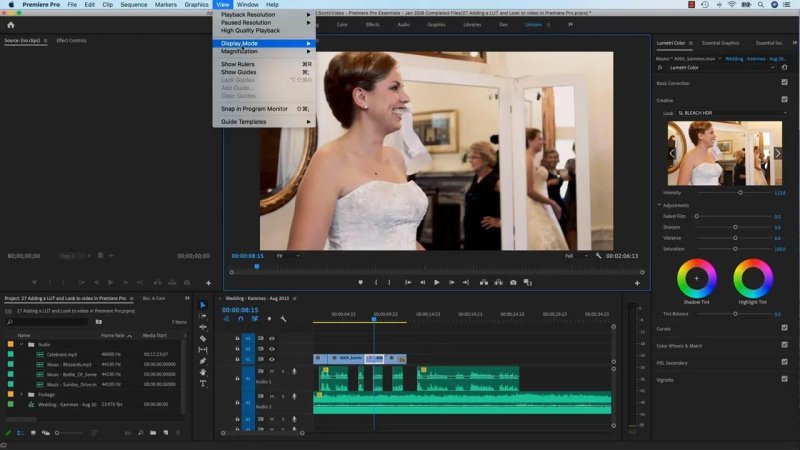
If Display Mode is unavailable, click inside the Program Monitor first, then open the View menu.
Turn On Comparison View
With the Program Monitor active, choose:
View
Display Mode
Comparison View
The normal setting is Composite Video. That is the regular Program Monitor display most of us use most of the time. Comparison View is something you switch on temporarily while making decisions about an adjustment.
There is also a Comparison View button in newer versions of Premiere Pro. It lives in the Program Monitor controls, so you can click it directly rather than going through the menu.
If you are using an older version and cannot see that button, use the little plus button in the Program Monitor to add it to the button bar. Adobe does enjoy moving these things around from time to time, so the menu route is worth knowing too.
Use Frame Comparison, Not a Random Reference Frame
Once Comparison View is enabled, make sure you are using Frame Comparison. This is the mode you want when assessing a colour grade or effect because it shows the same frame on both sides.
At first, the before and after panels may look identical. That is completely normal. Comparison View has nothing to compare until you make a change. Turn it on first, then adjust your clip.
Compare Two Creative Looks
Here is a practical example. Say you have a clip selected and you are trying to choose between two Lumetri creative looks, such as Bleach HDR and Cross LDR.
Enable Comparison View, then apply or change the look. One side keeps the previous state while the other shows the current adjustment. Suddenly, the choice becomes a lot less vague.
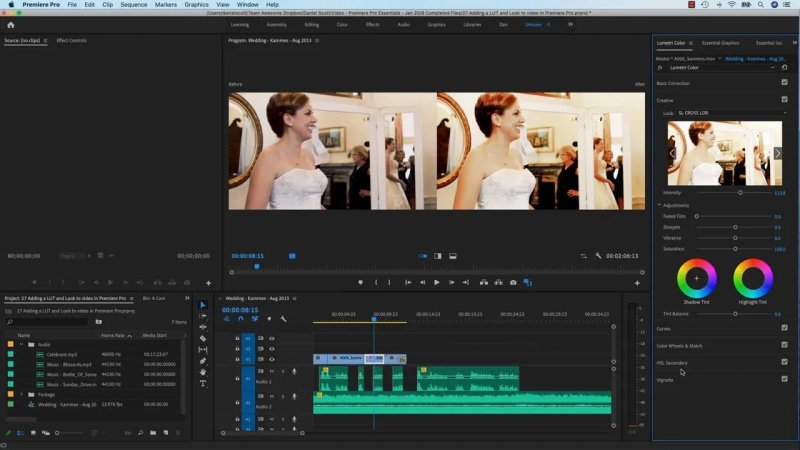
Side-by-side comparison makes the warmer creative look easy to judge against the previous version.
You can use the same approach for more than creative looks. It is useful whenever you are adjusting:
Exposure and contrast
White balance
Saturation and vibrance
Shadows and highlights
Curves and colour wheels
Any effect where a subtle change is hard to judge from memory
Choose a Comparison Layout That Helps You Decide
Premiere Pro lets you change the way the two versions are displayed. A full side-by-side layout is great when you want to compare the overall image. You can also use a split layout, with a dividing line running through the image.
The split can be arranged vertically or horizontally. It is one of those words that can make your brain briefly stop working, so do not worry about the label too much. Pick the orientation that makes the change easiest to see.
For example, a vertical split is often useful for judging colour across a face, skin tones, or an entire scene. A horizontal split can be useful when comparing bright skies, foreground detail, or exposure changes from top to bottom.
You can drag the divider through the image to inspect different areas. Move it over the subject, the background, bright highlights, or dark shadow areas. This gives you a much more confident read on whether the adjustment is helping.
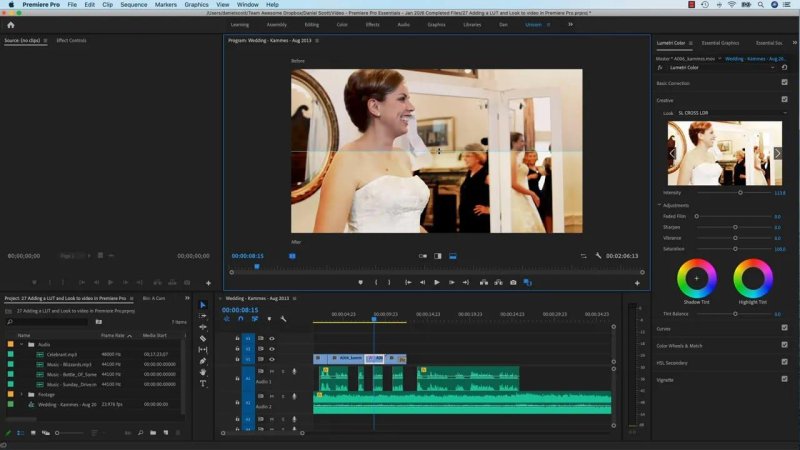
Drag the split line across important parts of the frame to check exactly where a grade is improving or hurting the image.
Keep It On While You Work
The real value of Comparison View is that you do not have to keep turning an effect on and off. Leave the comparison active while you work through your changes and glance between the before and after as you go.
That is especially helpful with strong looks. A warm orange-and-gold treatment might look interesting in isolation, but the comparison can quickly tell you whether it has pushed the footage too far. If the previous look, such as Bleach HDR, works better for the shot, switch back and carry on.
Return to the Normal Program Monitor
When you have made your decision, turn Comparison View off by clicking the Comparison View button in the Program Monitor. Alternatively, go back to:
View
Display Mode
Composite Video
That returns the Program Monitor to its usual single-image display. Comparison View is not something you need on permanently, but it is a brilliant little tool whenever you are making creative or technical grading decisions.
FAQs
Why is Comparison View greyed out in Premiere Pro?
The Program Monitor is probably not selected. Click inside the Program Monitor, then open View and Display Mode again.
What does Frame Comparison do in Premiere Pro?
Frame Comparison displays the same frame before and after an adjustment. It is ideal for comparing colour grades, creative looks, and other visual effects.
Can I move the dividing line in Premiere Pro Comparison View?
Yes. In split comparison layouts, drag the centre divider to inspect different parts of the image and compare the adjustment more precisely.
How do I turn off Comparison View?
Click the Comparison View button in the Program Monitor, or choose View, Display Mode, then Composite Video.
Written by Daniel Walter Scott — Founder of Bring Your Own Laptop & Chief Instructor
