How to add darkened edges vignette to video in Premiere Pro
Questions


Student Gallery
Course info
Overview
I am here to help you learn Adobe Premiere Pro and to show you the tools you need to become a successful video editor. Premiere Pro is the industry standard used by professional designers to create stunning, high class videos and, after completing this course, you too can become a confident, skillful and efficient creator of stunning videos.
This course is aimed at people who are completely new to Premiere Pro.
If you are self taught using Premiere, this course will show you techniques you never dreamed were necessary or possible and will show you efficiencies to help speed up your workflow.
The course covers many topics - all of them on a step-by-step basis. We will use real world video editing examples to work through:
- An interview
- A wedding video
- A short commercial
- A documentary
- Social media advertising videos
- YouTube ‘how to’ videos
- Talking head footage mixed with screencasts and voiceovers
We will work with text, animation, motion gfx, special effects and we will add music to our video.
We will learn how to do colour correction, colour balancing and also how to create amazing video transitions within our movie. Technical ‘guru’ topics such as HD v 4K, frames per second, exporting work, fixing up bad audio, balancing and synching audio will all become manageable tasks for you. Best of all...I will show you amazing shortcuts and techniques to speed up your workflow.
Throughout the course we will work on mini projects and I will be suggesting assignments which will add value to your portfolio.
Start your Premiere Pro training now and fast track your career as a video editor.
* Please note, you have full permission to transform and upload any work using footage of Daniel as a part of this course.

Daniel Walter Scott
Founder of Bring Your Own Laptop & Chief Instructor
I discovered the world of design as an art student when I stumbled upon a lab full of green & blue iMac G3’s. My initial curiosity around using the computer to create ‘art’ developed into a full-blown passion, eventually leading me to become a digital designer and founder of Bring Your Own Laptop.
Sharing and teaching are a huge part of who I am. As a certified Adobe instructor, I've had the honor of winning multiple Adobe teaching awards at their annual MAX conference. I see Bring Your Own Laptop as the supportive community I wished for when I was first starting out and intimidated by design. Through teaching, I hope to bring others along for the ride and empower my students to bring their stories, labors of love, and art into the world.
True to my Kiwi roots, I've lived in many places, and currently, I reside in Ireland with my wife and kids.
Certificates
We’re awarding certificates for this course!
Check out the How to earn your certificate video for instructions on how to earn yours and click the available certificate levels below for more information.
Downloads & Exercise files
How do I add a vignette to a video in Premiere Pro?
Select the clip in your timeline, open the Lumetri Color panel, and expand the Vignette controls. Drag Amount left for darker edges or right for white edges, then refine the midpoint, roundness, and feather until the effect suits the shot.
How to Add a Vignette in Adobe Premiere Pro
Key takeaways
Apply a vignette directly from Premiere Pro's Lumetri Color panel.
Use a negative Amount value for the familiar darkened-edge look.
Use a positive Amount value for a bright white-edge effect.
Control the vignette's size, shape, and softness with Midpoint, Roundness, and Feather.
Keep the effect subtle unless you deliberately want a dramatic, stylised result.
What a vignette does to a shot
A vignette is the darkening around the outside edges of an image. It is one of those small finishing effects that can quietly pull attention towards the centre of the frame and make an image feel a little more focused or cinematic.
You are not limited to dark edges, either. Premiere Pro can create a white vignette as well. It is a completely different mood: less cinematic and more dreamy, memory-like, or intentionally dramatic. Useful sometimes, but it can get a bit “remember when?” very quickly.
Vignettes originally appeared as an unwanted result of older camera equipment, where the lens and exposure did not capture light or focus evenly around the edges. Now, of course, we add them on purpose. Such is progress.
Set up the clip before applying the effect
First, place any footage on the timeline. The clip itself does not matter for the process.
Move the playhead over the clip you want to adjust.
Select that clip in the timeline.
Open the Lumetri Color panel.
If the panel is missing, open it from Window > Lumetri Color. With the correct clip selected, collapse the other Lumetri sections if needed and scroll to the final section, Vignette.
That is where all the controls live. Premiere Pro applies the vignette as part of the Lumetri colour adjustment, so there is no need to hunt through the Effects panel for a separate effect.
Use Amount to create dark or white edges
The first control is Amount, and it does the obvious, useful thing.
Drag Amount left to darken the outer edges.
Drag Amount right to brighten the outer edges with white.
For most edits, the dark version is the one to reach for. A modest darkening at the edges can direct the eye without announcing itself. The white version is much more stylised, so use it when that bright, hazy, flashback-type feeling is genuinely the point.
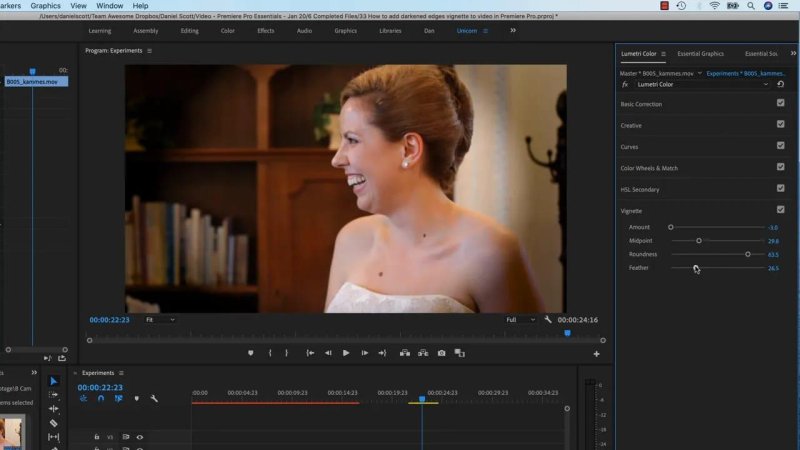
A heavy vignette makes the shape and edge treatment obvious, which is handy while learning the controls.
Adjust the Midpoint to control how far the vignette reaches
Midpoint determines how far towards the centre of the image the vignette extends. Think of it as controlling the area that remains relatively unaffected.
Adjusting it lets you stretch the effect inwards or outwards. Bring it in when you want the darkening to be more obvious across the image. Push it out when you only want a little hint around the very edges.
This is often the control that makes a vignette feel intentional rather than like a black border slapped on the footage. For a natural look, start with just the outer edges receiving the treatment, then make small adjustments.
Use Roundness to change the vignette shape
Roundness controls whether the vignette feels more rectangular or more circular. A lower setting can produce a squarer shape that follows the frame more closely. A higher setting creates a rounder, more oval-shaped vignette.
There is no magic setting here. Match the shape to the shot and the feeling you want. A strong round vignette can be useful for a deliberately retro or highly stylised look. Most of the time, though, subtle adjustments are plenty.
Set Feather high for softer edges
Feather controls how blurry or soft the transition is between the vignette and the unaffected centre of the image.
Generally, you will want Feather fairly high. A soft edge blends into the shot and feels much more natural. A low Feather setting makes the boundary sharper and more obvious, which can be useful for a graphic effect but is rarely the quiet finishing touch most footage needs.
If the vignette looks like a strange circle floating over the image, the Feather setting is one of the first places to look.
Keep the effect under control
Vignettes are dangerously easy to love. Once you learn how quickly they can make an image feel more focused, it is tempting to put one on absolutely everything. This is very much like discovering lens flare in Photoshop and then using it with wild abandon.
A vignette is not automatically “good” just because it is available. Check whether it supports the shot. If it makes the composition stronger and keeps attention where you want it, great. If it distracts from the subject or makes a bright, clean scene feel unnecessarily gloomy, dial it back or lose it.
A small adjustment is often enough. You want people to feel the effect, not necessarily spot it.
Turn the vignette on and off to compare
Use the enable checkbox for the Vignette section in Lumetri Color to switch the adjustment off and on. This is the quickest way to judge whether your settings are actually helping.
Compare the image with the effect disabled, then enabled. If the change feels too dramatic, reduce the Amount, move the Midpoint outwards, or increase Feather. If you cannot tell there is any difference at all, that may be perfect, or it may mean the adjustment is so subtle it is not doing anything useful. Your call.
Key terms
Vignette
A lightening or darkening effect around the edges of an image. In Premiere Pro, it is available within the Lumetri Color panel.
Amount
The strength and direction of the vignette. Negative values darken the edges, while positive values create white edges.
Midpoint
The control that determines how far the vignette reaches towards the centre of the frame.
Roundness
The setting that changes the vignette from a frame-following square shape towards a more circular shape.
Feather
The softness of the vignette edge. Higher feather values create a smoother transition into the image.
FAQs
Where is the Vignette control in Premiere Pro?
Select your timeline clip, open Window > Lumetri Color, then expand the Vignette section at the bottom of the panel.
How do I make a dark vignette in Premiere Pro?
In Lumetri Color's Vignette section, drag the Amount slider to the left. Negative Amount values darken the outer edges of the frame.
Can I create a white vignette in Premiere Pro?
Yes. Drag the Amount slider to the right to create light or white edges instead of dark ones.
Which vignette setting makes the edge softer?
Increase Feather. A higher Feather value makes the transition between the vignette and the centre of the image softer and blurrier.
Written by Daniel Walter Scott — Founder of Bring Your Own Laptop & Chief Instructor
